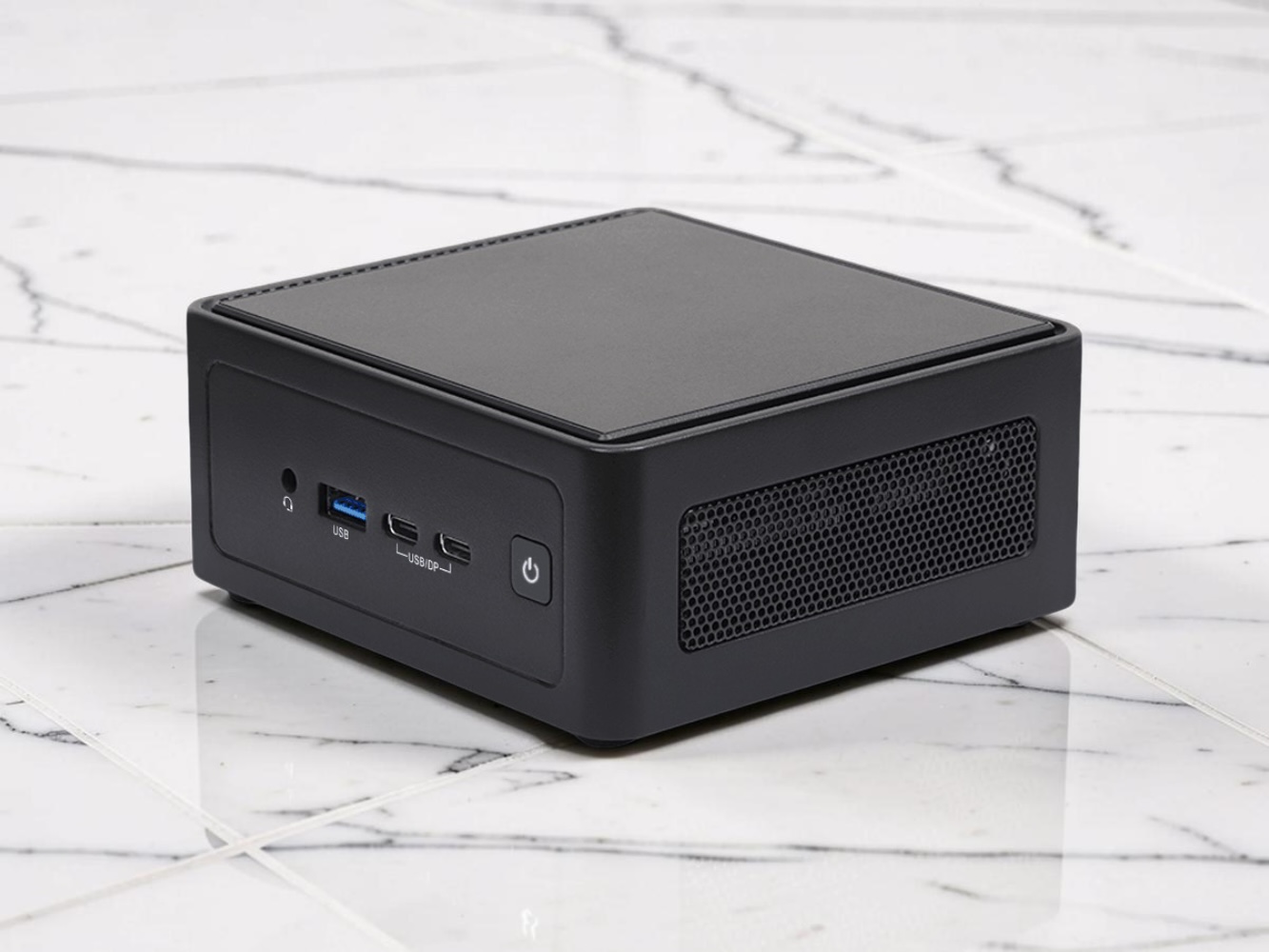
ASRock is expanding its mini PC offerings with the NUC Box Ultra 300 and slimmer NUCS Box Ultra 300 lineup, now with full specifications revealed after their CES 2026 debut. These compact desktops are built around Intel’s “Panther Lake” platform and target users who want a small footprint without giving up modern connectivity, fast memory, or serious integrated graphics performance.
At the top of the stack, the flagship configurations use the Intel Core Ultra 7 X358H, a 16-core processor arranged as 4 performance cores, 8 efficiency cores, and 4 low-power efficiency cores. ASRock is offering four total models: NUC Box 358H, NUCS Box 358H, NUC Box 325, and NUCS Box 325. If you’re scanning the names, it’s straightforward: the 358H models are the higher-end options, while the 325 versions step down to a Core Ultra 5 325 with 8 cores.
Graphics capability is one of the biggest differences between the tiers. The Core Ultra 7 X358H versions come with Intel Arc B390 integrated graphics featuring 12 Xe3 cores, positioning these mini PCs as strong choices for light content creation, GPU-accelerated productivity, and smoother casual gaming than you’d typically expect from an iGPU. In the provided details, performance is described as approaching RTX 4050 laptop-class levels in certain workloads, which is notable for a system without a discrete GPU.
The Core Ultra 5 325 models, meanwhile, use a smaller 4-core Xe3 iGPU. That puts them more in the “everyday performance” category—great for office work, web use, media playback, and general productivity—while sitting closer to mid-range integrated graphics solutions seen in previous-generation systems.
NUC vs NUCS: what’s the difference?
ASRock’s split between NUC and NUCS is mostly about thickness and port selection. Both share the same overall footprint at 117.5 x 110 mm, but the NUCS chassis is slimmer at 38 mm, compared to 49 mm for the standard NUC. The tradeoff for the thinner design is that NUCS models drop one 2.5G Ethernet port and one USB 3.2 Gen 2 Type-A port.
Ports and connectivity are up to date for modern desks and multi-display setups. Depending on whether you choose NUC or NUCS, you can expect the following I/O highlights:
Four USB 3.2 Gen 2 Type-A (three on NUCS)
USB4 with DisplayPort 2.1 support
USB 3.2 Gen 2×2 Type-C with DisplayPort 1.4a support
Dual HDMI 2.1
Dual 2.5G Ethernet (single 2.5G Ethernet on NUCS)
3.5mm audio combo jack
Memory and storage: built for upgrades
These mini PCs are designed with enthusiasts and professional users in mind when it comes to expandability. ASRock lists support for up to 128 GB of DDR5 memory, with rated speeds of DDR5-7200/6400 depending on configuration. Storage is handled through two M.2 slots: one M.2 2280 PCIe Gen 5 x4 slot for high-speed primary drives, and a secondary M.2 2242 PCIe Gen 4 x4 slot for additional SSD capacity.
Cooling is active, which is expected given the CPU options and the performance targets, and the wireless package is modern as well, with support for WiFi 7 and Bluetooth 6.
Pricing and release timing
ASRock hasn’t publicly shared pricing or availability details for the NUC Box Ultra 300 and NUCS Box Ultra 300 systems. That’s not unusual for mini PCs that can be sold through different channels and configured variably depending on region and buyer requirements.
With high-end Panther Lake CPU options, Intel Arc B390 integrated graphics on select models, up to 128 GB of DDR5, PCIe Gen 5 storage support, and a strong port selection including USB4 and dual HDMI 2.1, ASRock’s NUC Ultra Box 300 family is shaping up to be a compelling choice for anyone looking for a compact desktop that still feels modern and upgrade-friendly.