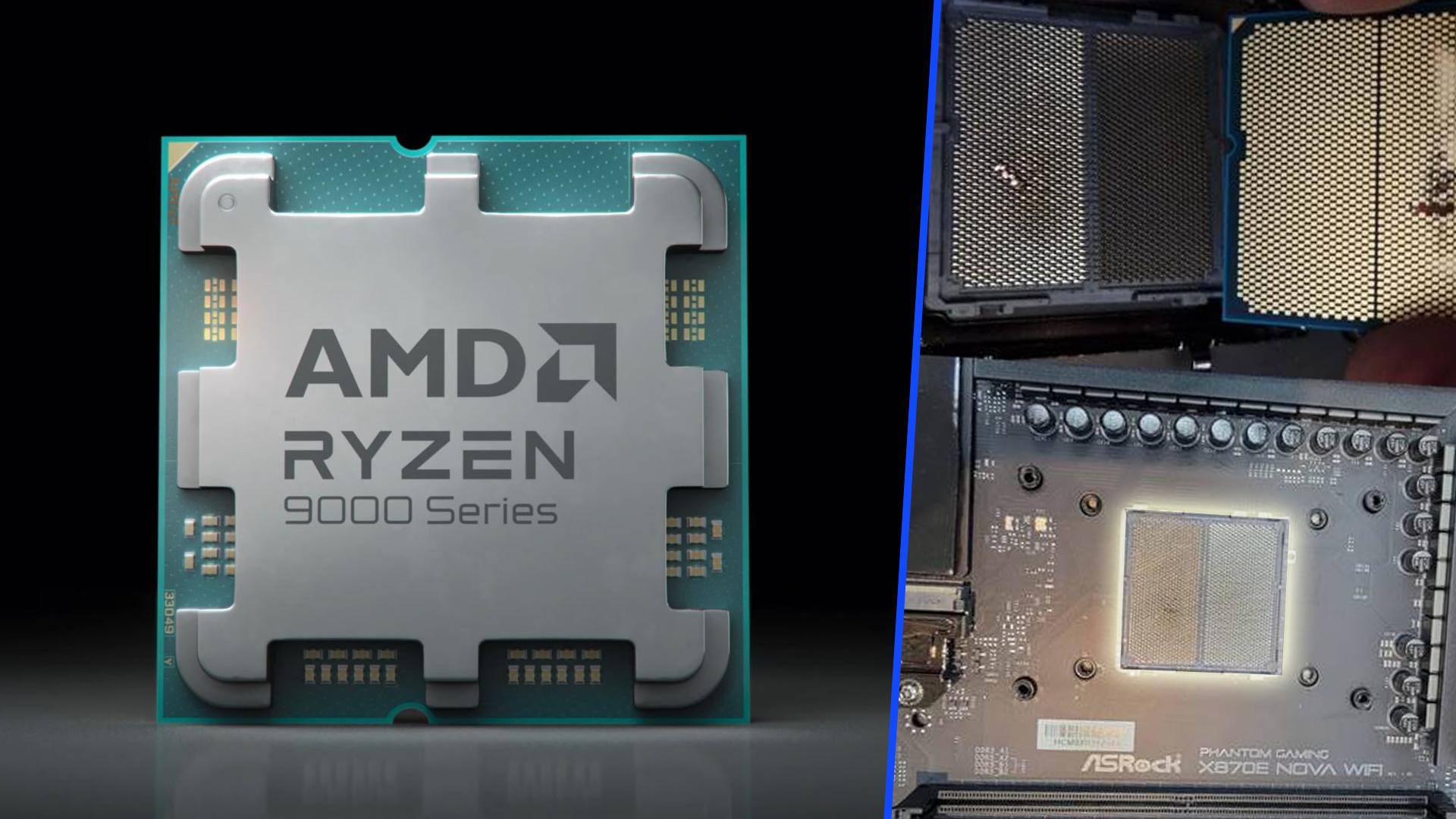
Reports of failed AMD Ryzen 9000 CPUs are showing up with increasing frequency, and one pattern keeps standing out: many of these incidents are being linked to ASRock motherboards. From mainstream 6-core chips to high-end X3D flagships, users are describing eerily similar symptoms—sudden no-boot situations, persistent debug lights, and motherboard error codes that point to a dead processor.
What makes the situation even more unsettling is the variety of Ryzen 9000 models involved. Recent user posts describe failures across multiple SKUs, including the Ryzen 5 9600X, Ryzen 7 9700X, Ryzen 7 9800X3D, and Ryzen 9 9950X3D. In other words, this doesn’t look isolated to one specific chip tier or configuration.
One of the latest cases involves a Ryzen 5 9600X paired with an ASRock B850 Pro-A motherboard. The user reported that even after updating the BIOS to version 4.03, the system still refused to boot. That’s a critical detail, because BIOS updates are often the first recommendation when platform stability problems appear—yet in this case, the update didn’t resolve the issue.
Two separate reports focus on the Ryzen 7 9700X. In one instance, the CPU was used with an ASRock B850M-X motherboard, and the owner says the system would not boot despite three days of troubleshooting. The situation matched a common failure signature people have been discussing: the CPU and DRAM debug LEDs staying lit, indicating the system can’t properly initialize the processor or memory. Another Ryzen 7 9700X failure was reported on the ASRock X870 PRO RS, a board that has been repeatedly mentioned in discussions about Ryzen CPU deaths. This system reportedly ran fine for months before suddenly throwing a CPU debug light and failing to start.
The problems aren’t limited to non-X3D processors either. A Ryzen 7 9800X3D reportedly died on an ASRock X870E Taichi while running BIOS 4.03—the same “latest” BIOS version some users are being urged to install. That’s leading to growing skepticism that simply updating to the newest BIOS is enough to prevent these failures. In fact, some users are now suggesting the opposite, claiming that rolling back to BIOS 3.50 may offer better stability, though that remains anecdotal.
The most severe report in this batch involves a Ryzen 9 9950X3D on an ASRock X870E Nova WiFi. The user said the system could no longer boot into BIOS and the motherboard displayed a “00” code—commonly interpreted as a sign the CPU is no longer functioning. The system had reportedly been running since May 2025, and the owner has started the RMA process.
Taken together, these stories are fueling ongoing concerns among PC builders and AMD Ryzen owners—especially anyone currently running or planning to build a Ryzen 9000 system on certain ASRock AM5 boards. While individual failures can happen on any platform, the consistency of the reported symptoms and the repeated appearance of ASRock motherboard models in these cases is what’s drawing the most attention.
If you want, I can rewrite this again in a more newsy style or a more consumer-advice style (what to watch for, what symptoms users reported, and how people are responding with BIOS changes and RMAs).


