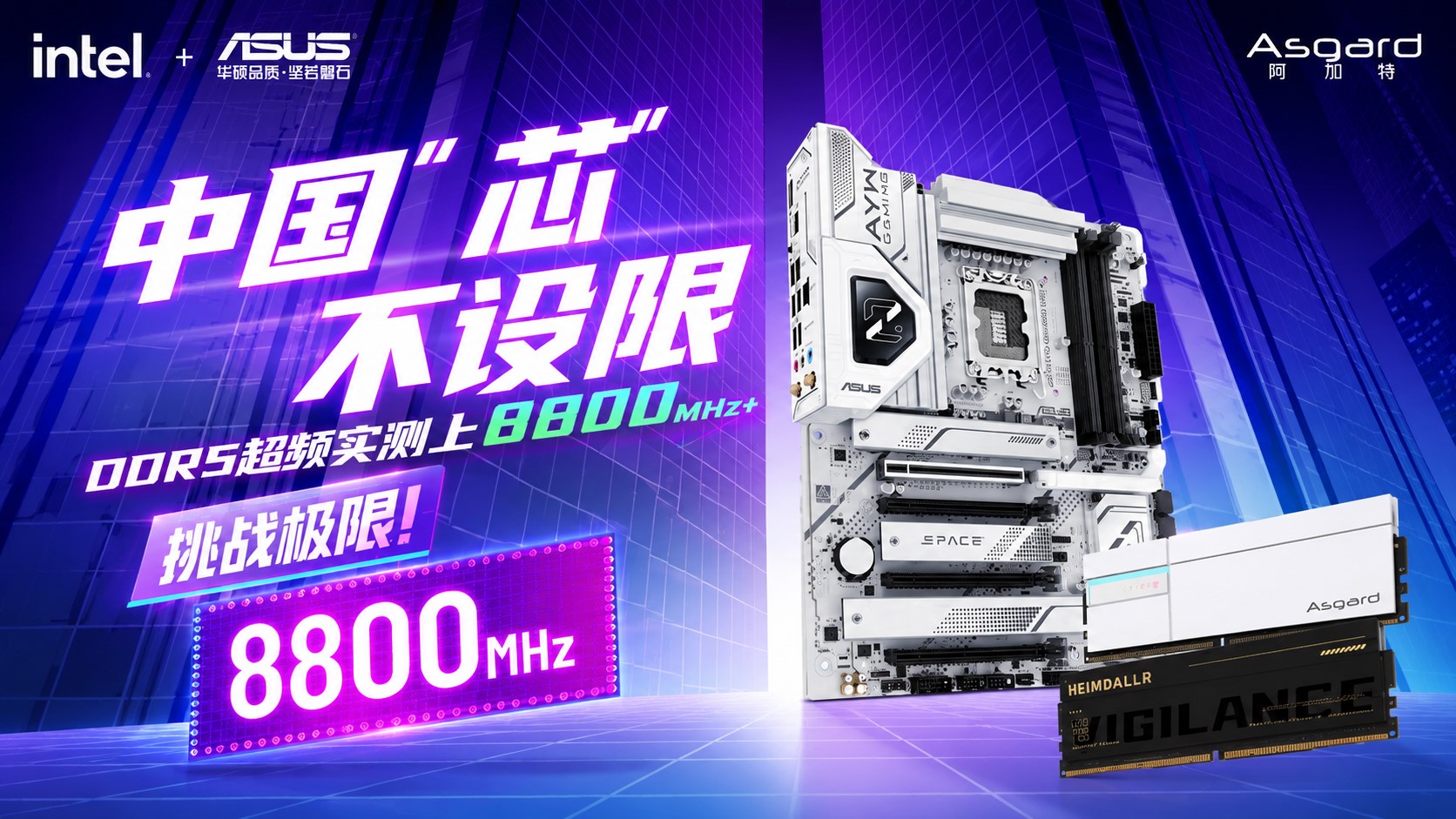
Asgard 48GB DDR5 kit reaches 8800 MT/s on ASUS Z890 motherboard with CXMT memory chips
DDR5 memory speeds continue to climb, and the latest results show that high-frequency kits are no longer limited to only the most extreme hardware setups. A 48GB Asgard DDR5 memory kit based on CXMT chips has reportedly been pushed to 8800 MT/s on an Intel Z890 platform, highlighting the rapid progress of China-made DDR5 memory technology.
The memory kit used in this test is the Asgard Valkyrie II RGB Special Edition DDR5-6000, a dual-channel 48GB kit made up of two 24GB modules. Instead of relying on chips from the industry’s traditional memory giants, the kit uses 24Gb DDR5 chips from CXMT, also known as ChangXin Memory Technology.
CXMT has been gaining attention as a growing competitor in the global DRAM market. The company has increasingly appeared in DDR5 memory products, and recent overclocking results suggest its chips are becoming more capable on both Intel and AMD mainstream platforms.
Not long ago, DDR5 modules using CXMT chips were typically seen reaching speeds around 7000 MT/s. That has changed quickly. Newer modules are now crossing the 8000 MT/s mark, with motherboard vendors adding BIOS support and memory manufacturers beginning to use CXMT DDR5 ICs in more retail kits.
In this latest case, the Asgard 48GB DDR5 kit was tested on an ASUS Z890 AYW Gaming WiFi W motherboard. What makes the result more interesting is that this is not a high-end overclocking-focused motherboard. It uses a four-DIMM layout with a 2DPC configuration, which is usually less ideal for memory overclocking than a two-DIMM 1DPC design.
Despite that, the 48GB kit was able to reach 8800 MT/s with timings of CL46-56-56-132. For a mainstream-class board and a relatively large-capacity dual-stick kit, that is an impressive achievement.
This result follows other recent demonstrations of CXMT-based DDR5 memory hitting high speeds on modern platforms. Previous testing has shown CXMT DDR5 modules reaching 8600 MT/s on an AMD system, while another Z890-based setup recently pushed CXMT memory to 8200 MT/s.
The latest 8800 MT/s result suggests there may still be more headroom available. With improved BIOS tuning, better memory profiles, and refined motherboard support, CXMT-based DDR5 could potentially move beyond 9000 MT/s on both Intel and AMD systems.
For PC builders and hardware enthusiasts, this is an important development. Faster DDR5 memory can benefit bandwidth-sensitive workloads, integrated graphics performance, and certain gaming or productivity scenarios. While real-world gains depend on the platform, CPU memory controller, timings, and software being used, the continued rise of high-speed DDR5 gives users more options when building next-generation systems.
The growing adoption of CXMT DDR5 chips could also increase competition in the memory market. More suppliers entering the high-performance DDR5 space may help improve availability and put pressure on pricing over time, especially as 24GB and 48GB kits become more common among gamers, creators, and workstation users.
As DDR5 platforms continue to mature, memory overclocking results like this show that the technology is still evolving quickly. The Asgard 48GB DDR5 kit reaching 8800 MT/s on an ASUS Z890 motherboard is another sign that high-speed DDR5 is becoming more accessible, and CXMT appears ready to play a larger role in the performance memory segment.


