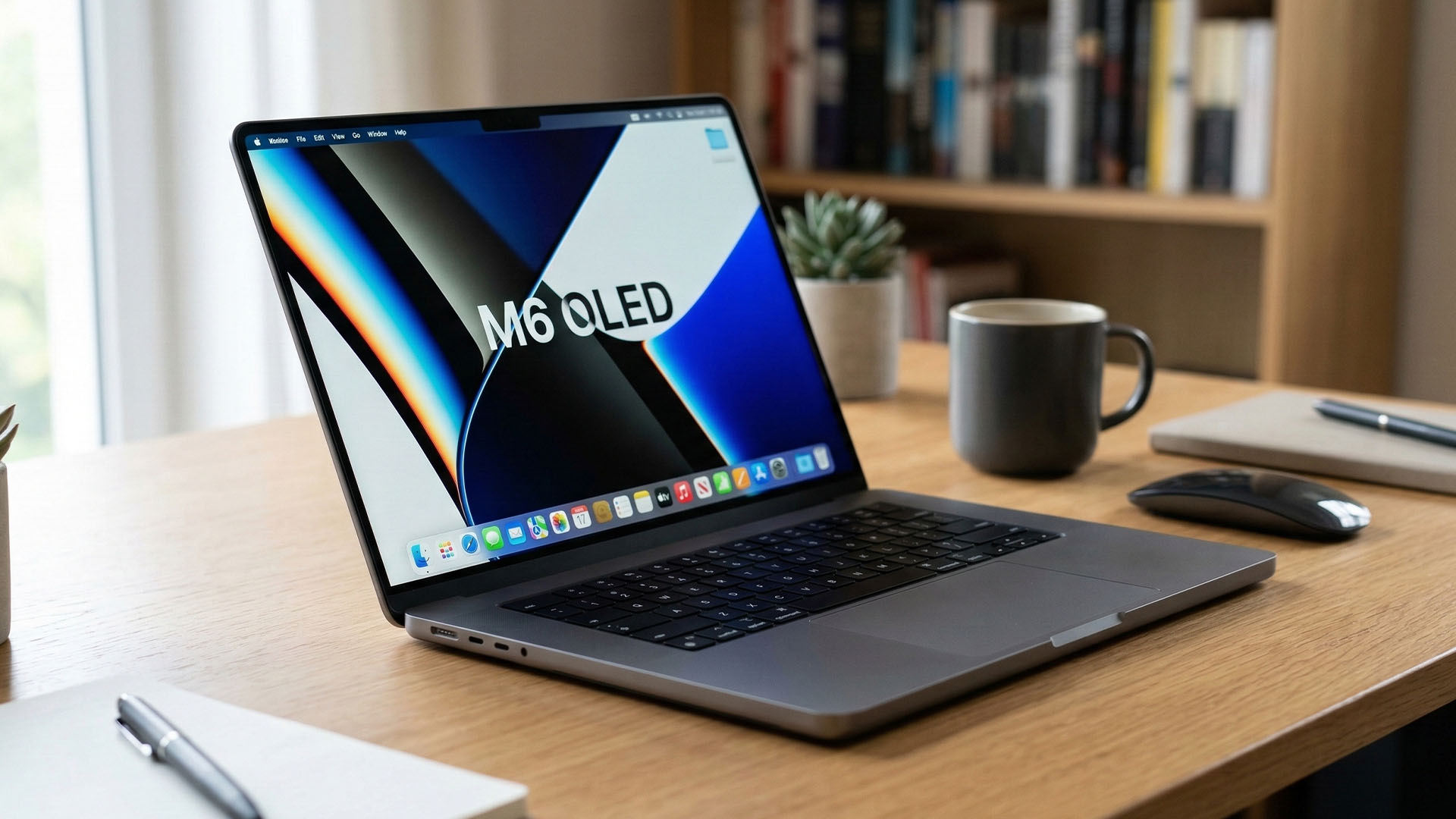
Apple’s next major MacBook Pro redesign is shaping up to be one of the biggest shifts the laptop has seen in years, but it may also be one of the most expensive. Current expectations point to a redesigned M6 MacBook Pro arriving in late 2026 or early 2027, and the headline change is a long-rumored move from mini-LED to OLED display technology in the MacBook Pro for the first time.
What’s especially notable is that this next generation may not follow Apple’s usual pattern of replacing the previous models outright. Instead of discontinuing the existing MacBook Pro configurations when the M6 family launches, Apple is rumored to keep selling M5 Pro and M5 Max models alongside the newer machines. The reason is simple: the M6 generation—especially the higher-end versions—is expected to land at a higher price tier, effectively pushing the MacBook Pro further upmarket.
Why the M6 MacBook Pro could cost significantly more
There are several costly upgrades reportedly coming together at once. OLED panels are more expensive than the mini-LED screens used in today’s MacBook Pro models, and Apple’s history suggests pricing tends to rise when OLED enters the lineup. Past transitions to OLED in other product categories have been associated with noticeable bumps in starting price, and the same logic is expected to apply here.
Beyond OLED, the redesign is rumored to include additional premium changes, such as a new hinge design, touchscreen support, and more advanced chip technology—specifically next-generation 2nm processors for the M6 Pro and M6 Max variants. When you combine a thinner or redesigned chassis, new display tech, touch input hardware, and cutting-edge silicon, the total cost of the device is likely to move higher.
Touchscreen and OLED may not come to every M6 model
One key detail is that not every M6 MacBook Pro is expected to receive the full set of upgrades. The base M6 MacBook Pro may continue without OLED, touchscreen functionality, and the redesigned look. The more dramatic changes are expected to be reserved for the M6 Pro and M6 Max models, which helps explain why Apple might keep M5 Pro and M5 Max versions around as “lower-priced” options even after the new lineup launches.
A possible new name at the very top
With Apple potentially creating a more premium tier above today’s MacBook Pro pricing, there’s also talk that the company could choose a new label to signal that positioning more clearly. While Apple may stick with the MacBook Pro name, an “Ultra” style branding has been floated as a way to distinguish the most expensive configurations as the top of the laptop range.
Early pricing expectations (estimates, not official)
While Apple hasn’t announced anything, estimated pricing scenarios suggest the M6 Pro MacBook Pro could start around $2,399, roughly $200 higher than the prior comparable tier. For the M6 Max MacBook Pro, estimates point to a possible starting price around $3,999, about $400 more than its predecessor tier. These numbers are projections, not confirmed pricing, and actual launch prices could differ depending on configuration and market conditions.
What to buy if you don’t want to wait
For buyers who’d rather upgrade sooner instead of holding out for an OLED MacBook Pro, the current M5 Pro and M5 Max MacBook Pro models remain the practical path—especially if Apple keeps them in the lineup once the M6 generation arrives. The existing machines already deliver high-end performance and generous base configurations, and they may become the “value” options in Apple’s professional laptop range if the M6 Pro and M6 Max models push into a more premium pricing tier.
Overall, the rumored M6 MacBook Pro story points to a familiar Apple strategy: introduce major technology upgrades, raise the ceiling of the lineup, and keep older models around to cover more price points—while the newest flagship becomes the new benchmark for premium laptops.