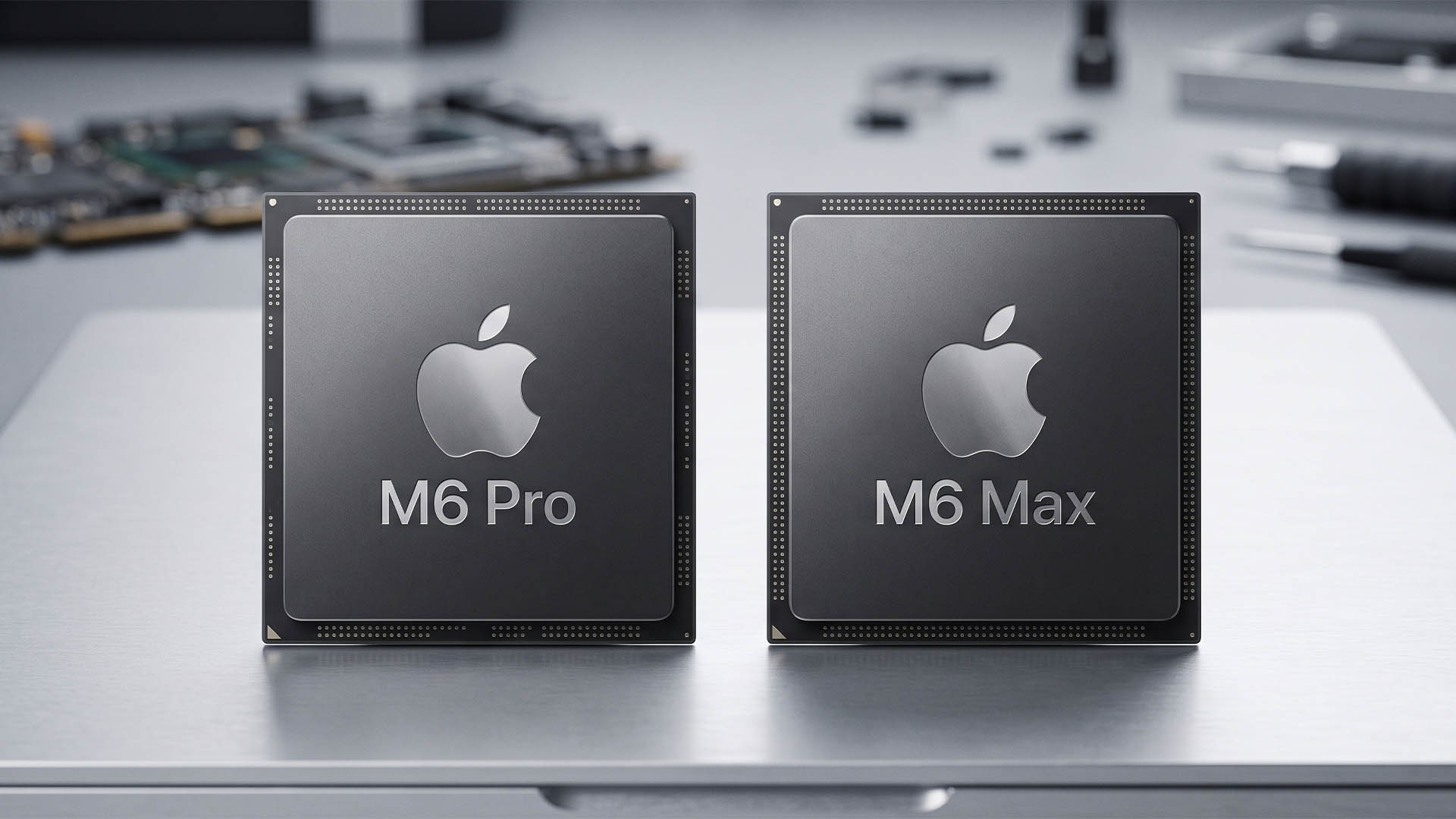
Apple’s M6 Pro and M6 Max may not be canceled after all, according to a new supply chain report that suggests the company is still developing its next wave of high-end Mac chips with advanced packaging technology.
Recent speculation claimed Apple could skip the M6 Pro and M6 Max entirely and move straight to the M7 Pro and M7 Max, especially as the company increases its focus on AI performance. However, a newer report indicates that Apple may still have plans for the M6 Pro and M6 Max, and these chips could bring major architectural changes designed to improve efficiency, performance, and manufacturing flexibility.
The key upgrade reportedly involves advanced chip packaging methods, including SoIC-MH and WMCM, short for Wafer-Level Multi-Chip Module. Apple is already believed to be using SoIC-MH for its newer high-end silicon, a technology the company refers to as Fusion Architecture. This approach helps Apple move away from relying on one large chip die and instead build processors using a more modular design.
That shift could be important for future Macs. Larger monolithic chips are more expensive to manufacture and can suffer from lower production yields. A modular chip design can help reduce costs, improve yield rates, and potentially deliver better power efficiency. For Apple’s MacBook Pro, Mac Studio, and other performance-focused machines, those gains could translate into faster performance without sacrificing battery life or thermal control.
The report also suggests that Apple is preparing to adopt WMCM technology more aggressively. This packaging method is expected to play a role in future iPhone chips as well, including the A20 Pro rumored for the iPhone 18 Pro lineup and Apple’s first foldable iPhone. If accurate, Apple could be aligning its iPhone and Mac chip strategies around the same advanced packaging roadmap.
WMCM is designed to combine multiple key components in a single advanced package, including logic chips, LPDDR memory, and high-speed input/output components. When paired with SoIC-MH, it can increase interconnect density, allowing the chip’s different parts to communicate more quickly and efficiently. In practical terms, this could mean higher bandwidth, lower latency, and improved performance per watt.
Apple’s chipmaking partner TSMC is also reportedly expanding its capacity to support this transition. Monthly WMCM production capacity is expected to reach around 60,000 wafers by late 2026 and potentially surpass 120,000 wafers in 2027. That would give Apple more room to scale production of advanced chips, even as demand for AI processors continues to put pressure on the semiconductor supply chain.
Still, the future of the M6 Pro and M6 Max remains uncertain. Well-known Apple analyst Mark Gurman has previously suggested that Apple may skip these chips and focus instead on the M7, M7 Pro, and M7 Max. The base M7 chip is rumored to feature unified memory bandwidth of 240GB/s, which would represent a 56 percent increase over the M5. Its launch is currently expected in the first half of 2026.
Gurman has also reported that Apple is already working on the M8 family, which raises the possibility that technologies once planned for the M6 Pro and M6 Max could instead debut later with the M7 Pro, M7 Max, or even the M8 series.
For now, the latest report keeps the M6 Pro and M6 Max discussion alive, but it does not settle the debate. Apple may still be testing these chips internally, or the company may be preparing the same packaging technology for a later generation of Mac processors.
What seems increasingly clear is that Apple’s future Mac chips are moving toward a more advanced, modular design. Whether that arrives with the M6 Pro and M6 Max or the M7 Pro and M7 Max, the next major leap in Apple Silicon could be less about raw clock speed and more about smarter packaging, better memory integration, and improved power efficiency.