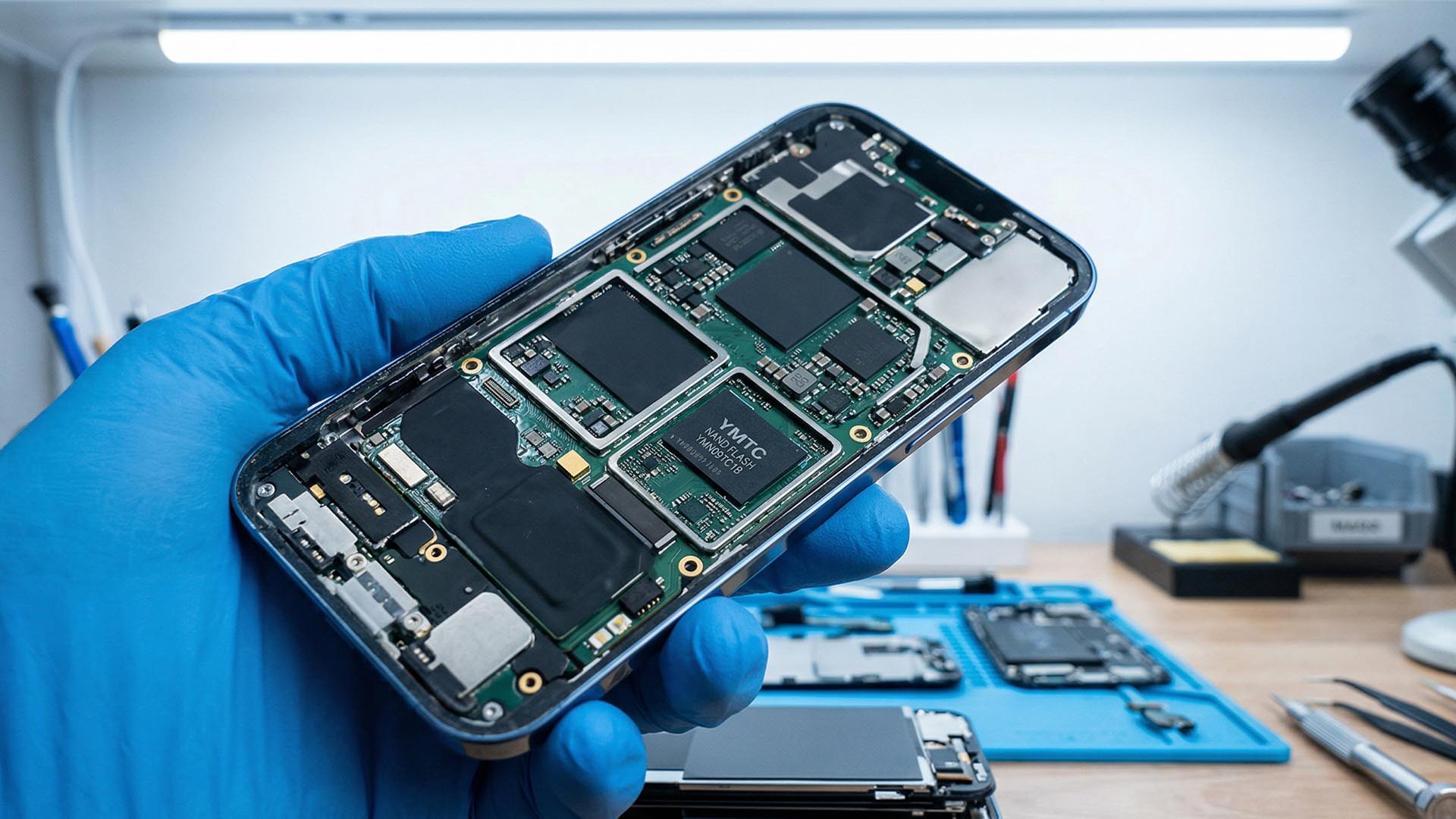
Apple’s iPhone supply chain is shifting again, and this time it’s being driven by a mix of U.S. restrictions, rising memory prices, and the need to protect profit margins.
After U.S. policy pressure pushed Apple to cut ties with China-based NAND flash maker YMTC, the company leaned more heavily on South Korean memory suppliers. But the timing hasn’t been ideal. A broader DRAM downturn has also rippled into storage-related costs, creating more pricing stress across key components used in smartphones. As a result, Apple is now believed to be paying around $70 per LPDDR5X RAM chip, a figure that can squeeze margins even for a company with Apple’s scale.
To keep iPhone profitability healthy without creating fresh political headaches, Apple is reportedly exploring a workaround: sourcing YMTC NAND flash chips again, but limiting their use to iPhones sold in China. This approach helps Apple in two ways. It reduces reliance on pricier supply options and keeps the company’s U.S.-facing strategy cleaner, since the devices using Chinese-made NAND would stay within the Chinese market.
YMTC also isn’t being considered simply because it’s local. The company has made major progress in advanced NAND flash technology, positioning itself far closer to the global leaders than it was just a few years ago. Its latest Xtacking 4.0 architecture has reportedly enabled mass production of 300-plus layer NAND flash, an important milestone in the race for higher-density, more efficient storage. That puts YMTC in much tighter competition with top-tier offerings like Samsung’s 286-layer NAND and SK hynix’s 321-layer NAND, effectively narrowing the technological gap that once made YMTC a less realistic option for premium smartphones.
That matters for Apple because iPhones require strict performance and reliability standards, especially when it comes to storage. If YMTC’s NAND meets Apple’s qualification requirements, then using those chips for China-bound iPhones becomes a practical way to manage costs while still delivering a flagship experience.
This potential supply move also fits into a much bigger story: China’s push for semiconductor independence. The country is reportedly targeting as much as 80% self-sufficiency in its domestic chip sector. Recent developments have also improved the outlook for Chinese memory makers, with CXMT and YMTC reportedly removed from a Pentagon-related restricted companies list, potentially making it easier for global firms to engage with them under certain conditions.
For Apple, adding YMTC back into the mix could also strengthen its negotiating position with established suppliers such as Samsung and SK hynix. With memory and storage pricing under pressure, having credible alternatives can help Apple control long-term component costs—especially as future iPhones demand even more advanced DRAM and NAND configurations.
Industry analyst Ming-Chi Kuo has also suggested that Apple could choose to absorb higher DRAM costs as part of its broader iPhone strategy, leaning on its fast-growing Services business to cushion hardware margin fluctuations. If Apple combines that financial buffer with smarter sourcing decisions for components like NAND flash, it could navigate the current market volatility while staying aggressive on pricing, features, and scale.
In short, Apple’s reported plan—using YMTC NAND only for iPhones sold in China—could be a calculated move to balance geopolitics, supply chain resilience, and profitability. And if YMTC’s 300-plus layer NAND continues to mature, Apple may gain a valuable lever in an increasingly expensive and competitive smartphone component market.