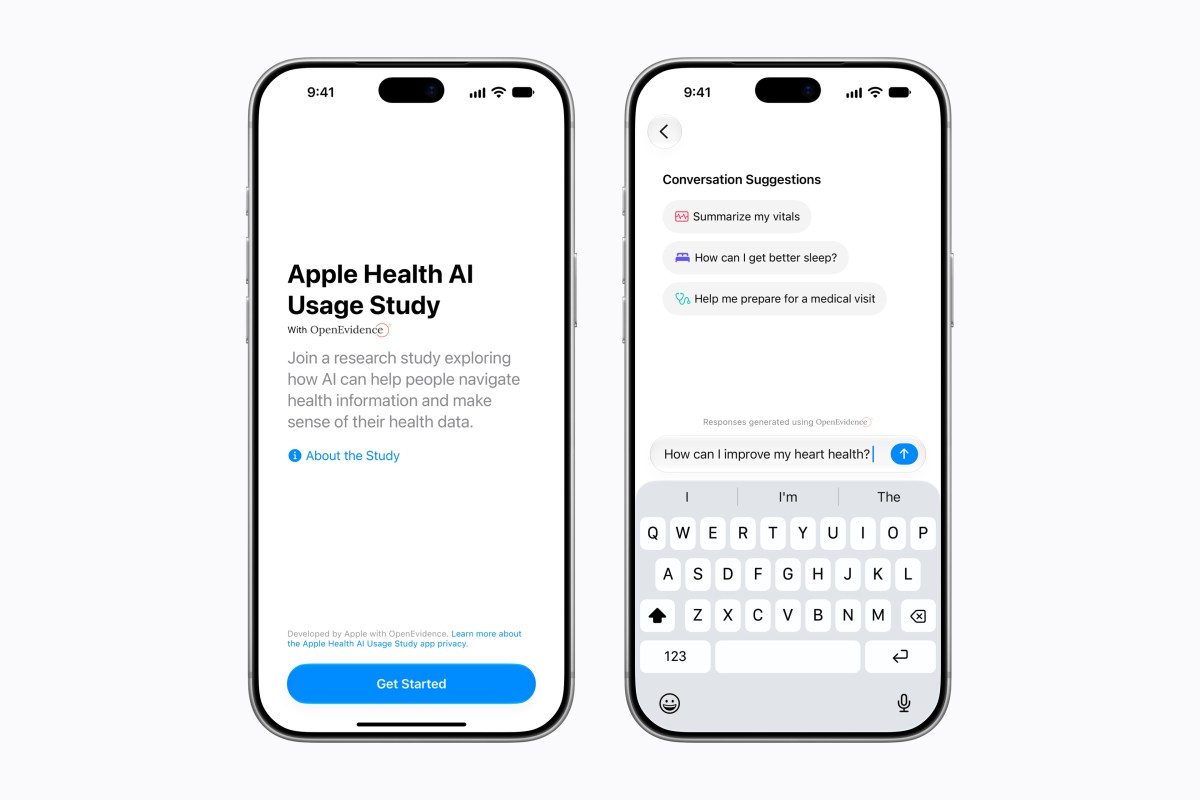
Apple is taking a careful, research-driven step into AI-powered health guidance with a new study designed to explore how people use artificial intelligence to understand medical information in everyday life.
Rather than simply launching a chatbot for health questions, Apple is focusing on whether AI can provide responses that are clinically grounded, easy to understand, and useful enough to support people before they speak with a healthcare professional.
The company is partnering with OpenEvidence, an AI company focused on healthcare, to launch a dedicated research app for eligible iPhone users in the United States. Participants must be 21 or older, use an iPhone 15 or newer, run iOS 26 or later, and have Apple Intelligence enabled.
Apple plans to include up to 200,000 participants in the study, which is expected to run for more than a year.
The study app will let users ask health-related questions in a conversational way, similar to how people interact with popular AI assistants. However, Apple says the answers will be based on clinical information from respected medical sources, including The New England Journal of Medicine, the Journal of the American Medical Association, and Nature.
The goal is to turn complex medical information into simpler explanations that can help users better understand common health concerns. Participants will be able to rate the answers they receive and share feedback on whether the responses are clear, useful, and trustworthy. Apple will also ask users to complete monthly surveys as part of the study.
One of the key features of the app is the ability to connect health data from Apple’s HealthKit. Participants can choose to share information such as resting heart rate, sleep patterns, physical activity, and lab results. With this data, the app may be able to offer more personalized responses and suggestions.
Apple says the app may also help users prepare for doctor visits by helping them organize questions or better understand symptoms and health topics. For more serious or concerning medical issues, the app is expected to guide users toward appropriate healthcare providers instead of trying to replace professional medical advice.
Privacy is a major part of Apple’s approach. The company says participant data will be anonymized before being sent to a secure third-party cloud provider. Apple also says the information collected in the study will not be used to train AI models. OpenEvidence will delete query and response data after 24 hours, according to Apple.
Sumbul Desai, M.D., Apple’s vice president of Health and Fitness, said the company believes responsible innovation must be backed by scientific rigor and clinical grounding. She emphasized that health is deeply personal and that a dedicated research study is the right way to learn how people interact with AI health tools in real-world situations.
The study arrives at a time when AI health searches are growing rapidly. Millions of people already use AI assistants to ask questions about symptoms, medications, fitness, sleep, nutrition, and general wellness. Apple’s research could help shape how future health-focused AI tools are designed, especially when it comes to safety, privacy, accuracy, and user trust.
For now, Apple has not confirmed whether this technology will eventually become part of the Health app or Siri. However, the study suggests the company is exploring how AI could play a larger role in personal health management while still keeping medical reliability and privacy at the center of the experience.
The new Apple health AI study app is now available for eligible users in the United States.