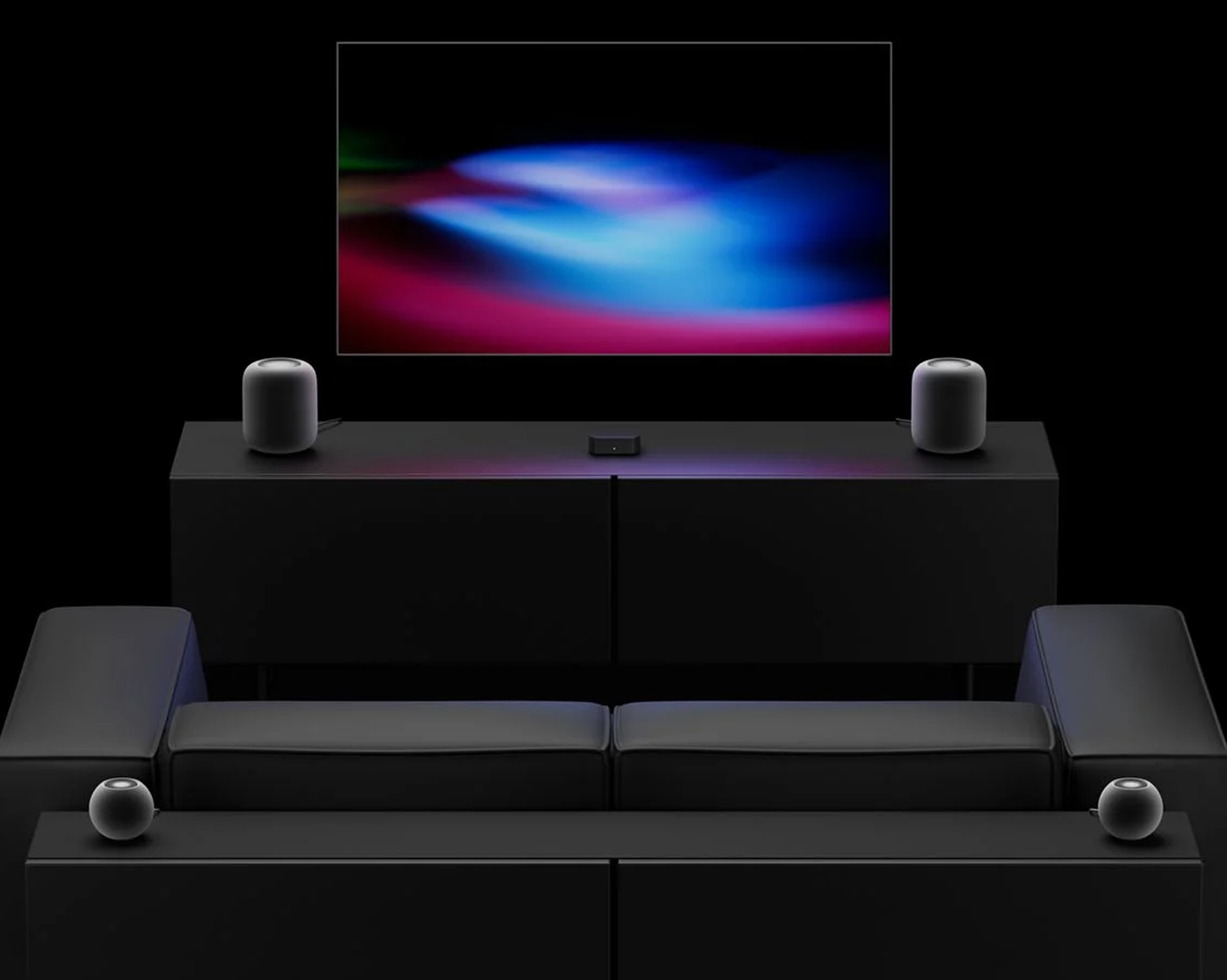
Apple TV 4K Adds Whole Room Audio for Four HomePods, Turning Your Living Room Into a Party-Ready Sound Zone
Apple’s fourth-generation Apple TV 4K is arriving with a major audio upgrade aimed at people who want bigger, more immersive sound at home. The new streaming box introduces a feature called Whole Room Audio, a listening mode designed to spread sound evenly across four HomePod speakers.
Apple is positioning the feature as an ideal setup for parties, sports nights, and gatherings where people are moving around the room instead of sitting in one fixed spot. The new Apple TV 4K is priced at $299, with pre-orders already open ahead of its November 13 release.
Whole Room Audio is different from Apple’s new four-speaker Surround Sound mode. While Surround Sound is designed for a more traditional home theater experience, Whole Room Audio focuses on keeping music, commentary, and general audio clear throughout the entire space. Apple says the goal is to make sound feel balanced “no matter where you are in the room.”
That is a notable change from earlier Apple TV 4K models, which can connect to only two HomePods as a stereo pair. With the latest model, Apple is expanding the HomePod setup into a four-speaker arrangement, giving users more flexibility for music, movies, sports, and everyday streaming.
Details found in tvOS 27.2 code suggest that once four compatible HomePods are connected, users will see two main Speaker Mode options: Whole Room Audio and Surround Sound.
Whole Room Audio works by playing stereo sound through both pairs of speakers, but with an unusual channel arrangement. The left channel is sent to the front-left and rear-right speakers, while the right channel is sent to the front-right and rear-left speakers. This diagonal layout is meant to keep stereo sound balanced whether someone is sitting on the couch, standing near the kitchen, or walking around the room.
The mode appears to be designed for simplicity. There are no extra tuning controls or manual adjustments, which means users can turn it on and let the Apple TV and HomePods handle the sound distribution automatically.
Surround Sound, on the other hand, offers more traditional audio customization. It includes a Spatialize Stereo option that is enabled by default for both video and music. When switched off, standard stereo audio plays through the front speakers, while the rear pair does not receive a stereo mix.
For users who want to fine-tune the rear speakers, Apple includes a Surround Level control. This setting allows rear output to be adjusted from -8 dB to +8 dB in 0.5 dB steps, with 0 dB as the default level.
Apple says a four-HomePod setup can automatically detect speaker positions in the room and adjust volume and timing accordingly. This should help create a more balanced listening experience without requiring users to manually measure distances or configure complex settings.
The system supports the HomePod mini 2 and the second-generation HomePod. However, each speaker pair must use matching models. For example, users can place two full-size second-generation HomePods at the front and two HomePod mini 2 speakers at the rear, but each pair needs to match within its position.
The HomePod mini 2 launches on October 30, arriving about two weeks before the new Apple TV 4K. It runs on Apple’s S10 chip and introduces a new Sound Glow top surface that lights up with colors inspired by the album artwork of the currently playing track.
The new Apple TV 4K also receives a major performance upgrade. It moves to Apple’s A19 chip, which the company says delivers up to 50% faster CPU performance and twice the graphics performance compared with the previous generation. A dedicated AV1 decoder is also included, which should improve efficiency and playback support for modern streaming video formats.
Connectivity gets a boost as well. The new Apple TV 4K supports Wi-Fi 7 and Bluetooth 6, along with a gigabit Ethernet port. Apple is selling it in a single 128GB configuration.
Another major addition is built-in far-field microphones. These allow owners to speak to Siri without pressing the Siri Remote, making voice control feel more natural from across the room.
Siri AI features on Apple TV will require tvOS 27.2. The update is expected to arrive around the November 13 launch window and will initially support English in markets including the United States, United Kingdom, Canada, Australia, India, and South Africa.
Apple is also updating the Siri Remote with Find My support and Precision Finding, making it easier to locate when it disappears between couch cushions or under a blanket. The redesigned remote will also be available separately for older Apple TV models at $59.
With Whole Room Audio, four-HomePod support, a faster A19 chip, improved wireless connectivity, and hands-free Siri, the new Apple TV 4K is shaping up to be more than a simple streaming box. Apple appears to be pushing it further into the center of the smart home and home entertainment experience, especially for users already invested in HomePod speakers.