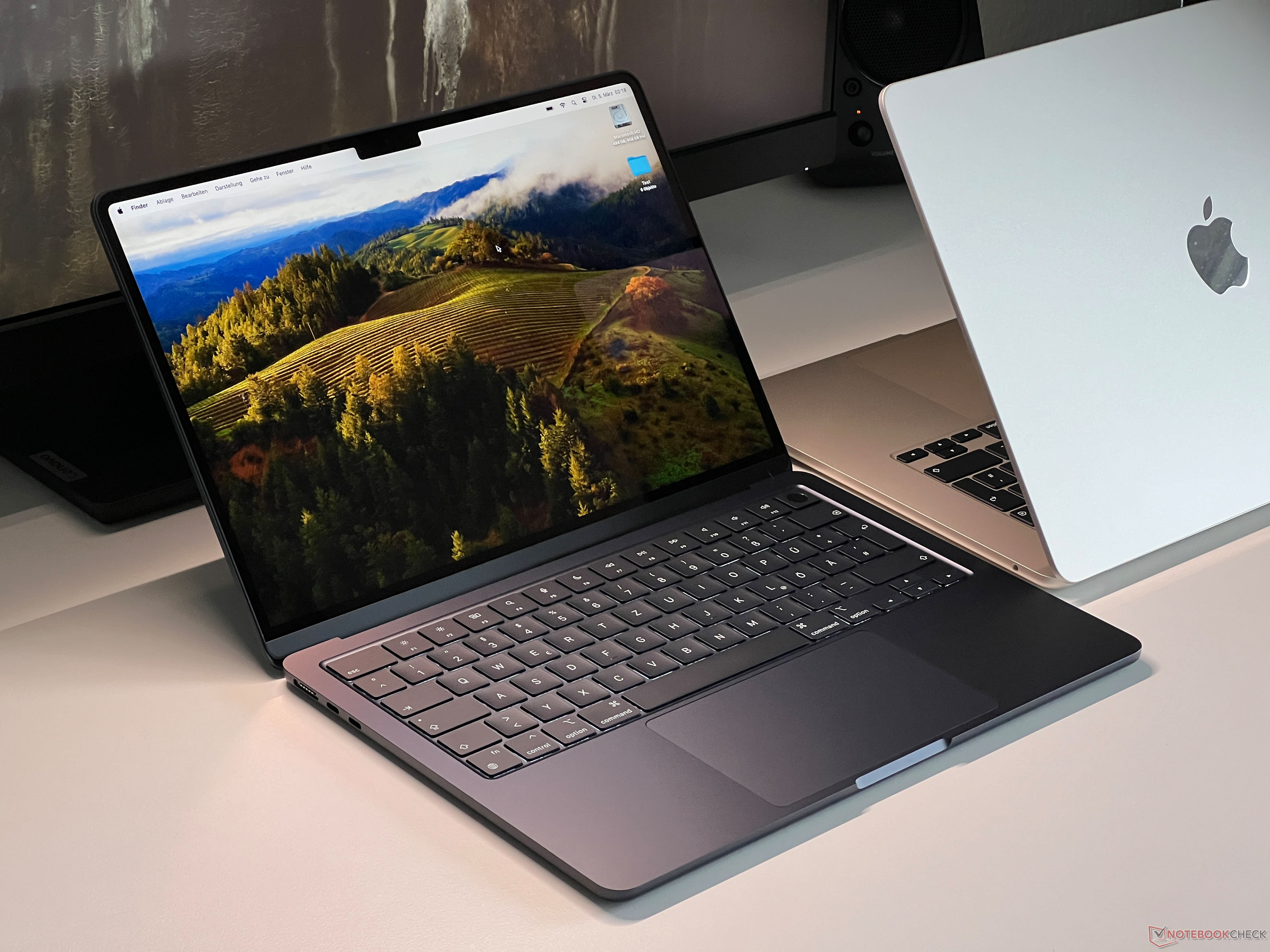
The latest iteration of the MacBook Air, equipped with the new M3 SoC, has taken a significant leap in performance, demonstrating a noteworthy 20% improvement over its predecessor, the M2. The M3 chip, fabricated with 3-nm process technology, has maintained similar power consumption levels to the M2 while delivering substantial gains in computational power.
A key advantage of this performance hike is most notable in single-core operations, where the MacBook Air M3 consistently outperforms competitors such as the AMD Ryzen-8000 series and Intel’s Meteor Lake chips. This is particularly remarkable considering the MacBook Air’s passive cooling system, which does exhibit a performance drop of around 20% under sustained loads—a behavior also seen in actively-cooled Intel models during intense multi-core tasks.
The MacBook Air M3 also excels in other areas. Thanks to incorporating Wi-Fi 6E (160 MHz), the device now matches up to current WLAN standards, offering robust wireless performance. When it comes to connectivity, the laptop’s limitations are highlighted by the dual USB-C ports on the left side and the absence of Thunderbolt 4 support, which may not be a deal-breaker for everyday usage but still might concern some users.
Battery life on the MacBook Air M3 remains impressive, despite the increasingly competitive Windows laptops in this realm. Although the included 35-watt power supply is convenient, splitting its power between two USB-C ports, it falls slightly short when the M3 chip is pushed to its limits. Any power deficit is temporarily compensated for by the laptop’s battery.
The MacBook Air 13 has introduced a new color variant, Midnight, which has been treated with an additional coating, reducing the visibility of fingerprints and enhancing the device’s aesthetic.
This new model maintains the high-quality display standards that Apple is known for. The 13.6-inch IPS panel offers good picture quality with accurate color reproduction and satisfactory brightness. While a move to a higher refresh rate of 120 Hz would be welcome, Apple’s choice avoids PWM, which can be advantageous.
Users who need to work with multiple displays will appreciate that the MacBook Air M3 can support two external monitors when the laptop’s lid is closed, an option that adds flexibility to desktop setups.
One of the sticking points for potential buyers is the MacBook Air M3’s price point. Starting at $1,099, the base model includes only 8 GB of RAM and a 256-GB SSD, which, although potentially sufficient for casual users, may be considered a sparse offering compared to other options on the market.
When taking into consideration the impressive silent operation, strong performance, and the absence of comparable Windows devices offering the same total package, the MacBook Air 13 with M3 SoC stands out as an appealing option for those in search of a powerful and efficient laptop.


