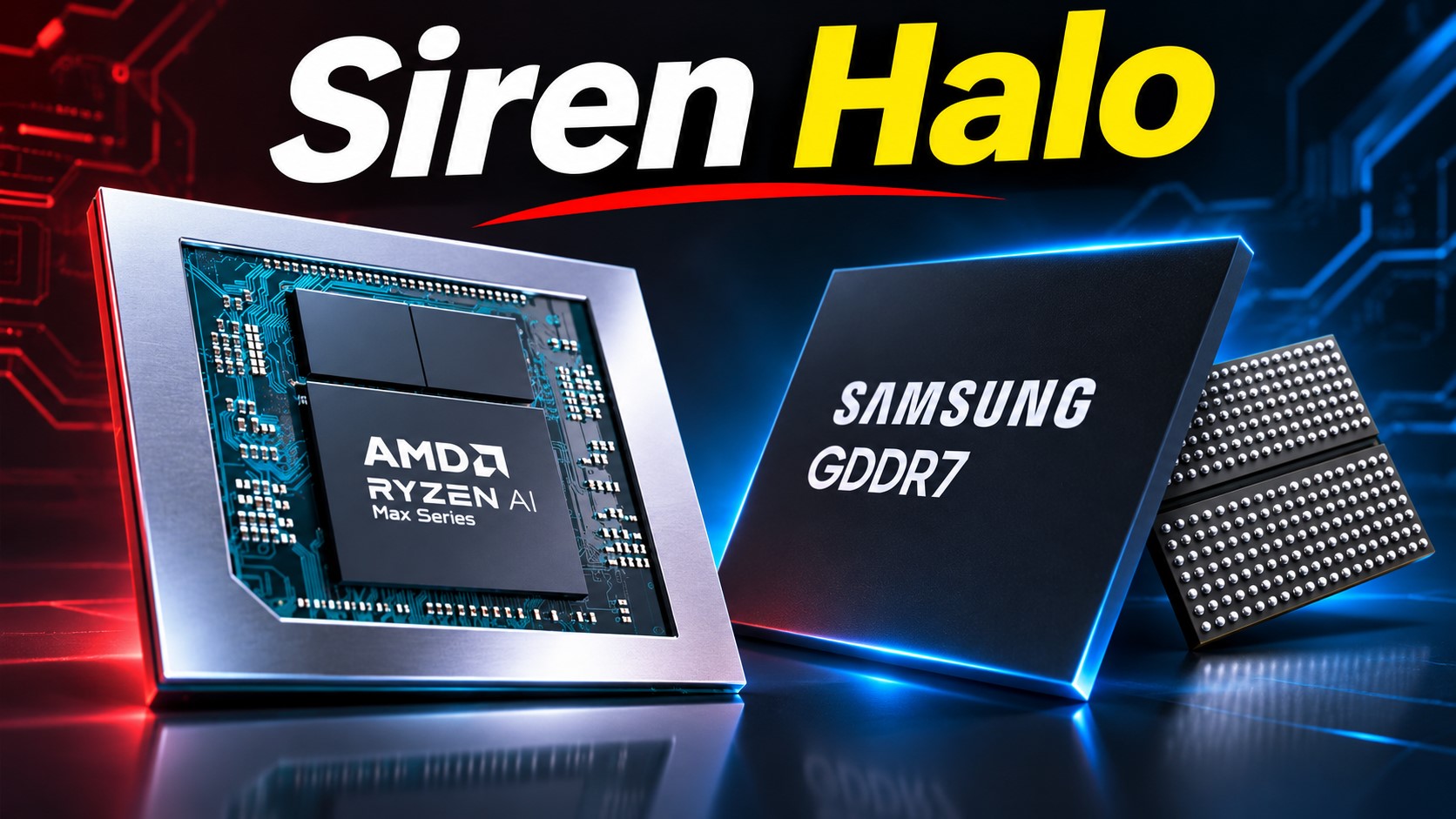
AMD Siren Halo Rumor Points to GDDR7 Memory for a Major Graphics Bandwidth Boost
AMD’s future high-performance mobile processor lineup could be getting a major memory upgrade. A new rumor claims that the upcoming AMD Siren Halo APU may combine Zen 6 CPU cores, RDNA 5 graphics, and dedicated GDDR7 memory, potentially giving the chip a significant boost in graphics bandwidth.
The leak suggests that Siren Halo will move beyond the memory approach used in AMD’s current Halo-class chips. Today’s Zen 5-based Strix Halo and Gorgon Halo processors rely on LPDDR5X onboard unified memory, which is shared between the CPU and integrated GPU. That setup is efficient and flexible, especially for compact laptops and AI-focused workloads, but it does not offer the same level of raw graphics bandwidth as dedicated high-speed graphics memory.
If the rumor is accurate, GDDR7 could give AMD’s next Halo-class chip a major advantage in gaming, content creation, and GPU-heavy tasks. GDDR7 is designed to deliver far higher bandwidth than conventional low-power memory, making it a natural fit for powerful integrated graphics solutions that aim to close the gap with entry-level or mid-range discrete GPUs.
Siren Halo is expected to follow AMD’s Medusa Halo family, which is also believed to use Zen 6 CPU architecture and RDNA 5 graphics. However, the new rumor indicates that Siren Halo may not be a simple refresh. Instead, it could act as a more advanced successor, keeping the same core architecture foundation while improving the memory subsystem to unlock better graphics performance.
This matters because memory bandwidth is often one of the biggest limits for integrated graphics. Even if the GPU architecture is powerful, performance can be held back if the graphics unit cannot access data quickly enough. By pairing RDNA 5 with GDDR7, AMD could allow the integrated GPU to stretch its legs much further, especially in modern games, high-resolution rendering, AI-assisted creative tools, and professional graphics workloads.
There are still important questions that remain unanswered. It is not yet clear whether the Zen 6 CPU and RDNA 5 GPU would both have access to the GDDR7 memory, or whether the GDDR7 pool would be reserved mainly for graphics. If the memory is dedicated only to the GPU, gaming performance could benefit greatly, but AI and productivity workloads may lose some of the flexibility offered by a large unified memory design.
That distinction could be especially important for users interested in Ryzen AI Max-style systems, where large shared memory pools can be useful for running AI models and handling demanding creative workloads. A split-memory design could improve graphics performance while making certain AI tasks less convenient, depending on how AMD configures the final chip.
The use of GDDR7 with RDNA 5 would not be entirely surprising. AMD has already shown signs of preparing software support for future graphics technologies, and a higher-bandwidth memory solution would make sense for a premium APU aimed at gaming laptops, compact workstations, and powerful small-form-factor systems.
For now, Siren Halo remains unconfirmed, and AMD has not officially announced the product or its specifications. Still, the rumor is notable because it points to a possible shift in AMD’s APU strategy. Rather than relying only on unified low-power memory, AMD may be exploring a more graphics-focused design that gives integrated GPUs access to much faster dedicated memory.
If this leak proves accurate, AMD Siren Halo could become one of the company’s most exciting next-generation processors, combining Zen 6 efficiency, RDNA 5 graphics performance, and GDDR7 bandwidth in a single package. That combination could make future premium laptops and compact PCs far more capable for gaming, AI acceleration, and creative workloads without requiring a separate graphics card.