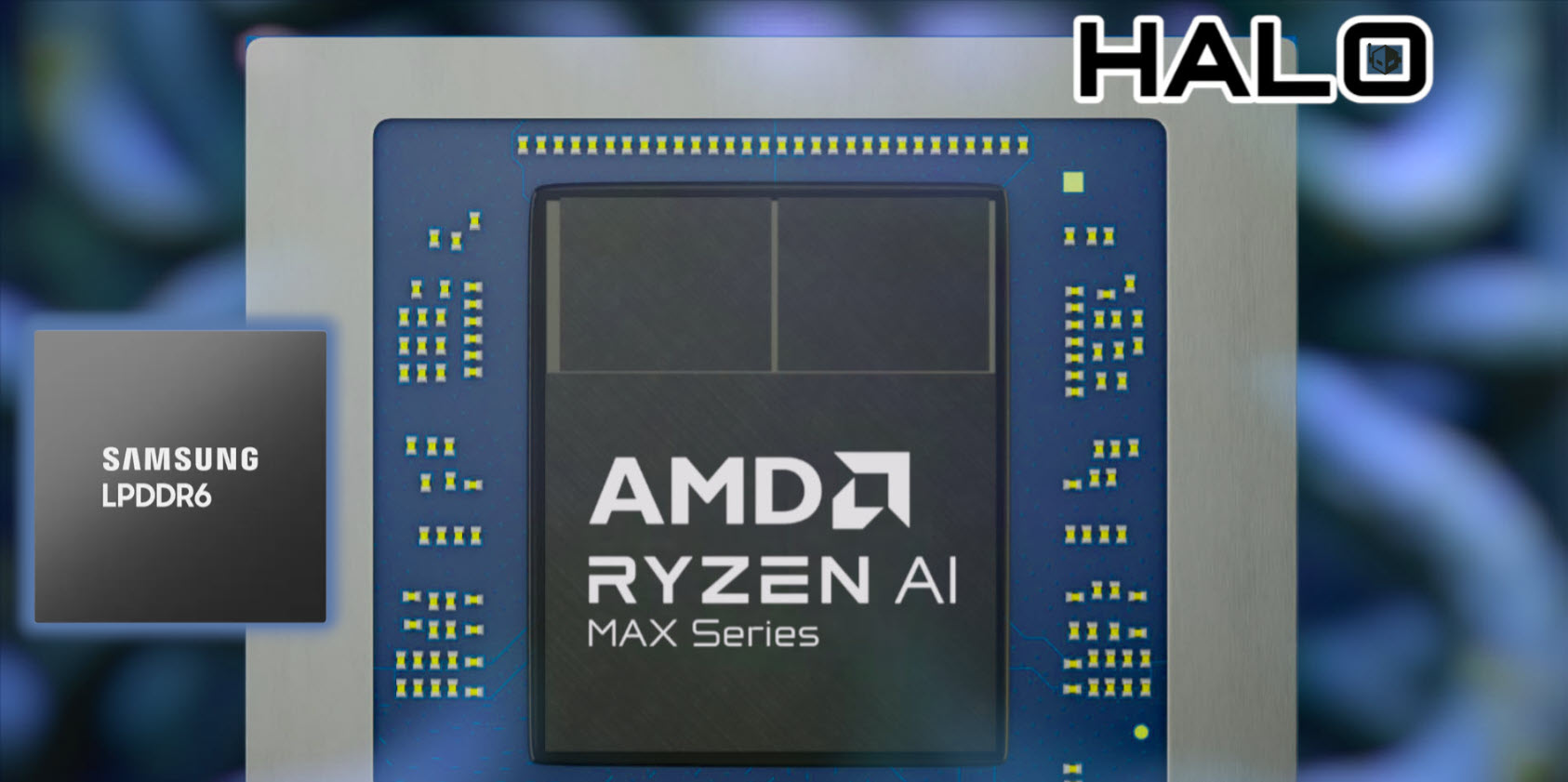
AMD is already laying the groundwork for the next big leap in its premium “Ryzen AI MAX” laptop-class SoCs. According to the latest chatter around the roadmap, the true successor to today’s Strix Halo platform will be the Ryzen AI MAX 500 series, codenamed Medusa Halo, and one upgrade stands out: support for next-generation LPDDR6 memory.
Ryzen AI MAX has quickly positioned itself as AMD’s flagship answer for high-performance AI PCs and thin-and-light machines that still want serious graphics horsepower. After expanding the lineup recently, AMD is expected to keep the momentum going with a refresh of the first Halo generation before Medusa Halo arrives.
Before Medusa Halo, a refreshed Halo wave is expected under the name Gorgon Halo (Ryzen AI MAX 400). The idea here is straightforward: push performance higher with boosts to CPU and GPU clocks and faster memory speeds. The current Strix Halo platform tops out around LPDDR5X-8000, while the refresh is expected to move up to roughly LPDDR5X-8533, giving the integrated GPU and AI workloads a little more breathing room.
Medusa Halo is where things get more interesting. Slated for a 2027–2028 window, the Ryzen AI MAX 500 family is rumored to bring new Zen 6 CPU cores paired with RDNA 5 GPU technology on premium configurations. Reports also suggest AMD could diversify the Medusa lineup, with more entry-focused chips potentially using RDNA 3.5 integrated graphics, while higher-end and “Halo” tier parts move to newer RDNA 5 iGPU configurations.
While exact specs are still up in the air, expectations point to up to 24 CPU cores on top-tier models, and graphics configurations that are at least comparable to today’s strongest Halo designs—possibly stronger. But regardless of core counts, memory bandwidth may become the defining advantage.
LPDDR6 has been outlined with speeds reaching 14,400 MT/s using a 24-bit wide channel, delivering up to 38.4 GB/s of bandwidth per module. That matters because integrated graphics performance in an SoC is often limited less by compute and more by how quickly it can access memory. Strix Halo already offers a premium bandwidth setup, with figures that reach up to 256 GB/s depending on configuration. The refresh should raise that modestly.
With Medusa Halo, if AMD retains a similar 256-bit memory bus width and pairs it with LPDDR6-class speeds, total bandwidth could rise to around 460 GB/s—roughly an 80% jump versus the current generation. For the onboard GPU, that kind of bandwidth increase can translate into noticeably stronger gaming performance, higher sustained frame rates, and better headroom for modern GPU-accelerated creator apps. It’s also a big deal for AI workloads that benefit from fast memory access, especially when models and data need to move quickly between compute blocks.
The competitive context is heating up too. Intel’s newest mobile SoC direction has been pushing memory faster in notebooks, and the broader industry is also exploring deeper collaborations between CPU and GPU ecosystems. Even so, AMD appears committed to pushing its own integrated strategy forward, leaning into high-bandwidth memory configurations and increasingly capable iGPUs to deliver strong performance without relying on a separate discrete graphics chip in every design.
If the roadmap holds, Ryzen AI MAX 500 “Medusa Halo” could become one of the most important laptop SoC launches of its generation—continuing what Strix Halo started, building on the expected Gorgon Halo refresh, and taking a major step forward with LPDDR6 bandwidth. Just as importantly, the broader Ryzen AI Halo platform is expected to keep evolving with each Halo generation, meaning more consistent improvements for AI PC features, graphics capability, and overall performance over time.
Quick roadmap snapshot based on current expectations:
– Ryzen AI MAX 300 (Strix Halo): Zen 5 CPU, RDNA 3.5 GPU, LPDDR5X up to ~8000 MT/s, launching around 2025
– Ryzen AI MAX 400 (Gorgon Halo): Zen 5 CPU, RDNA 3.5 GPU, LPDDR5X up to ~8533 MT/s, expected 2026–2027
– Ryzen AI MAX 500 (Medusa Halo): Zen 6 CPU, RDNA 5 GPU on premium/Halo tiers, LPDDR6 up to ~14,400 MT/s, expected 2027–2028
As more concrete details emerge—especially around final core counts, GPU compute units, TDP targets, and real-world memory configurations—Medusa Halo is shaping up to be one of the most anticipated upgrades in the AI PC and integrated-gaming laptop space.