AMD Zen 6 Low-Power Core Could Bring Big Efficiency Gains to Future Laptops and Handhelds
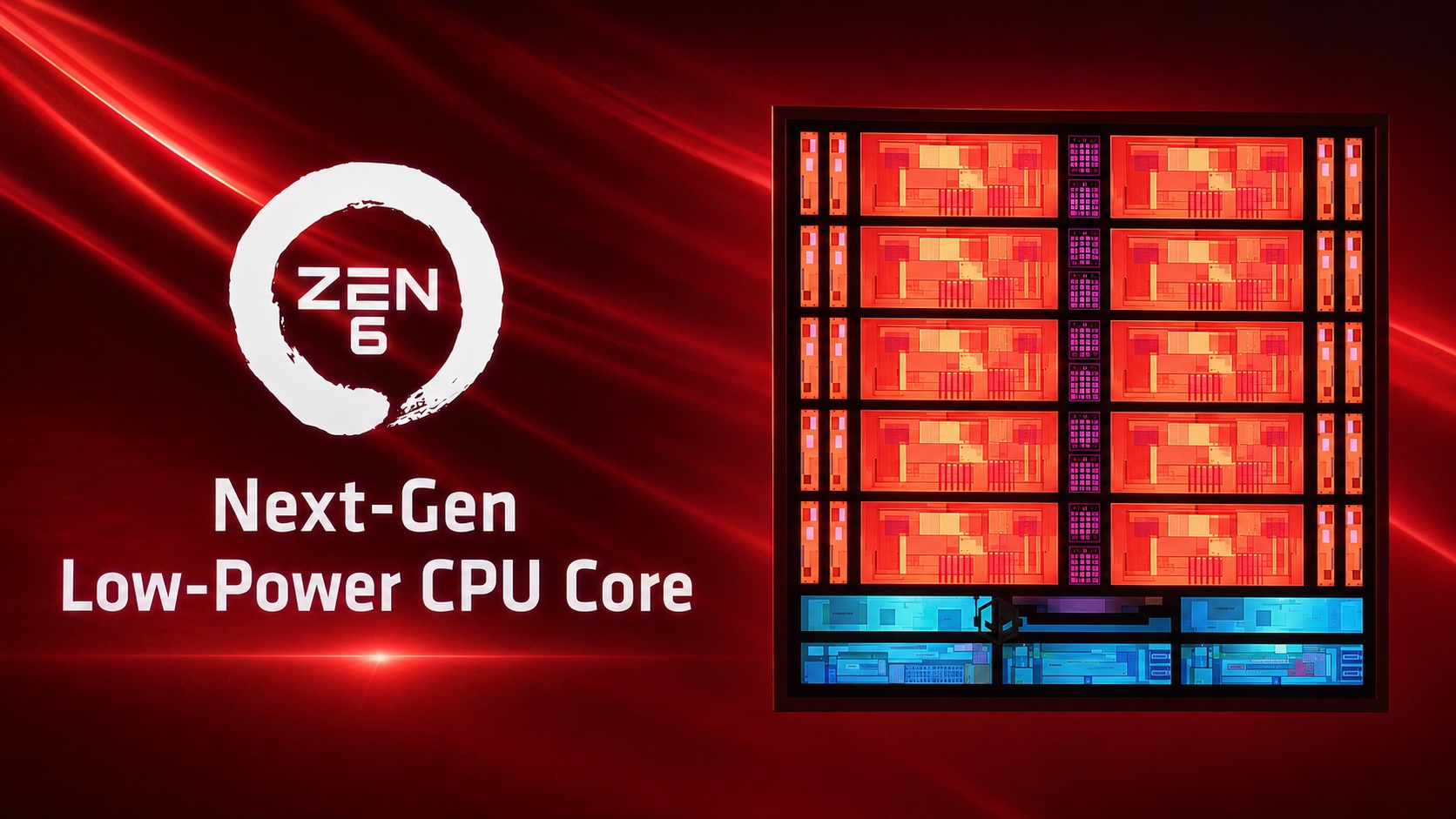
AMD’s next-generation Zen 6 CPU lineup is shaping up to be more than a simple performance upgrade. New information spotted in Linux kernel patches suggests that AMD is preparing a third type of Zen 6 core designed specifically for low-power devices, including laptops, compact PCs, and handheld gaming systems.
With Zen 6, AMD is expected to use three different core designs: a standard high-performance Zen 6 core, a dense Zen 6C core, and a new Zen 6 LP core aimed at ultra-efficient operation. While the classic and dense Zen 6 cores are already associated with upcoming server products, the low-power variant appears to be targeted at client platforms where battery life, idle efficiency, and thermal control matter just as much as raw speed.
The newly spotted Zen 6 LP core appears in Linux kernel-related entries with a CPU identification string that points to a distinct low-power design. AMD’s own description indicates that this core type is built to reduce power consumption during background tasks and idle workloads. That detail is important because modern mobile devices spend a large amount of time handling light system activity rather than running at full performance.
This approach could help AMD compete more aggressively in devices where efficiency is critical. A laptop or handheld powered by Zen 6 LP cores could potentially stay cooler, last longer on battery, and handle everyday background tasks without waking up larger, more power-hungry CPU cores.
What makes the Zen 6 Low-Power core especially interesting is that it does not appear to be just a smaller or slower version of the standard Zen 6 core. Instead, it seems to combine design elements from several generations of AMD’s Zen architecture while still supporting the Zen 6 instruction set.
According to the available details, Zen 6 LP may use a microarchitecture similar to Zen 5, a 256-bit floating-point unit similar to Zen 4, 512 KB of L2 cache like Zen 3, and 1 MB of L3 cache per core in a style associated with older low-power AMD designs. In other words, AMD may be building a carefully balanced hybrid core that borrows proven components from past Zen generations to deliver strong efficiency without sacrificing too much performance.
That would make Zen 6 LP different from Zen 6C. AMD’s dense cores are typically designed to fit more cores into a given silicon area while maintaining solid performance per watt. Zen 6 LP, on the other hand, appears to focus more directly on minimizing power draw during lighter workloads, which could make it especially valuable for mobile processors.
There are also claims that Zen 6 LP cores may be able to match or even exceed Zen 5C cores in certain areas. It is not yet clear whether that refers to performance, efficiency, or a combination of both. Still, if AMD can deliver low-power cores that perform at or above the level of its previous-generation efficiency-focused cores, it could mark a major step forward for the company’s mobile CPU strategy.
The first major product family expected to use these low-power cores is AMD’s upcoming Medusa APU lineup. These next-generation chips are expected to include different configurations featuring standard Zen 6 cores, Zen 6C dense cores, and Zen 6 LP cores. That opens the door to more flexible processor designs, where AMD can mix core types depending on the target device.
For high-performance laptops, AMD could use a combination of standard Zen 6 cores and Zen 6C cores to deliver strong multitasking and creator-focused performance. For thinner laptops or handheld gaming devices, Zen 6 LP cores could take on background and light workloads to preserve battery life while allowing the larger cores to activate only when needed.
This kind of hybrid CPU strategy has become increasingly important across the PC industry. Users expect laptops to deliver desktop-like performance when plugged in, but they also want long battery life, quiet operation, and low heat when browsing, streaming, or working on basic tasks. A dedicated low-power Zen 6 core could help AMD address those expectations more effectively.
The Linux kernel references also suggest that AMD is working to make sure operating systems can properly identify and manage these low-power cores. That matters because hybrid processors depend heavily on correct scheduling. If the operating system knows which cores are optimized for performance and which are optimized for efficiency, it can assign tasks more intelligently.
For example, background updates, messaging apps, music playback, and idle system processes could run on Zen 6 LP cores, while gaming, rendering, compiling, or AI workloads could shift to the faster Zen 6 cores. Better scheduling could lead to smoother performance and lower power consumption in real-world use.
AMD’s Zen 6 generation is not expected to arrive immediately, with Medusa APUs reportedly aiming for a launch window around CES 2027. Until AMD officially reveals the lineup, exact specifications, performance numbers, and product names remain unconfirmed. However, the appearance of Zen 6 LP in kernel patches strongly suggests that AMD is preparing a more advanced and flexible CPU architecture for future mobile platforms.
If the current information proves accurate, Zen 6 LP could become one of the most important additions to AMD’s next-generation processor roadmap. By combining low idle power, modern Zen 6 compatibility, and design elements from proven Zen architectures, AMD may be preparing a CPU core that is ideal for the next wave of efficient laptops, handheld PCs, and compact computing devices.