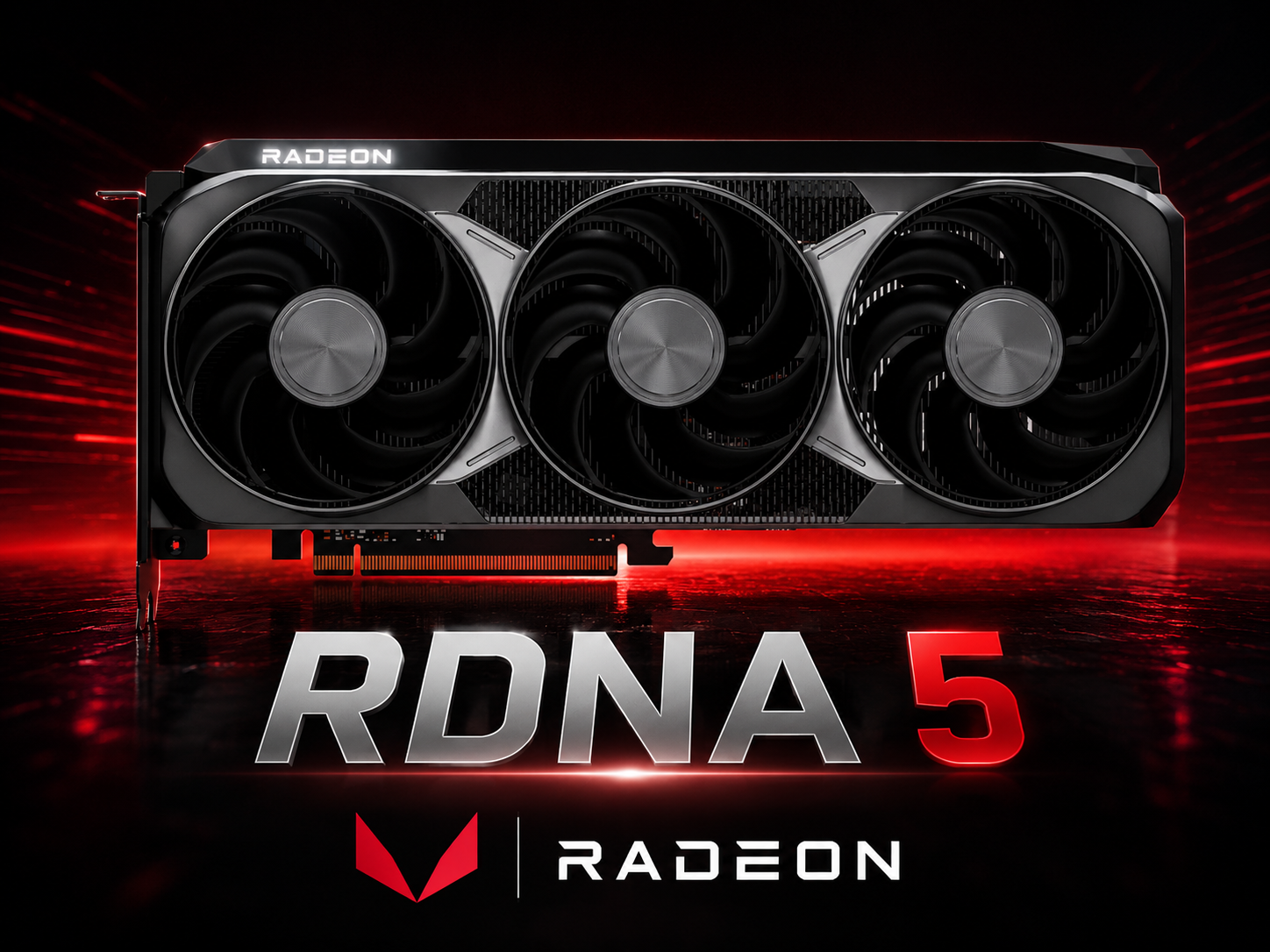
AMD RDNA 5 leak hints at major Radeon RX 10000 performance gains, GDDR7 memory, and stronger ray tracing
Fresh rumors around AMD’s next-generation RDNA 5 graphics architecture suggest Radeon GPUs could be preparing for one of their biggest leaps in years. If the latest information is accurate, AMD may be planning a Radeon RX 10000 series lineup that stretches from affordable mainstream cards to a flagship model capable of challenging Nvidia’s fastest gaming GPUs.
Previous leaks have already painted an ambitious picture for RDNA 5. The architecture is expected to be manufactured on TSMC’s advanced N3P process node and reportedly carries the internal codename AT, short for Alpha Triton. The full RDNA 5 die, known as AT0, has been rumored to feature up to 192 Compute Units, which would be double the CU count of AMD’s Radeon RX 7900 XTX.
However, the complete AT0 design is not expected to appear in a consumer Radeon gaming card. Instead, it is widely believed to be reserved for AI and professional accelerator products. The Radeon RX 10000 desktop GPU lineup would likely use cut-down versions of the chip, such as AT1, AT2, and other variants.
A newer rumor now claims to outline possible specifications for several Radeon RX 10000 graphics cards, including their Compute Unit counts, memory configurations, and expected performance targets.
At the entry level, AMD is reportedly preparing a Radeon RX 10050 XT. This card is said to feature 24 Compute Units and deliver rasterization performance roughly in line with the GeForce RTX 3070. That would make it a potentially strong budget or lower-midrange option if AMD prices it aggressively.
The most unusual detail is the rumored memory configuration. The RX 10050 XT is claimed to use 12 GB to 16 GB of LPDDR5X memory. That would be a major departure from traditional desktop graphics card design, as LPDDR memory is usually associated with laptops, handheld gaming devices, and compact systems where power efficiency is more important than raw bandwidth.
Moving up the stack, the rumored Radeon RX 10060 XT reportedly doubles the Compute Unit count to 48 and could include 16 GB to 24 GB of LPDDR5X memory. Performance is claimed to land around the GeForce RTX 4080 Super in rasterized gaming workloads, which would be a massive jump for a card that may sit below AMD’s highest-end RDNA 5 offerings.
The idea of LPDDR5X memory on desktop Radeon GPUs is surprising and should be treated with caution. Desktop graphics cards usually have more power and cooling headroom, allowing them to use faster, higher-bandwidth memory technologies such as GDDR6, GDDR6X, or the upcoming GDDR7. AMD has also not used LPDDR memory in mainstream desktop Radeon graphics cards before.
Still, the concept is not impossible. Modern GPUs already rely heavily on memory-saving technologies to reduce bandwidth pressure. Techniques such as Delta Color Compression, depth buffer compression, framebuffer compression, and lossless memory compression help reduce the amount of data that must move between the GPU and VRAM. If RDNA 5 introduces more advanced compression methods, AMD may be able to offset some of the bandwidth limitations of LPDDR5X.
Cost could be another reason AMD might experiment with LPDDR5X on lower-end desktop GPUs. LPDDR memory packages may allow for simpler board designs and potentially lower manufacturing costs, especially on entry-level and mainstream products. AMD may also want to test improved memory compression on desktop graphics cards before bringing similar technology to future APUs, handheld gaming chips, and integrated graphics platforms, where LPDDR memory is already common and memory bandwidth is often a major limitation.
The higher-end RDNA 5 models are where the rumor becomes even more exciting. The Radeon RX 10070 XT is said to feature 68 Compute Units, 16 GB to 24 GB of GDDR7 memory, and raster performance comparable to the GeForce RTX 5080. If true, this would place AMD firmly back into the high-end gaming GPU competition.
Interestingly, there is no mention of a Radeon RX 10800 XT in the rumored lineup. Whether AMD is skipping that naming tier, saving it for a later launch, or simply using a different branding structure remains unclear.
At the very top, the rumored Radeon RX 10090 XT is claimed to feature 96 Compute Units, 24 GB to 36 GB of GDDR7 memory, and performance approaching the GeForce RTX 5090. That would be a major statement from AMD, especially after RDNA 4 focused more heavily on the upper-midrange market rather than chasing the absolute flagship segment.
One of the most important areas to watch is ray tracing. AMD Radeon GPUs have traditionally been competitive in rasterized gaming performance, but ray tracing has remained a weakness compared with Nvidia’s GeForce lineup. The new leak suggests RDNA 5 could deliver much larger gains in ray tracing than in standard raster performance.
If accurate, that would point to deeper architectural changes rather than a simple refresh. AMD may have redesigned key parts of the ray tracing pipeline, improved hardware acceleration, or made changes to scheduling, cache behavior, and memory handling. Such improvements would be critical if AMD wants RDNA 5 to compete more directly with Nvidia in modern games that rely heavily on ray tracing and advanced lighting effects.
RDNA 5 has often been described by leakers as a potential turning point for Radeon, similar in spirit to what Zen did for AMD’s CPU business. That is a bold comparison, but it reflects the level of expectation surrounding the architecture. For AMD, a successful RDNA 5 launch could mean stronger competition in high-end gaming graphics, better ray tracing performance, improved efficiency, and a more complete product stack.
However, several major questions remain unanswered. Power consumption is one of the biggest. The rumor does not reveal how much power these GPUs may require, and performance claims are difficult to judge without efficiency data. If AMD’s flagship Radeon RX 10090 XT truly targets RTX 5090-class performance, it may require a very high power envelope.
That raises another question: power connectors. If AMD pushes flagship RDNA 5 power consumption into the same range as Nvidia’s top-tier GPUs, it may need to adopt a modern high-power connector such as 12VHPWR or its revised version. While newer versions of the connector have improved over the original design, reliability concerns have not disappeared completely, and many PC builders remain cautious.
For now, all of these specifications should be viewed as rumors rather than confirmed details. AMD has not officially announced the Radeon RX 10000 series, RDNA 5 product names, Compute Unit counts, memory configurations, or performance targets. Still, the information lines up with the broader expectation that AMD is preparing a more aggressive Radeon generation.
If RDNA 5 can combine strong raster performance, meaningful ray tracing gains, competitive pricing, and improved power efficiency, the Radeon RX 10000 series could become one of AMD’s most important graphics launches in years. The possibility of GDDR7 on high-end models, LPDDR5X experimentation on mainstream cards, and a flagship GPU that challenges the fastest GeForce cards makes RDNA 5 one of the most closely watched upcoming GPU architectures.


