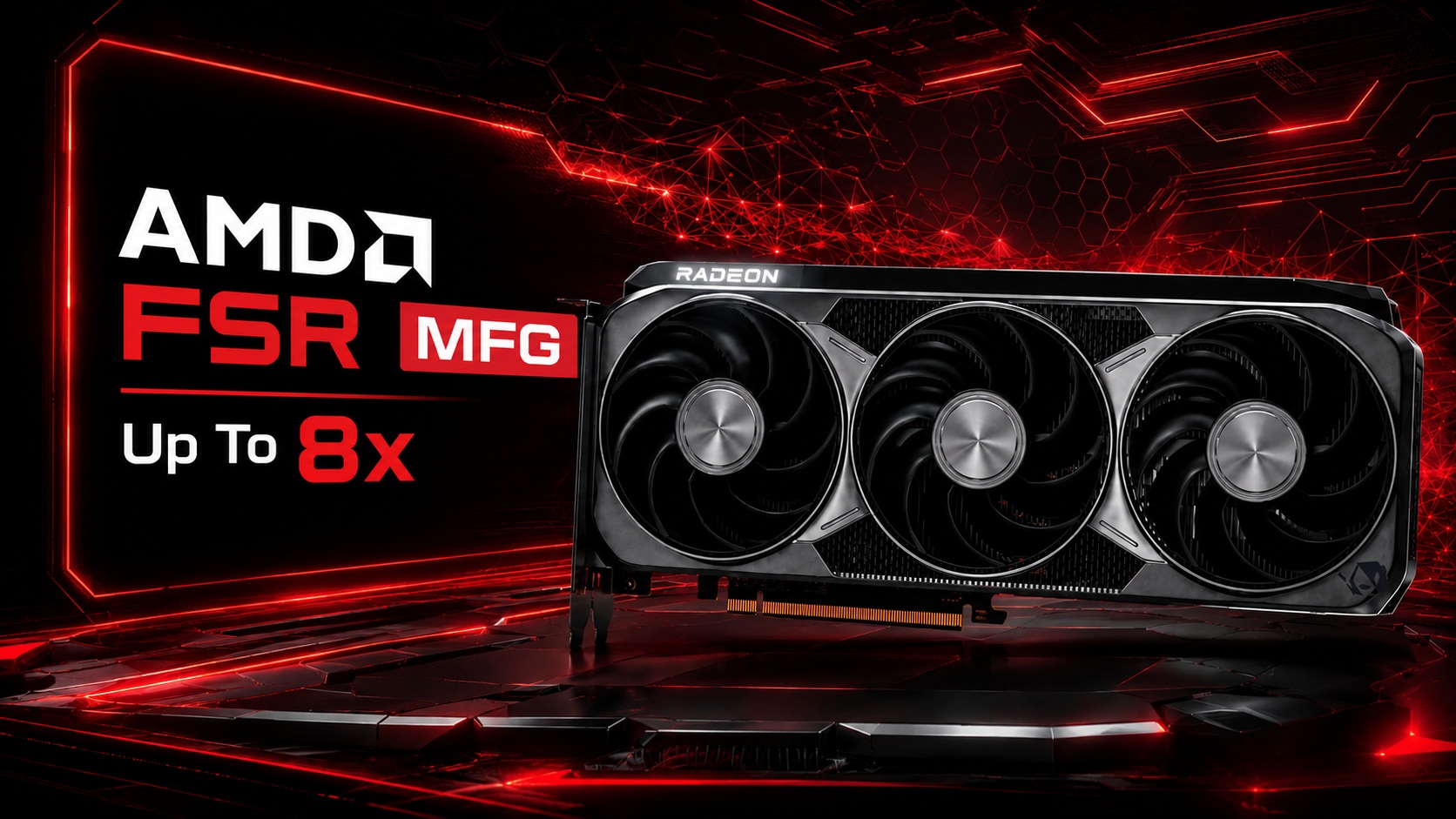
AMD Radeon drivers hint at FSR Multi-Frame Generation 8x and new graphics overrides
AMD appears to be preparing a major upgrade for its FidelityFX Super Resolution technology, with recent Radeon driver files exposing new options tied to FSR Multi-Frame Generation, including an 8x mode. If these settings are eventually enabled for users, AMD could deliver a much larger frame-generation boost than what is currently available in mainstream GPU software.
The discovery comes from options found inside AMD’s recent Adrenalin 26.6.2 WHQL driver package. Using the RadeonTuner utility, hidden graphics settings were revealed under the FSR section, suggesting AMD is actively testing expanded controls for frame generation and ray-tracing enhancement features.
The most eye-catching option is “FSR Multi Frame Generation Ratio,” which appears to support up to 8x frame generation. There is also an “FSR Multi Frame Generation Override,” indicating AMD may allow users to force or adjust the feature beyond standard game-level support.
AMD has already been laying the groundwork for FSR Multi-Frame Generation in recent driver and SDK updates. Earlier support appeared in the FidelityFX SDK, where the feature was described as a way to let users choose a preferred frame generation ratio for the best balance of performance and image quality. However, the feature is not yet broadly available across Radeon GPUs.
The newly exposed driver options suggest that AMD’s work has progressed further than expected.
What FSR Multi-Frame Generation 8x could mean for gaming
Frame generation works by creating additional frames between traditionally rendered frames, making gameplay appear smoother and dramatically increasing perceived FPS. Current AMD frame generation typically creates one generated frame for each rendered frame, but an 8x mode would be a much more aggressive approach.
If AMD’s FSR MFG 8x functions as the setting implies, it could generate seven additional frames for every one natively rendered frame. That would represent a huge potential increase in frame rate, especially in demanding games using ray tracing or high resolutions such as 4K.
This could be particularly useful for future Radeon GPUs, where AMD may want to compete more aggressively in AI-assisted rendering, high-refresh-rate gaming, and visually intensive titles.
However, generating more frames also introduces challenges. The higher the frame-generation ratio, the more important latency control, frame pacing, and input responsiveness become. Smooth visuals are only useful if the game still feels responsive. Because of that, AMD may need to improve or expand its Anti-Lag technology alongside any future MFG 8x rollout.
Better latency reduction would be essential for competitive games, fast-paced shooters, and action titles where input delay can be noticeable. If AMD can combine high frame-generation ratios with strong latency management, FSR MFG could become a major selling point for Radeon graphics cards.
New FSR override options also discovered
Alongside Multi-Frame Generation settings, RadeonTuner also exposed several other interesting FSR-related options inside the driver. These include:
FSR Multi Frame Generation Ratio, up to 8x
FSR Multi Frame Generation Override
FSR Ray Regeneration Denoiser Override
FSR Neural Radiance Caching Override
The last two options are especially interesting because they suggest AMD may be working on broader driver-level controls for advanced rendering features.
FSR Ray Regeneration could help improve ray-traced image quality by enhancing or reconstructing lighting data more intelligently. This type of technology is designed to reduce noise, improve clarity, and make ray-traced scenes look cleaner without relying only on traditional denoising methods.
FSR Neural Radiance Caching, meanwhile, appears focused on improving how lighting is calculated and reused in supported scenes. In theory, this could help with global illumination, indirect lighting, and other advanced rendering effects while reducing the performance cost.
If AMD allows these features to be enabled through driver overrides, it could make them available in more games, even where native support is limited. That would be a major advantage for Radeon users, especially if the results are stable and visually consistent.
Why driver-level overrides matter
Driver-level overrides can be powerful because they give users more control over how GPU features behave in games. Instead of waiting for every game developer to integrate a specific technology, users may be able to activate certain features directly through AMD’s software or compatible tuning tools.
AMD already offers features such as Radeon Super Resolution, Anti-Lag, and Fluid Motion Frames through its graphics software. Expanding this approach to newer FSR technologies could make Radeon GPUs more flexible and appealing.
For gamers, the benefit is simple: more performance options, wider compatibility, and potentially better visuals without needing every title to receive a dedicated update.
Still, there are risks. Not every override works perfectly in every game. Some titles may show visual artifacts, inconsistent frame pacing, UI issues, or unexpected behavior. For this reason, AMD may need to carefully test these features before making them publicly available in the Adrenalin interface.
Games expected to use AMD’s advanced FSR technologies
AMD’s newer FSR features, including neural rendering and ray regeneration, are expected to appear in a growing list of games. Titles associated with these technologies include:
Call of Duty: Black Ops 7
Crimson Desert
Mafia: The Old Country
Warhammer 40,000: Darktide
The current list is still relatively limited, but driver-level overrides could help AMD expand the practical reach of these features. If Radeon users can apply FSR enhancements across a wider range of games, AMD may be able to close the feature gap with competing GPU ecosystems.
A major Radeon update could be on the way
The appearance of FSR Multi-Frame Generation 8x inside AMD’s driver files does not guarantee an immediate public release. Hidden settings often appear before features are finalized, and AMD has not officially launched MFG 8x for Radeon users yet.
Even so, the discovery strongly suggests that AMD is actively preparing a more advanced version of FSR frame generation. Combined with ray regeneration and neural radiance caching overrides, the company seems to be building a broader AI-enhanced gaming platform for future Radeon GPUs.
If AMD can deliver high frame rates, clean image quality, wide game compatibility, and low latency, FSR MFG 8x could become one of the most exciting Radeon features in the coming months. For PC gamers looking for smoother gameplay and better performance in demanding titles, AMD’s next FSR update may be worth watching closely.


