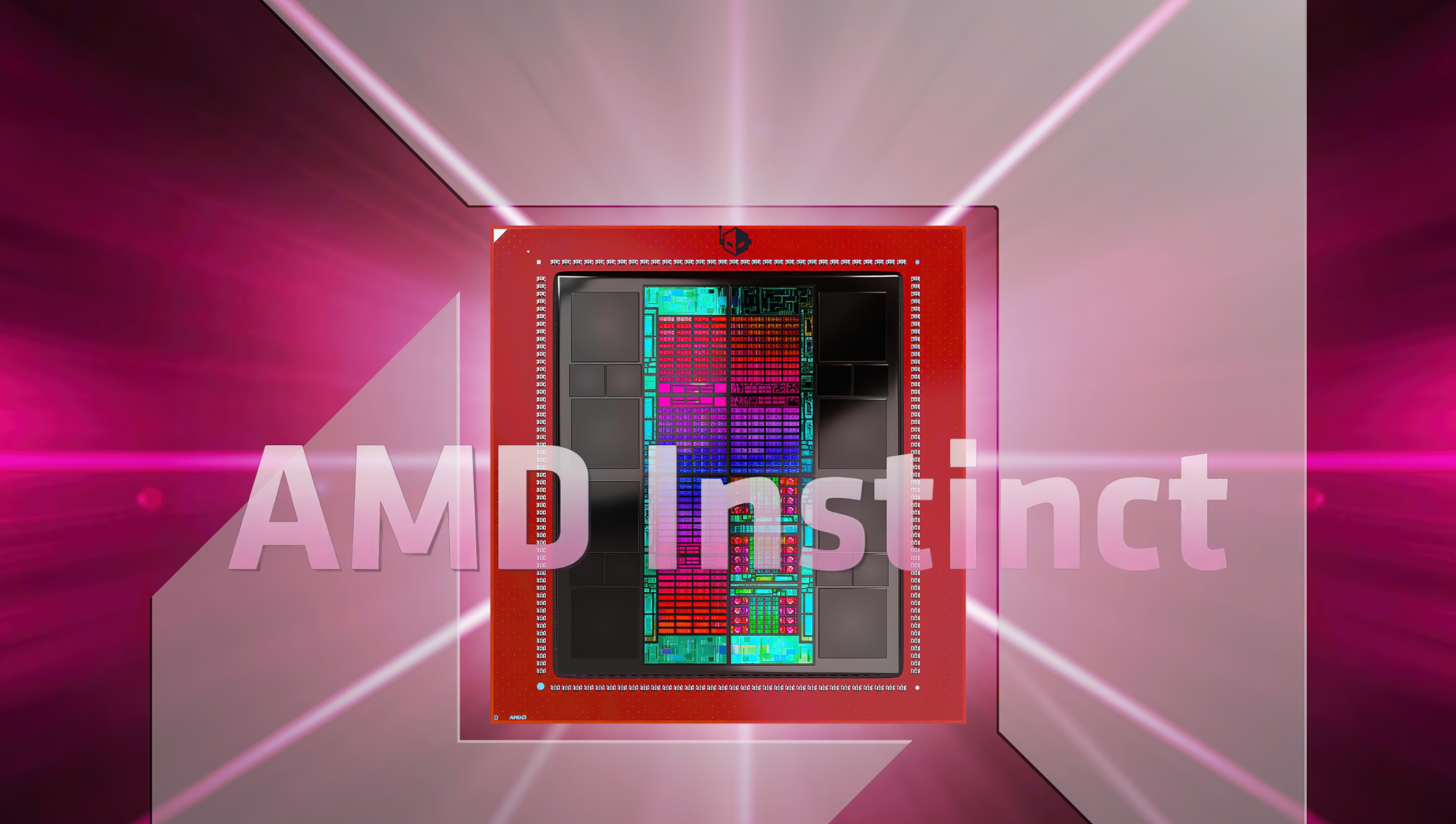
The GPU landscape has taken a significant turn with the introduction of AMD’s Instinct MI300X 192 GB GPU. Surpassing its competitors in the industry, this formidable Data Center GPU has snatched the crown in the Geekbench OpenCL benchmark, demonstrating a 19% lead over NVIDIA’s top-tier RTX 4090.
The AMD Instinct MI300X is not just any GPU; it is specifically crafted for the intense demands of today’s artificial intelligence (AI) applications. While its direct competitors include NVIDIA’s Hopper AI GPU family, this GPU has proven itself to be a powerhouse by dominating in benchmark tests.
Crafted with the cutting-edge CDNA 3 architecture, the MI300X is a marvel of engineering that leverages a highly advanced chiplet packaging design, boasting a staggering 153 billion transistors. Featuring a multi-die layout, the GPU incorporates an impressive 28 dies, which includes eight HBM3 memory packages, achieving memory capacities of up to 192 GB—the highest available in the Data Center GPU market.
In terms of performance metrics, the Instinct MI300X showcases a substantial 304 compute units, translating to 19,456 cores. With an astonishing 5.3 TB/s VRAM bandwidth and an agile 896 GB/s Infinity Fabric interconnect speed, this GPU is built for speed and efficiency.
However, such high performance comes at a power cost, with the MI300X having a rated thermal design power (TDP) of 750W. This is significantly higher than the NVIDIA RTX 4090’s TDP, which stands at 450W.
In recent performance tests, the AMD Instinct MI300X scored a remarkable 379,660 points in the Geekbench 6.3.0 OpenCL benchmark, outpacing the RTX 4090 which achieved 319,697 points. The underlying system supporting the MI300X was an AMD EPYC-powered setup with two 9754 CPUs, each sporting 128 cores, and paired with a colossal 3 TB of system memory.
These results underscore the sheer capability of modern Data Center and AI GPUs, which due to their specialized hardware requirements, such as high power consumption and sophisticated cooling systems, remain inaccessible on standard computing platforms. For instance, an RTX 4090 may retail between $1500 and $2000, while an MI300X can command a price around $15,000.
Such GPUs are not viable for standard PC platforms, not only because of their cost but also due to their specialized hardware designs and accelerators, which are tailored for Data Center, AI, HPC, and Cloud server requirements, rather than for gaming or conventional PC use.
Looking ahead, AMD continues to push the boundaries with their next-generation Instinct roadmap, which includes the upcoming MI350 and MI400 series, ensuring that their dominance in this space is not fleeting but part of a sustained strategy to lead the future of high-performance GPUs.