AMD FSR 4.1 Expands to Radeon RX 6000 GPUs, Ryzen APUs, Handhelds, and More
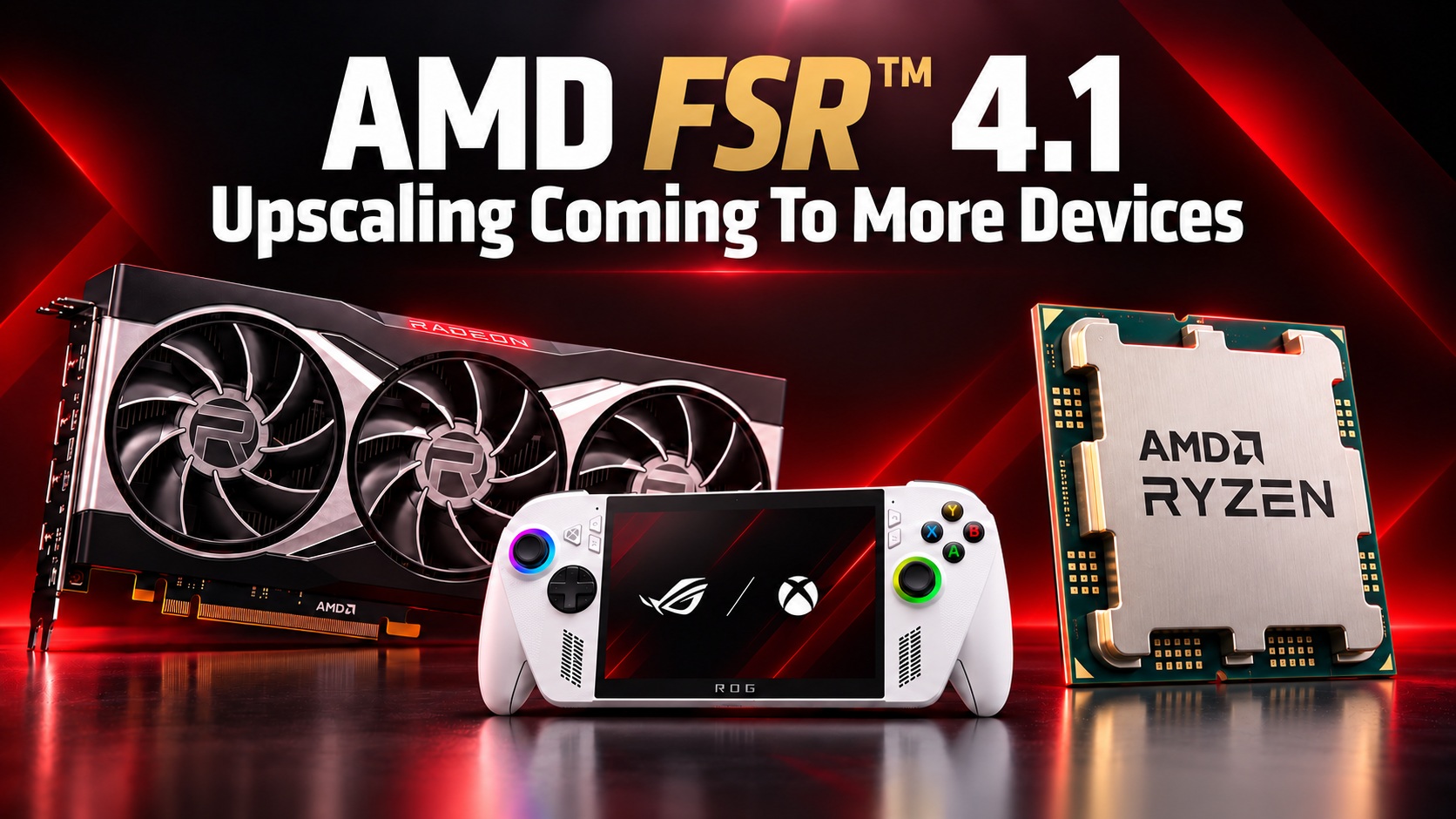
AMD is making a major move to bring its latest upscaling technology to a much wider range of gamers. The company has announced a broad expansion of FSR 4.1 Upscaling, its machine-learning-based image enhancement technology, with support coming to Radeon RX 6000 Series graphics cards, Ryzen APUs, gaming handhelds, and additional platforms.
The update is especially important for PC gamers using older AMD hardware. Until now, AMD’s newest FSR 4.1 features were mainly associated with newer Radeon graphics families, but the company is now extending support to RDNA 2-based Radeon RX 6000 Series GPUs. That includes cards ranging from high-end models such as the Radeon RX 6900 series down to more affordable entry-level options like RX 6400-class hardware.
For many players, this could be a meaningful upgrade without buying a new GPU. AMD says it has optimized the FSR 4.1 model and execution path specifically for the RX 6000 lineup, helping improve image quality and performance across a wide range of cards. In its demonstration, AMD showed FSR 4.1 running on a Radeon RX 6800 XT, with a focus on sharper visuals and better 4K gaming performance.
This is welcome news for anyone still gaming on Radeon RX 6000 hardware. As newer games become more demanding, upscaling technologies like AMD FSR can help extend the life of existing graphics cards by improving frame rates while preserving visual clarity.
AMD is not limiting the expansion to desktop graphics cards. FSR 4.1 Upscaling is also coming to AMD-powered APUs, including Ryzen AI Max processors based on Strix Halo and Gorgon Halo designs, as well as Strix and Gorgon Ryzen 9 laptops. The company is also bringing support to gaming handhelds powered by Ryzen AI Z2 Extreme, Ryzen Z2 Extreme, and Ryzen Z2 A chips.
Because handhelds and thin laptops have tighter power and thermal limits than desktop PCs, AMD has created a more efficient machine-learning model for these devices. According to the company, this new version is less than half the size of the previous FSR 4.1 Upscaling model. Despite being smaller, AMD says it can deliver better image quality than FSR 3.1 Upscaling at higher-quality presets while still maintaining frame rates above 60 FPS in the scenarios shown.
That could be a major advantage for portable gaming devices, where battery life, heat, and performance balance are critical. Better upscaling can allow handheld gamers to enjoy smoother gameplay and sharper visuals without pushing the hardware as hard as native rendering.
AMD also confirmed that FSR 4.1 Upscaling is arriving on ASUS ROG Xbox handhelds. In addition, Microsoft has confirmed that the technology will be made available to developers for Xbox Series X and Xbox Series S consoles in the future. This signals a broader push to make AMD’s upscaling technology more common across PCs, consoles, laptops, and handheld gaming systems.
AMD also highlighted its continued work with Microsoft on Project Helix, which is expected to make use of the upcoming FSR Diamond technology. While full details are still limited, this suggests AMD is preparing its next generation of image reconstruction and gaming performance features for an even wider ecosystem.
Beyond FSR 4.1 Upscaling, AMD shared updates on several other gaming technologies. FSR Redstone is now supported in more than 400 games on Radeon RX 9000 Series GPUs. The company is also working to improve FSR Frame Generation, with a focus on better frame pacing for smoother gameplay. Improved frame pacing is important because high frame rates alone do not always guarantee a smooth experience if frames are delivered unevenly.
AMD is also expanding Ray Regeneration support to more games. This technology is designed to improve ray-traced visuals by enhancing image quality in demanding lighting and reflection scenarios. As ray tracing becomes more common in modern games, better reconstruction tools can help make advanced visual effects more practical across a wider range of hardware.
Another important announcement is upcoming Vulkan support for FSR. Vulkan is widely used in games and graphics applications, so adding FSR compatibility should give developers more flexibility and help bring AMD’s upscaling features to more titles.
AMD has not yet provided exact release dates for every platform and device included in this expansion. However, the announcement marks one of the company’s biggest FSR compatibility updates so far. By bringing FSR 4.1 Upscaling to Radeon RX 6000 Series GPUs, Ryzen APUs, gaming handhelds, and future console development, AMD is clearly aiming to make high-quality upscaling more accessible to a much larger audience.
For gamers, the biggest takeaway is simple: more AMD-powered systems are getting access to newer performance-boosting technology. Whether you play on a desktop PC, laptop, handheld, or console-style device, AMD’s latest FSR expansion could help deliver sharper visuals, smoother frame rates, and a longer useful life for existing gaming hardware.