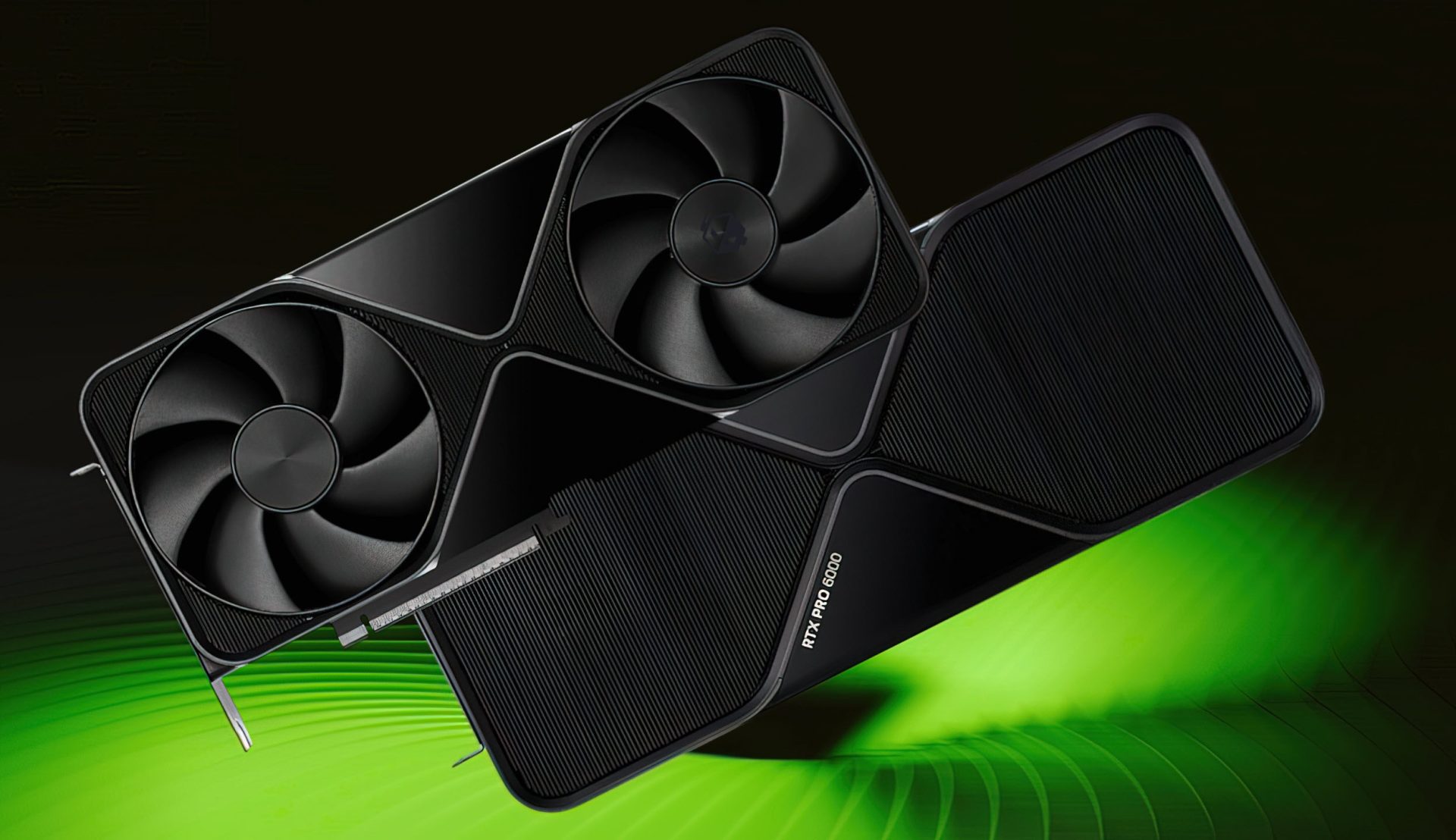
NVIDIA RTX PRO 6000 Blackwell price climbs past $10,000 as AI GPU demand heats up
NVIDIA’s flagship professional graphics card, the RTX PRO 6000 Blackwell, is becoming significantly more expensive across major U.S. retailers. The workstation-class GPU, built for AI development, professional visualization, rendering, simulation, and high-end compute workloads, originally appeared near the $8,000 range. Now, just months later, listings are moving closer to $10,000, with some retailers already pushing well beyond that mark.
The RTX PRO 6000 Blackwell is one of NVIDIA’s most powerful single-card solutions, and its biggest advantage is clear: 96 GB of GDDR7 ECC memory. That massive VRAM capacity makes it especially attractive for AI professionals, data scientists, 3D artists, researchers, and studios that need large memory pools without relying on multi-GPU setups.
At NVIDIA’s own store, the standard RTX PRO 6000 Blackwell is currently listed at $8,900 but is out of stock. The Max-Q version remains available. Meanwhile, retailer pricing has continued to rise. Micro Center has listed the card at $9,999 after a discount from $10,999. Amazon has had units available around $9,449, while server-focused editions are selling above $10,000. B&H has pushed pricing even higher, with listings reaching around $11,500.
Newegg appears to offer one of the lower current prices at roughly $9,349, helped by a bundle deal that includes a Gigabyte Brix Mini PC valued at nearly $700. Even with promotions, however, the overall trend is clear: the RTX PRO 6000 Blackwell is no longer hovering around its launch price and is now entering five-figure territory at several stores.
The reason for the price climb is not surprising. Demand for AI hardware remains extremely strong, and GPUs with large memory capacities are especially valuable. Many AI workloads, including large language model inference, fine-tuning, generative AI tasks, and complex data processing, benefit heavily from more VRAM. With 96 GB of ECC memory on a single card, the RTX PRO 6000 Blackwell occupies a premium position that few alternatives can match.
Consumer GPUs are also feeling the pressure. NVIDIA’s GeForce RTX 5090, aimed at gaming enthusiasts and creators, has also seen steep pricing in the market. While its official pricing is much lower than the professional Blackwell card, real-world listings have climbed sharply, with some RTX 5090 models appearing around $4,000 and third-party sellers asking more than $6,000 in certain cases.
Even at those inflated prices, the RTX 5090 is still far cheaper than the RTX PRO 6000 Blackwell. That price gap helps explain why AI users may still consider the professional card worthwhile, especially if their workloads require far more memory than the RTX 5090’s 32 GB can provide.
The RTX PRO 6000 Blackwell is built around a significantly larger professional configuration. It features 24,064 CUDA cores, which is about 10.5% more than the GeForce RTX 5090’s 21,760 CUDA cores. It also includes 752 Tensor Cores and 188 RT Cores, making it a serious option for AI acceleration, ray tracing, rendering, and compute-heavy workflows.
Performance is another major selling point. The card is rated for up to 125 TFLOPs of FP32 performance and up to 4,000 AI TOPS. Those numbers position it as a top-tier workstation GPU for professionals who need maximum throughput in demanding applications.
Memory is where the RTX PRO 6000 Blackwell truly separates itself from consumer-grade hardware. While the GeForce RTX 5090 includes 32 GB of GDDR7 memory on a 512-bit interface, the RTX PRO 6000 Blackwell triples that capacity with 96 GB of GDDR7 ECC memory using the same 512-bit bus. The memory runs at 28 Gbps, delivering up to 1.8 TB/s of bandwidth.
That ECC memory support is important for professional users because it helps improve reliability in long-running workloads where data accuracy matters. For AI training, scientific computing, engineering simulations, and mission-critical rendering pipelines, memory stability can be just as important as raw speed.
Power consumption is also substantial. The RTX PRO 6000 Blackwell carries a 600W total board power rating, reaching the limit of what a single 12V-2×6 16-pin power connector can provide. Cooling such a powerful card is a major challenge, and NVIDIA has adapted a dual-slot, dual-fan thermal design to manage the heat output while keeping the card suitable for workstation environments.
The broader market outlook suggests that GPU pricing may remain under pressure throughout 2026. Strong demand for AI accelerators, rising memory demand, and tight supply chains are all contributing to higher prices across PC components. Professional GPUs with large VRAM capacities are likely to remain among the most affected products.
For buyers, the RTX PRO 6000 Blackwell presents a difficult but clear equation. It is extremely expensive, but it also offers one of the strongest combinations of AI performance, professional features, and high-capacity memory in a single GPU. For gamers and typical PC enthusiasts, the price is far beyond practical limits. For AI developers, research labs, production studios, and enterprise users, it may still be a worthwhile investment if the card can reduce compute time, simplify workflows, or replace more complex multi-GPU configurations.
As AI adoption continues to expand, the RTX PRO 6000 Blackwell is likely to remain in high demand. Unless supply improves or demand cools, five-figure pricing may become the new normal for NVIDIA’s fastest professional Blackwell GPU.