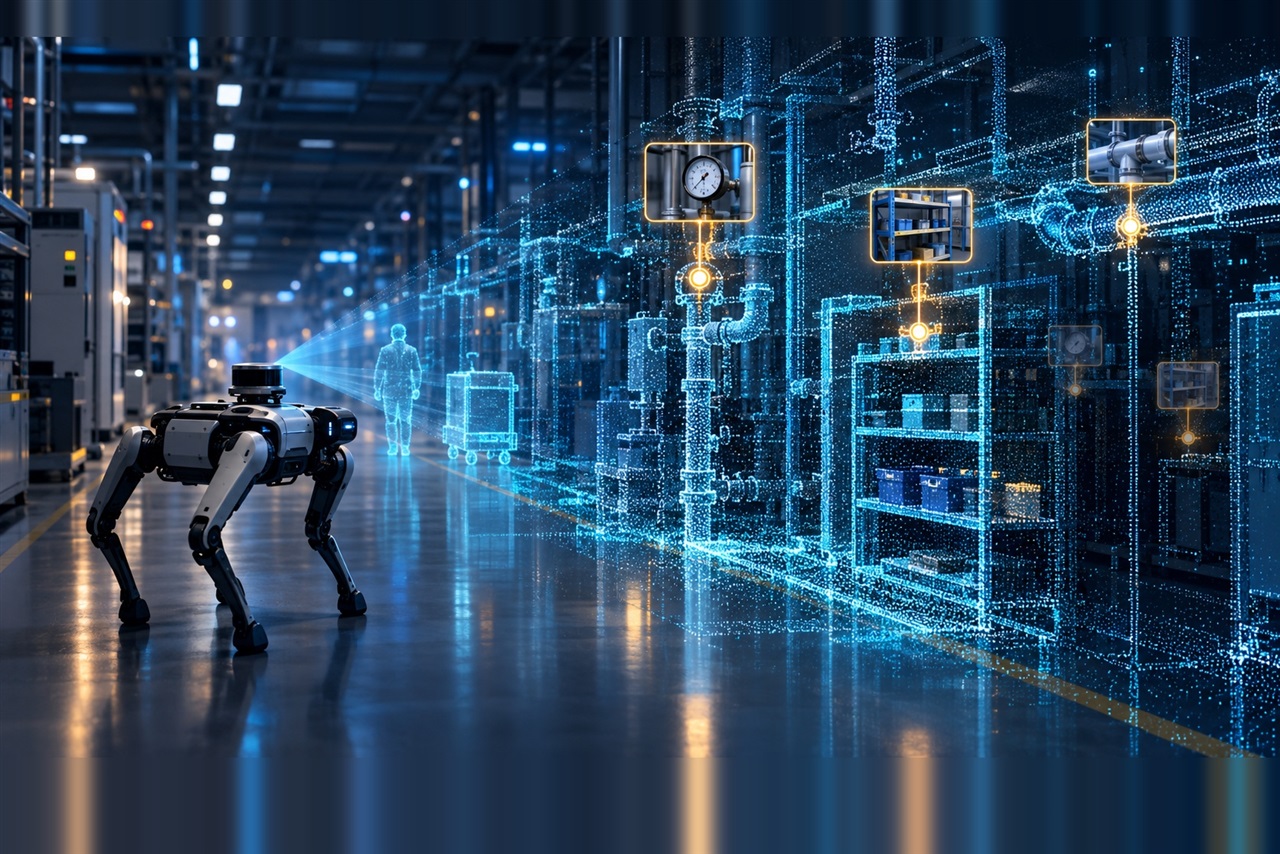
A robot that can create a digital map of a factory floor may seem intelligent, but mapping is only the first step toward true autonomy. The bigger challenge begins after the map is built. Can the robot find a specific box? Can it remember where it saw an item earlier? Can it return to a location with confidence, understand changes in the environment, and use past observations to make better decisions?
This is where physical AI is rapidly evolving. Autonomous robots are moving beyond simple navigation and entering a new stage where memory, object recognition, and reasoning become essential.
For years, robotics has focused heavily on mapping and localization. A machine needed to understand its surroundings, identify walls, paths, obstacles, and work areas, then move safely through them. This remains important, especially in warehouses, factories, hospitals, retail spaces, and logistics centers. However, a map alone does not tell a robot what matters inside that space.
A factory map may show aisles, shelves, and workstations, but it does not automatically tell the robot which package needs to be collected, whether a tool was left on a table, or whether an object has moved since the last inspection. To become truly useful, robots must connect maps with memory.
In practical terms, this means a robot must not only see its environment but also understand and recall it. If it passes a pallet in one aisle, it should be able to remember that observation later. If it is asked to retrieve a box, it should be able to search through what it has seen, reason about where the object might be, and plan a route to reach it.
This ability is becoming increasingly important as robots are deployed in more complex real-world environments. Unlike controlled demonstrations, real workplaces are constantly changing. Boxes are moved, people walk through work areas, equipment shifts position, and new obstacles appear. A robot that relies only on a static map can quickly become confused. A robot with memory can adapt.
The next generation of autonomous robots will need to combine several capabilities at once: visual perception, spatial understanding, long-term memory, object search, navigation, and AI reasoning. Together, these systems allow machines to act more like intelligent assistants rather than simple automated vehicles.
For example, in a warehouse, a robot may be asked to locate a missing package. Instead of randomly scanning every aisle, it could use memory of previous observations to narrow the search. It might recall that the package was last seen near a loading area or that similar boxes are usually stored in a certain zone. This kind of contextual awareness saves time and makes automation more efficient.
In manufacturing, memory-enabled robots could help track parts, tools, or materials across a production floor. They could assist workers by recalling where items were placed, identifying misplaced components, or checking whether a station has the required supplies. In healthcare or service environments, the same concept could help robots navigate busy spaces while remembering important locations and objects.
The shift from mapping to memory also opens the door to more advanced AI reasoning. When robots can retrieve information about what they have seen, they can make better decisions. Instead of reacting only to the present moment, they can use past experience to understand the current situation. This is a major step toward more reliable physical AI.
However, building this kind of robotic memory is not simple. Robots must process huge amounts of visual and spatial data, decide what information is worth storing, and retrieve the right details when needed. They must also handle uncertainty. An object may have moved, the lighting may have changed, or the robot may have viewed the area from a different angle.
Another challenge is making memory useful for AI models. It is not enough to store raw sensor data. The robot needs structured information that can support reasoning. It must connect objects, places, events, and actions in a way that helps it answer questions and complete tasks. In other words, the robot needs a memory system that is searchable, meaningful, and tied to the physical world.
This is why maps are turning into something more powerful. They are becoming memory systems for autonomous machines. Instead of being simple layouts, future robot maps may include object histories, scene descriptions, task records, and real-time updates. A robot’s map could become a living model of its environment.
This evolution will be critical for industries that want robots to perform more flexible work. Traditional automation works best when tasks are repetitive and environments remain predictable. Physical AI is different. It aims to help machines operate in dynamic spaces where conditions change and instructions may vary.
A robot that can map, remember, search, and reason will be far more valuable than one that can only move from point A to point B. It could support inventory management, inspection, delivery, maintenance, security, and workplace assistance. It could also reduce human workload by handling tasks that require awareness of both space and context.
The future of autonomous robotics will not be defined only by better sensors or faster movement. It will depend on how well robots can understand the world over time. Memory gives robots continuity. It allows them to learn from previous observations, recognize what has changed, and respond more intelligently.
As physical AI continues to advance, the map will no longer be the final achievement. It will be the foundation. The real breakthrough will come when robots can use those maps as memory, turning visual and spatial data into practical intelligence for real-world tasks.