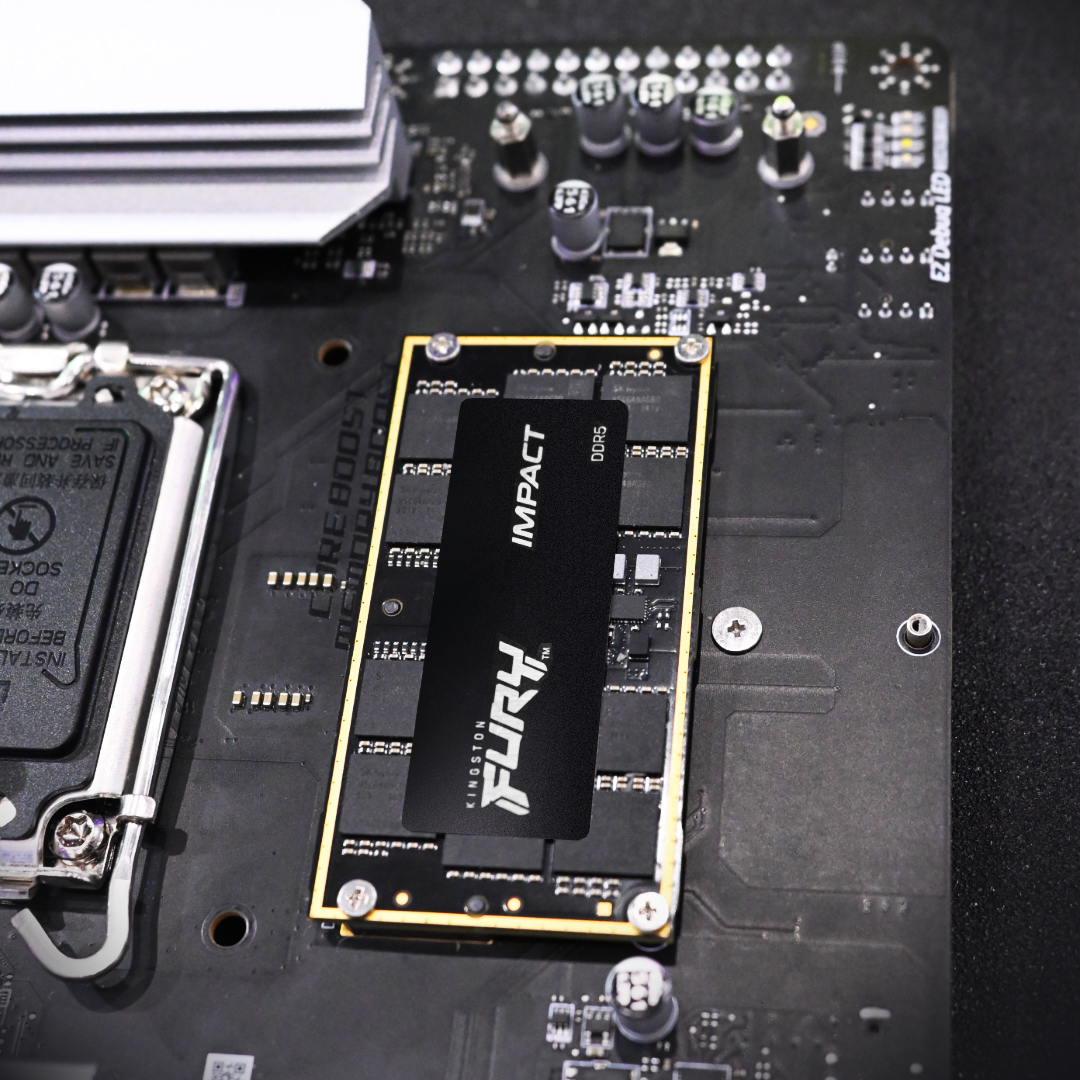
Recent benchmarks have focused on the comparison between Kingston’s CAMM2 memory and the more conventional DDR5 DIMMs, showcasing their performance levels on the MSI Z790 Project Zero Plus motherboard. This testing reveals how the emerging CAMM2 memory technology stands up against the established DDR5 format in high-performance computing scenarios.
Performance tests were conducted using Kingston’s DDR5-7200 C38 CAMM2 memory equipped with Compute Express Link Dynamic (CKD). These tests were aimed at understanding how CAMM2 competes with standard DDR5 DIMMs. For a fair comparison, both were configured with the same specs, including DDR5-7200 with CL38-44-44-105 timings and a command rate of 2.
The results obtained from AIDA64 benchmarks showed that performance between CAMM2 and DDR5 DIMMs is nearly identical. The CAMM2 memory demonstrated impressive read speeds of 105.83 GB/s, write speeds of 88,637 MB/s, and copy speeds of 94,772 MB/s, with a latency of 66.3 nanoseconds. Meanwhile, the conventional DDR5 DIMM setup showed read speeds of 106.76 GB/s, write speeds of 91,821 MB/s, and copy speeds of 94,619 MB/s, with the latency standing at 65.3 nanoseconds.
Though DDR5 DIMMs exhibited slightly better performance in most metrics, their lead over CAMM2 was marginal. The most considerable difference was noted in the write speeds, where DDR5 demonstrated a 3% advantage over CAMM2.
These benchmark outcomes highlight that when similarly configured, CAMM2 memory has the capability to match the performance of standard DDR5 DIMMs. To further validate these results, additional evaluation is needed within various real-world applications and gaming environments.
CAMM2 technology is not limited to DDR5 but also extends to LPDDR5X, which offers bandwidth that competes with top-tier XMP memory kits. The LPDDR5X variants of CAMM2 have managed to achieve speeds up to DDR5-9600, which exceeds what is currently seen in DDR5 offerings.
The benchmarks have dispelled concerns about fundamental performance issues with CAMM2. Nevertheless, there is a lingering curiosity regarding its overclocking capabilities and how widely it will be embraced by motherboard producers and memory providers, particularly for products enabled with XMP.
The memory landscape within high-performance computing and gaming is ever-evolving, and as such, understanding the capabilities and compatibilities of emerging technologies like CAMM2 is critical for consumers and industry professionals. Whether you are building a new system or upgrading an existing one, keeping a pulse on the latest memory technologies will inform your decisions and could enhance your computing experience.