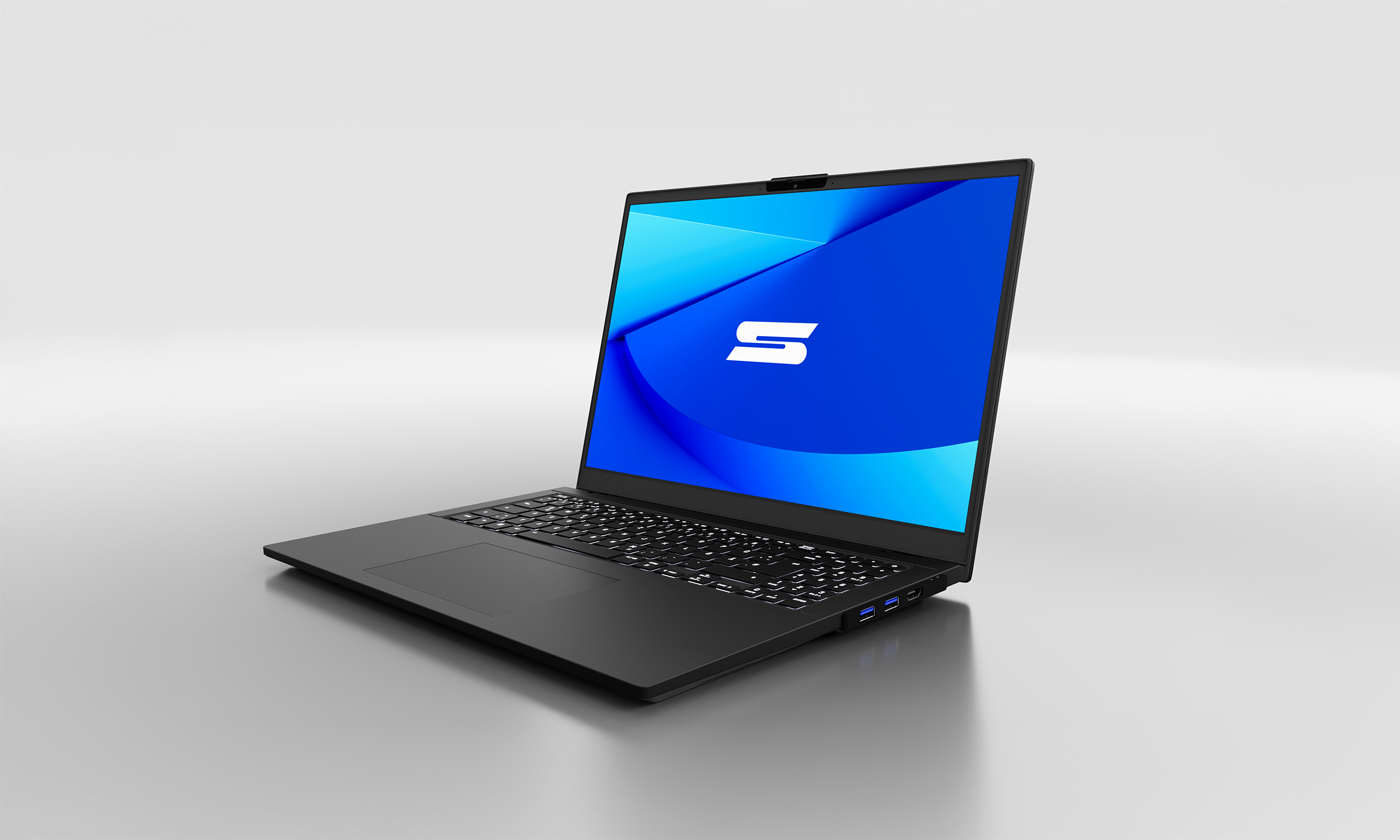
Schenker is teaming up with Intel to push laptop design in a more repairable, longer-lasting direction with what it calls the world’s first semi-modular notebook built around Intel’s upcoming Core Ultra Series 3 “Panther Lake” processors. First shown at CES under the project name “M16P,” the concept is expected to arrive in Europe as the SCHENKER ELEMENT 16 in spring 2026.
Unlike many modern laptops that are difficult to open and even harder to service, the SCHENKER ELEMENT 16 is designed to make maintenance and upgrades far more practical. A screwless quick-release mechanism on the bottom cover is meant to simplify access to the internals, reducing the friction that usually comes with routine repairs—like swapping a battery—or upgrades years down the line.
The semi-modular approach centers on replaceable, easy-to-maintain components. Schenker’s plan includes modular I/O boards for the external ports on both the left and right sides of the chassis, along with replaceable parts such as the battery, fans, storage, RAM, and even the keyboard. The keyboard swap is especially useful not only for repairs and cleaning, but also for users who want different layouts, including switching between ANSI and ISO.
Memory flexibility is another highlight. The laptop is set to include 16 GB of DDR5-6400 BGA RAM, plus an upgradeable SO-DIMM slot that can add up to 64 GB more. Up to 32 GB can run in dual-channel mode, and the soldered BGA RAM can be disabled if needed—an unusual option that adds flexibility for troubleshooting or specific configuration goals.
Schenker also says it plans to support future motherboard upgrades, potentially allowing owners to move from Intel Core Ultra Series 3 to later Intel platforms without replacing the entire laptop. To make repairs and upgrades easier for users and technicians, documentation outlining the required steps will be available.
This focus on upgradeability and repairability is closely tied to sustainability. By extending the usable life of the laptop beyond what’s typical for many mainstream designs, fewer complete systems should need to be replaced over time. Schenker also notes that the sustainability concept carries into the chassis itself, with several parts made from recycled metal or recycled plastic.
On the performance side, the SCHENKER ELEMENT 16 is built around Intel’s new Core Ultra Series 3 platform, including a higher-end option like the Intel Core Ultra 7 356H, which is listed with 16 cores and boost speeds up to 4.7 GHz. Integrated Intel Graphics are positioned for efficient productivity performance and entry-level gaming, aiming to cover everyday professional workloads without relying on a discrete GPU.
For modern connectivity and business readiness, the laptop is set to support key standards such as Thunderbolt 4, TPM 2.0, Wi‑Fi 7, and Bluetooth 6. Display options include a 16-inch 16:10 panel with resolutions up to 2560 x 1600 and 100% sRGB coverage, targeting users who care about sharp text, increased vertical workspace, and accurate color for content work.
Durability is also a core part of the pitch. Testing aligned with MIL‑STD 810H is intended to help the system meet the expectations of professional and corporate environments where reliability matters as much as performance.
Schenker is currently aiming for a spring 2026 release window in Europe. The SCHENKER ELEMENT 16 is being positioned for demanding end users, along with retailers and system integrators looking for a more serviceable, adaptable laptop design. Pricing and final specifications haven’t been confirmed yet, but the overall direction is clear: a modern Intel-powered laptop that prioritizes easy repairs, real upgrades, and a longer product life.