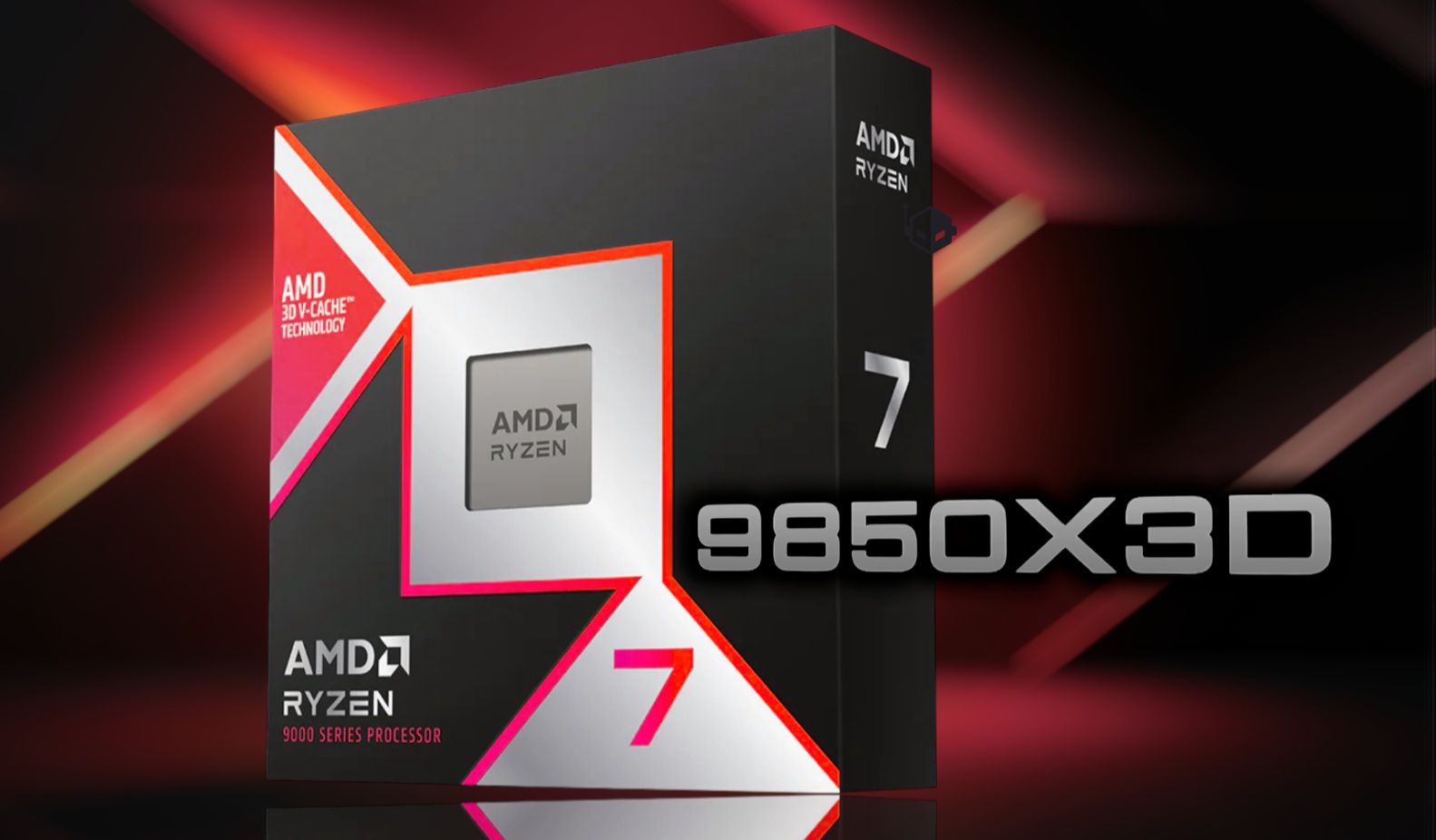
Early retail listings suggest AMD’s next X3D desktop chip, the Ryzen 7 9850X3D, is beginning to show up in distributor and store databases ahead of its expected debut at CES 2026. And while the numbers being shown today look surprisingly high, they’re far more likely to be placeholder pricing than the final MSRP.
Two separate retailer listings have put the Ryzen 7 9850X3D above the $500 mark. One US listing shows it at $553, while a Swiss listing places it at CHF 473.55 (roughly $549). Prices like these immediately stand out because the current Ryzen 7 9800X3D launched with a $479 MSRP, and historically, early listings often come in high before launch-day pricing settles. In other words, these figures should be treated as “not final” until AMD officially announces the chip and partners update their listings.
So what should buyers actually expect? Based on the positioning and the way AMD typically refreshes popular gaming CPUs, it’s reasonable to anticipate something closer to $500, or potentially even in the same neighborhood as the 9800X3D. That’s still speculation, but it lines up better with the market than $550+ being the long-term street price.
What makes the Ryzen 7 9850X3D interesting isn’t a dramatic spec overhaul—it’s a familiar recipe with a speed bump. The chip is essentially a refreshed take on the Ryzen 7 9800X3D, keeping the same 8-core, 16-thread configuration and the same 120W TDP. The big change is clock speed: the base clock remains 4.7 GHz, but the boost clock is listed at up to 5.6 GHz. That’s a 400 MHz boost increase over the 9800X3D’s 5.2 GHz, which could translate into measurable gains in certain workloads and lightly threaded scenarios, especially in games that respond well to higher peak clocks.
Cache—one of the biggest reasons X3D processors are so popular with PC gamers—appears unchanged. Listings point to 96 MB of L3 cache plus 8 MB of L2 cache, matching what the 9800X3D offers. One listing mentions “108 MB total cache,” but given the breakdown, that total looks like a simple typo rather than a meaningful spec difference.
Integrated graphics also looks the same: an RDNA 2-based iGPU with 2 GPU cores, which is useful for basic display output and troubleshooting, though most buyers pairing an X3D chip with a powerful gaming rig will still rely on a discrete graphics card. Memory support listed across the current Ryzen 9000 desktop family remains DDR5-5600.
Performance expectations should be kept realistic. Since core count, cache configuration, and power limits appear unchanged, the Ryzen 7 9850X3D likely won’t be a night-and-day leap over the 9800X3D. The uplift will probably come down to how consistently it can hit and hold those higher boost clocks—and whether AMD has made any behind-the-scenes tuning adjustments. Still, with X3D parts traditionally ranking among the best gaming CPUs available, even a modest improvement can be meaningful for competitive players and high-refresh-rate builds.
Alongside the 9850X3D, the broader Zen 5 Ryzen 9000X3D lineup is expected to include higher-end models such as the Ryzen 9 9950X3D2 and Ryzen 9 9950X3D, continuing AMD’s strategy of pairing high core counts with extra cache for both gaming and creator workloads. If the CES 2026 window holds, official specs, pricing, and performance benchmarks should arrive soon—at which point we’ll find out whether the early $500+ retailer listings were simply placeholders, or a sign of a higher-priced next-gen X3D tier.