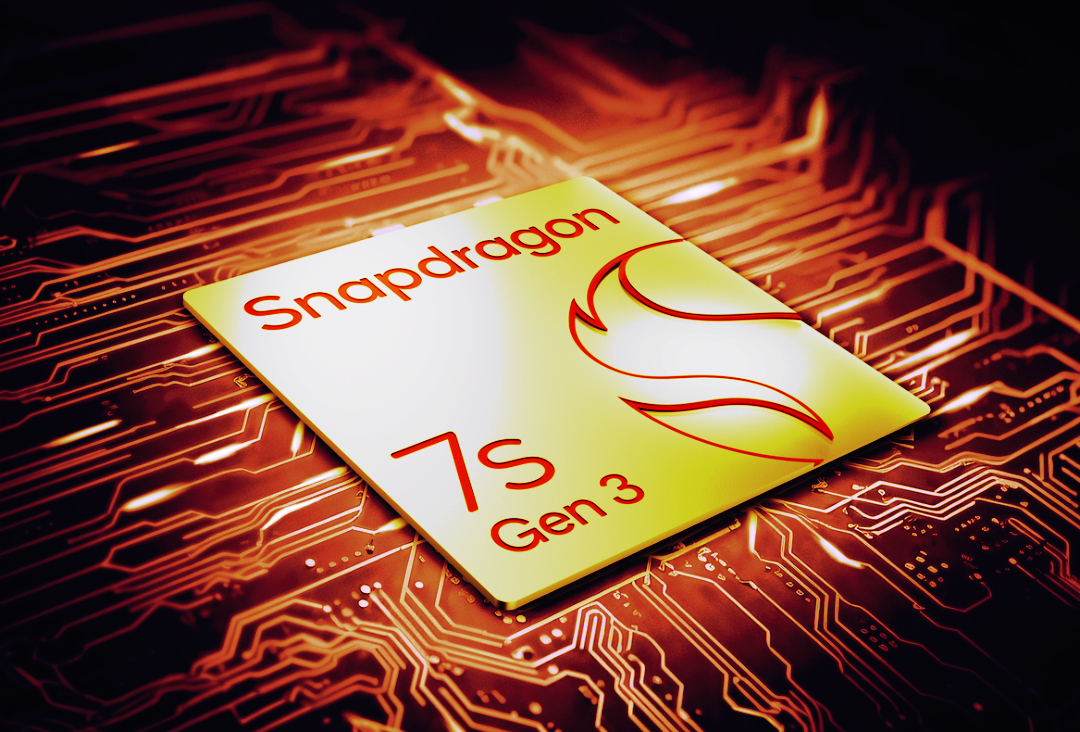
Qualcomm, a prominent player in the tech industry, has recently unveiled its latest offering for the mid-range market, the Snapdragon 7s Gen 3 chipset. This new addition enhances the Snapdragon 7 Gen 3 series, which already includes the Snapdragon 7 Gen 3 and the more robust Snapdragon 7 Plus Gen 3.
The Snapdragon 7s Gen 3 is designed to provide a cost-effective yet powerful solution for devices that don’t necessarily require the top-tier internals of the premium market. As such, this chipset will likely find its way into a range of mid-level smartphones, offering a balance of performance and affordability.
Building upon the technological achievements of its predecessors, the Snapdragon 7s Gen 3 is fabricated using TSMC’s N4P process node. This process node is known for its efficiency and performance enhancements, making it a solid choice for this new chipset. The CPU configuration includes one ARM Cortex-A720 prime core clocked at 2.5 GHz, three Cortex-A720 performance cores at 2.4 GHz, and four Cortex-A520 efficiency cores set at 1.8 GHz.
Performance improvements are significant with the new Snapdragon 7s Gen 3, boasting a 30% increase in CPU speed when compared to the Snapdragon 7s Gen 2. It also outpaces its predecessor with a 40% faster GPU and 30% better AI capabilities. In terms of power efficiency, the new chipset draws 12% less power, which can contribute to longer battery life in devices.
Connectivity is also a highlight for the Snapdragon 7s Gen 3, featuring the latest Bluetooth 5.4 standard and Wi-Fi 6E compatibility. The chipset’s triple 12-bit Spectra ISP supports advanced imaging capabilities. It also supports high-speed memory, with options for LPDDR5 RAM reaching 6,400 MT/s and 25.6 GB/s bandwidth or the more cost-efficient LPDDR4X ram peaking at 17 GB/s.
Several smartphone manufacturers are rumored or expected to integrate the Snapdragon 7s Gen 3 into their upcoming devices. Notably, Xiaomi is speculated to implement the chipset in their anticipated Redmi Note 14 Pro. Other companies, including Realme, Samsung, Sharp, and Xiaomi, have also been indicated by Qualcomm as potential adopters of the Snapdragon 7 series chipset in the near future.
As the smartphone market continues to evolve, the Snapdragon 7s Gen 3 is set to become a critical component for mid-range devices. With the right mix of power and efficiency, along with support for the latest connectivity and memory standards, it is positioned to be a popular choice for OEMs looking to deliver high-quality experiences without breaking the bank. Consumers can look forward to a new wave of affordable yet powerful devices that don’t compromise on performance or modern features.


