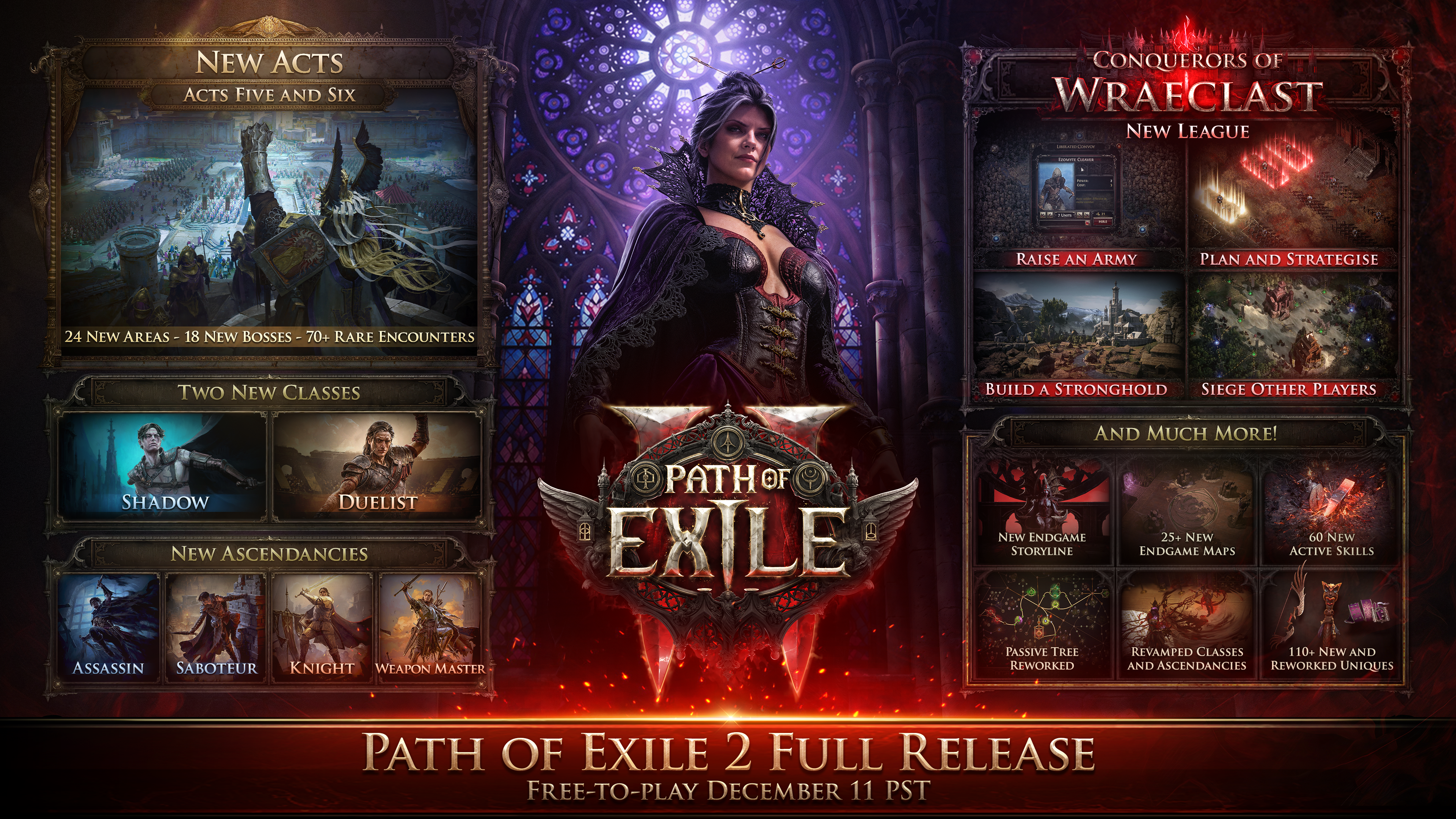
Path of Exile 2 is finally preparing for its full release, and Grinding Gear Games is making version 1.0 feel like a true relaunch. After nearly two years in Early Access, the action RPG will officially launch as a free-to-play game on December 11, 2026, bringing a huge wave of new content for both veterans and newcomers.
The full release update will complete the long-awaited campaign, add two new playable classes, overhaul major character and endgame systems, introduce new crafting features, improve performance, and launch a massive new Challenge League built around faction warfare, army management, and territorial conquest.
Grinding Gear Games has confirmed that Path of Exile 2 version 1.0 will include ten playable classes, 26 Ascendancy specialisations, more than 320 skills, over 400 Unique Items, and more than 150 endgame maps. For players who have been waiting for the game to feel complete before jumping in, this update is shaping up to be the moment they have been waiting for.
One of the biggest highlights is the completion of the main campaign. Path of Exile 2 entered Early Access in December 2024 with only three acts available. Since then, the game has expanded with Act 4 and several interludes designed to bridge the gap between the story and the endgame. With version 1.0, Acts 5 and 6 will finally arrive, allowing players to experience the full journey from start to finish.
The final chapters will add 24 new areas, 18 unique bosses, and more than 20 special Champion Rare encounters. These enemies are not just stronger versions of regular monsters. They feature unique visuals, mechanics, and abilities, making them feel closer to mini-boss fights than standard rare enemies.
Act 5 brings players back to Oriath, a familiar location from the original Path of Exile. This time, however, the once-powerful city has been left in ruins. The Twilight Order and the Beast now threaten what remains of Wraeclast, setting the stage for some of the most intense story content in the sequel so far. Act 6 is still being kept mostly secret, though it is expected to be shorter than the other acts.
Grinding Gear Games says the final two acts include some of the studio’s most ambitious environments and boss encounters to date. The campaign will also connect with the new Conquerors of Wraeclast league, weaving its large-scale conflict directly into the main story.
The release will also introduce two new playable classes, raising the total roster to ten. The first is the Shadow, a returning archetype built around daggers, traps, deception, and ambush tactics. Unlike traditional melee characters, the Shadow focuses on planning engagements, striking from concealment, and slipping away before enemies can respond.
The Shadow’s signature feature is a new Stealth mechanic. While hidden, nearby monsters cannot detect the player until they move close enough. Attacking from Stealth can enhance certain abilities, and killing an enemy instantly resets the mechanic’s cooldown. This allows skilled players to chain together deadly ambushes and maintain momentum through combat.
Traps are also a major part of the Shadow’s toolkit. While concealed, the class can place traps that do not activate right away. Once the Shadow breaks Stealth, the traps detonate in the order they were placed. There will be eight trap types, letting players combine effects such as poison, fire, freezing, and impale damage.
The Shadow can also summon Shades, shadowy copies that distract enemies and replicate attacks. A new resource called Darkness will empower certain abilities, while the Eclipse skill temporarily turns attacks into Stealth strikes. At launch, the class will include two Ascendancy specialisations: Assassin and Infiltrator.
The second new class is the Duelist, a fast and precise fighter who also introduces swords to Path of Exile 2. Swords have been notably absent during Early Access, making the Duelist’s arrival an important addition for players who prefer agile melee combat.
The Duelist is built around speed, precision, and weapon combinations. Its signature system allows players to switch between combat Stances, changing how sword skills behave in battle. This should give the class a flexible playstyle that rewards timing, positioning, and smart ability use.
One of the Duelist’s Ascendancy options is the Knight, which blends melee combat with battlefield support. The Knight can recruit a Squire, equip the companion with weapons and armor, and assign melee skills to it. For players who enjoy companion-based builds, this adds a new layer of customization to melee gameplay.
The Knight also gains access to War Banners that provide different bonuses inspired by Wraeclast’s ancient empires. Another standout ability is a mounted charge that lets the Knight ride through groups of enemies, scattering and stunning them. It appears to be a powerful but resource-heavy tool, likely best saved for key moments rather than constant use.
Beyond the new classes and campaign content, the most ambitious part of Path of Exile 2 version 1.0 may be the Conquerors of Wraeclast Challenge League. This league adds elements of army management, base building, siege warfare, and real-time strategy to the action RPG formula.
The league begins when players meet Varek, the leader of a mercenary group that has abandoned its former master. After rescuing his companions, players can begin recruiting soldiers and leading them into battle. Each unit type has its own strengths and weaknesses. Shield-bearing troops can endure ranged attacks, while other units are better suited to specific enemy types.
Before a battle begins, players can position their troops and plan their approach. However, the player character remains directly involved in the fight. The army system is designed to support the core Path of Exile 2 combat experience, not replace it.
During the campaign, Conquerors of Wraeclast will feature more than 70 league-related points of interest and 23 battles. Completing these encounters will reward players with resources, new recruits, and ways to strengthen their growing forces. In the endgame, the system becomes even deeper.
Players will be able to align with one of three factions: the Karui, the Ezomytes, or the Maraketh. Each faction has its own architecture, military units, and stronghold designs. Players can establish a castle, construct buildings, recruit stronger soldiers, and eventually deploy siege equipment against enemy fortifications.
The league will feature a wide range of military units, including war elephants, two-headed Chimaeras, and siege engines capable of smashing through castle walls. Commanders will also play an important role. Players can recruit up to three commanders and send them on independent missions across the Atlas, allowing them to explore areas and gather rewards over time.
The shared territorial conflict could become one of the most exciting endgame systems Path of Exile 2 has ever introduced. Grinding Gear Games says players will collectively fight for control of 100 castles scattered across the Atlas. This gives the league a larger sense of scale, as players are not just clearing maps for personal rewards but also contributing to a wider war across Wraeclast.
Path of Exile 2 version 1.0 is shaping up to be much more than a standard full release. With the complete campaign, two new classes, hundreds of skills and items, sweeping system updates, and a league that adds strategy and faction warfare to the familiar action RPG loop, the December 11 launch could mark a major turning point for the game.
For returning players, it offers a reason to rebuild, experiment, and dive back into Wraeclast. For new players, the free-to-play launch may be the best possible time to begin.Path of Exile 2 Version 1.0 is shaping up to be far more than a simple full-release milestone. Grinding Gear Games is preparing a major overhaul that touches nearly every part of the action RPG, including its new league, passive skill tree, endgame Atlas, Unique Items, Ascendancies, performance, and platform support.
The headline addition is a new league built around a large-scale faction conflict. Rather than turning Path of Exile 2 into a traditional PvP-focused RPG, the system adds a persistent competitive layer where players contribute to their chosen side and fight for control of key locations. Capturing and holding territory can provide meaningful bonuses, including improved item rarity, access to special hunting grounds, and other strategic advantages that can influence progression throughout the league.
This faction war is not just a gameplay system. It also comes with a darker storyline involving rival clans, forbidden rituals, and an ancient vampire lord whose followers are attempting to bring her back. As players push into enemy strongholds and claim territory, they will uncover more of the mystery behind the conflict and eventually face the power driving the war from the shadows.
One of the most requested quality-of-life features is finally arriving with Path of Exile 2 Version 1.0: death recap. After dying, players will be able to see a detailed breakdown of the damage that killed them, including how much damage they took and what type it was. For a game known for intense endgame encounters and sudden one-shot deaths, this should make build improvement and defensive planning much clearer.
Character progression is also receiving a major shake-up. More than 200 new equipment base types are being added, giving players far more options when crafting and upgrading gear. On top of that, over 40 brand-new Unique Items are being introduced, while more than 70 existing Uniques are being reworked with updated modifiers, new effects, and refreshed visuals.
These Unique Item changes could have a major impact on established builds. Players who rely on specific Uniques may need to revisit their setups once Version 1.0 launches, while others may discover entirely new build possibilities thanks to revised item effects and broader gear diversity.
The passive skill tree is another major focus of the update. Grinding Gear Games is adding hundreds of new stats and passive effects, expanding the number of mechanics players can build around. The tree is already one of Path of Exile 2’s defining features, and Version 1.0 aims to make it even deeper while reducing some of the repetitive pathing choices seen in earlier builds.
A key change involves Jewel Sockets. Previously, players often had to travel through similar routes just to reach efficient socket locations, which caused many endgame builds to look alike. In Version 1.0, Jewel Sockets are being moved into individual passive clusters. This means players will need to make more deliberate choices about which parts of the tree they invest in, instead of simply pathing toward the same high-value socket routes.
This adjustment should also increase the value of Time-Lost jewels, especially when placed in sockets that match the right stats and build requirements. For players who enjoy fine-tuning character power through jewels, this could become one of the most important progression changes in the full release.
Support Gems are being rebalanced as well. The goal is to make more support options useful across a wider range of builds, rather than leaving certain gems locked into narrow use cases. Elemental penetration supports are being consolidated, while other support gems are being redesigned or adjusted to make them more appealing for different playstyles. Recommended gem choices are also being improved, which should help newer players make stronger decisions without relying entirely on outside build guides.
Existing classes are getting new active skills. Molten Forge lets players summon a flaming anvil that empowers mace attacks, giving melee characters a dramatic new tool. Soul Extraction gives Chaos-focused builds a way to consume accumulated Decay for a powerful burst of damage. These additions should help open up new archetypes and strengthen underused mechanics.
Several Ascendancies are also being revamped. The Infernalist gains a demonic companion that can cast assigned spells and can command up to three Infernal Hounds. The Blood Mage is receiving new skills and curses, along with changes to the Corrupted Blood mechanic. The Acolyte of Chayula gains access to a companion capable of using Quarterstaff skills and can even transfer consciousness into a clone, creating new tactical possibilities.
The Mercenary is also being improved, especially when it comes to crossbow reloading. Bolts will now reload in the background, allowing players to fire one type, swap to another, and return to the original once it is ready. This should make crossbow gameplay feel smoother and more fluid, especially for builds that rotate between different ammunition types.
The endgame Atlas is getting one of the biggest redesigns in Path of Exile 2 Version 1.0. The Atlas Passive Tree is being condensed to around 70 more impactful nodes, replacing a larger number of smaller upgrades. Instead of spending points on minor bonuses that may not feel exciting, players should now have more meaningful decisions that shape their preferred endgame experience.
Atlas Passive Points will be earned by completing objectives, defeating bosses, and progressing through special maps. The intent is to give players more control over which activities they want to focus on, while making each point feel more valuable.
More than 25 additional maps are being added, pushing the total number of endgame maps beyond 150. The endgame structure is also becoming more convenient. Players will no longer need to manually path to every major mechanic such as Delirium, Breach, Abyss, Ritual, or Expedition. Instead, they can teleport directly to a hub and begin the content they want to run. The expanded endgame will also include new encounters and a new pinnacle boss.
Performance is another important part of the full release. Grinding Gear Games says Version 1.0 will bring CPU performance improvements of up to 25%, along with lower memory usage and smoother frame pacing. For a game that can become visually intense during late-game combat, these optimizations could make a noticeable difference.
Path of Exile 2 has also achieved Steam Deck Verified status, making it easier for handheld players to jump in without relying on unofficial workarounds. A native Mac version is planned for the full release as well, with support for newer Apple Silicon systems, including M2-series Macs and compatible M1 Pro devices.
Cooperative multiplayer will continue to support up to six players, giving groups the option to experience the campaign, league mechanics, and endgame together. With so many system changes coming in Version 1.0, party play balance and scaling will be worth watching closely after launch.
Grinding Gear Games is also running a pre-registration campaign with cosmetic rewards unlocked through community milestones. Players who already own Early Access will still need to register separately if they want to claim these rewards.
Path of Exile 2 officially leaves Early Access on December 11, 2026, Pacific Time. The exact launch hour has not been confirmed yet. New supporter packs will also be available for players who want additional cosmetics and extras.
With a new faction-based league, major class updates, a revamped passive tree, a redesigned Atlas, new skills, reworked Uniques, stronger performance, Steam Deck support, and a native Mac version, Path of Exile 2 Version 1.0 is positioned as a massive reset for the game. Whether you are a returning player, a build-crafting veteran, or someone waiting for the free-to-play full release, this update looks set to reshape the entire Path of Exile 2 experience.