Paper Boy S3 Turns an E Ink Touchscreen Into a Playable Game Boy-Style Handheld
E Ink screens are usually associated with e-readers, digital notebooks, and low-power displays, not handheld gaming. But the Paper Boy S3 project shows that electronic paper can do more than display books and notes. With clever software tricks and the right hardware, it can even run classic Game Boy games.
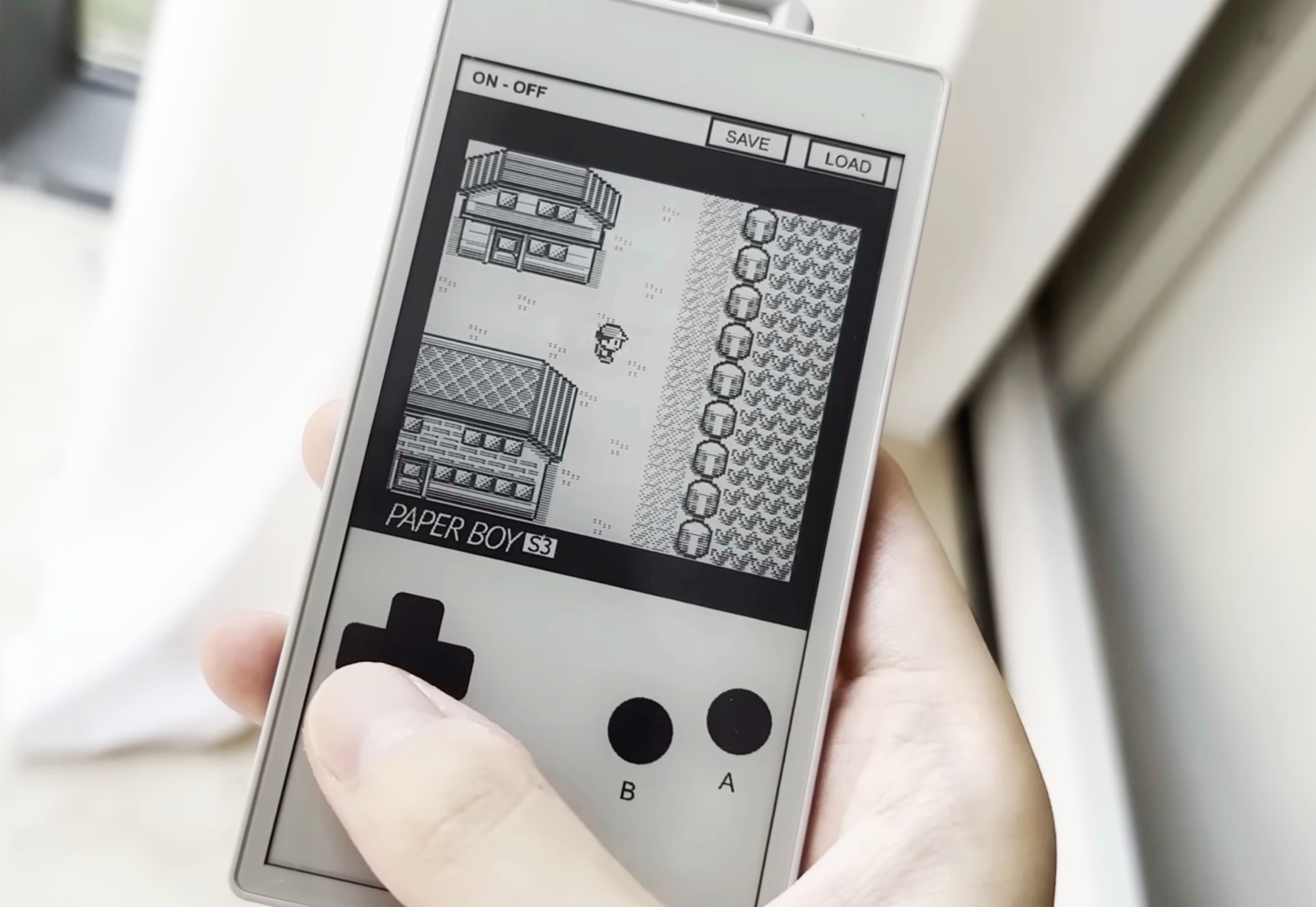
Created by developer Wenting Zhang, Paper Boy S3 imagines what a Nintendo Game Boy might look like if it used a modern E Ink touchscreen instead of a traditional LCD. The project is built around the M5Stack M5PaperS3, a developer kit featuring a 4.7-inch E Ink touchscreen with a 960 x 540 resolution and an ESP32-S3 microcontroller.
At first glance, E Ink may seem like an unusual choice for gaming. These displays are known for excellent readability, low power consumption, and paper-like contrast, but they typically struggle with fast motion. Full-screen refreshes are too slow for smooth gameplay, which makes videos and action-heavy games difficult.
Paper Boy S3 gets around that limitation by updating only the parts of the screen that change instead of refreshing the entire display. This partial refresh approach allows the E Ink panel to respond much faster than expected, making certain Game Boy titles surprisingly playable.
The system uses CrankBoy, an open-source Game Boy emulator originally designed for the Playdate handheld. Combined with the M5PaperS3 hardware, it creates a compact experimental gaming device that blends retro gaming nostalgia with an unconventional display technology.
Games with slower pacing work best on the Paper Boy S3. Puzzle and role-playing titles such as Tetris and Pokémon are especially well suited because they do not require rapid screen updates at every moment. Fast-paced action games may still expose the limitations of E Ink, but for many classic Game Boy experiences, the result is more functional than many would expect.
Controls are handled in an inventive way. The lower portion of the E Ink touchscreen displays virtual Game Boy-style buttons, allowing the device itself to act as both screen and controller. For players who prefer physical controls, Bluetooth gamepad support is also possible, although compatibility is currently limited.
Paper Boy S3 is not a commercial handheld and is not being sold as a finished product. Instead, it is a maker-focused modding project for people who already own, or plan to buy, the M5PaperS3 development kit. The required project files have been shared publicly, allowing enthusiasts to build their own E Ink Game Boy-style device.
The project is a fascinating example of how far E Ink technology has come. While it is still not ready to replace traditional gaming screens for every type of game, Paper Boy S3 proves that low-power electronic paper displays can be used for more than reading. For retro gaming fans, hardware tinkerers, and E Ink enthusiasts, it is an exciting glimpse at what experimental handheld gaming devices could become.