This could be the most powerful Chromebook yet, and it raises a fascinating question: what will ChromeOS actually do with all that muscle?
A new shipping log points to a 16-inch Chromebook prototype built on the Felino baseboard and paired with an Intel Panther Lake processor carrying stepping code Q7AP. The standout detail is the integrated graphics: 12 Xe3 GPU cores. That single spec all but confirms this isn’t a low-power PTL-U chip (those are expected to carry just 4 Xe3 cores), but a top-tier PTL-H configuration.
If accurate, we’re looking at a 16-core hybrid CPU made up of 4 performance cores, 8 efficient cores, and 4 low-power efficient cores, plus that 12-core Xe3 iGPU. In the world of Chromebooks, where even quad-core CPUs are usually more than enough for web-first workflows, this is a huge step up in raw compute and graphics capability. The Felino baseboard has been tied to a major Chromebook maker earlier this year, and the 16-inch footprint fits a premium, high-performance direction.
Why a Chromebook needs this much horsepower is the obvious question. ChromeOS has traditionally thrived on efficient, affordable hardware. Many popular models carry ultra-efficient Core i5 or i7 variants and lean heavily on web apps, Android apps, and Linux containers. More performance cores don’t typically translate to massive gains in everyday browsing and productivity, and they can drive up costs. But the landscape is changing, and a chip like PTL-H could unlock several new use cases:
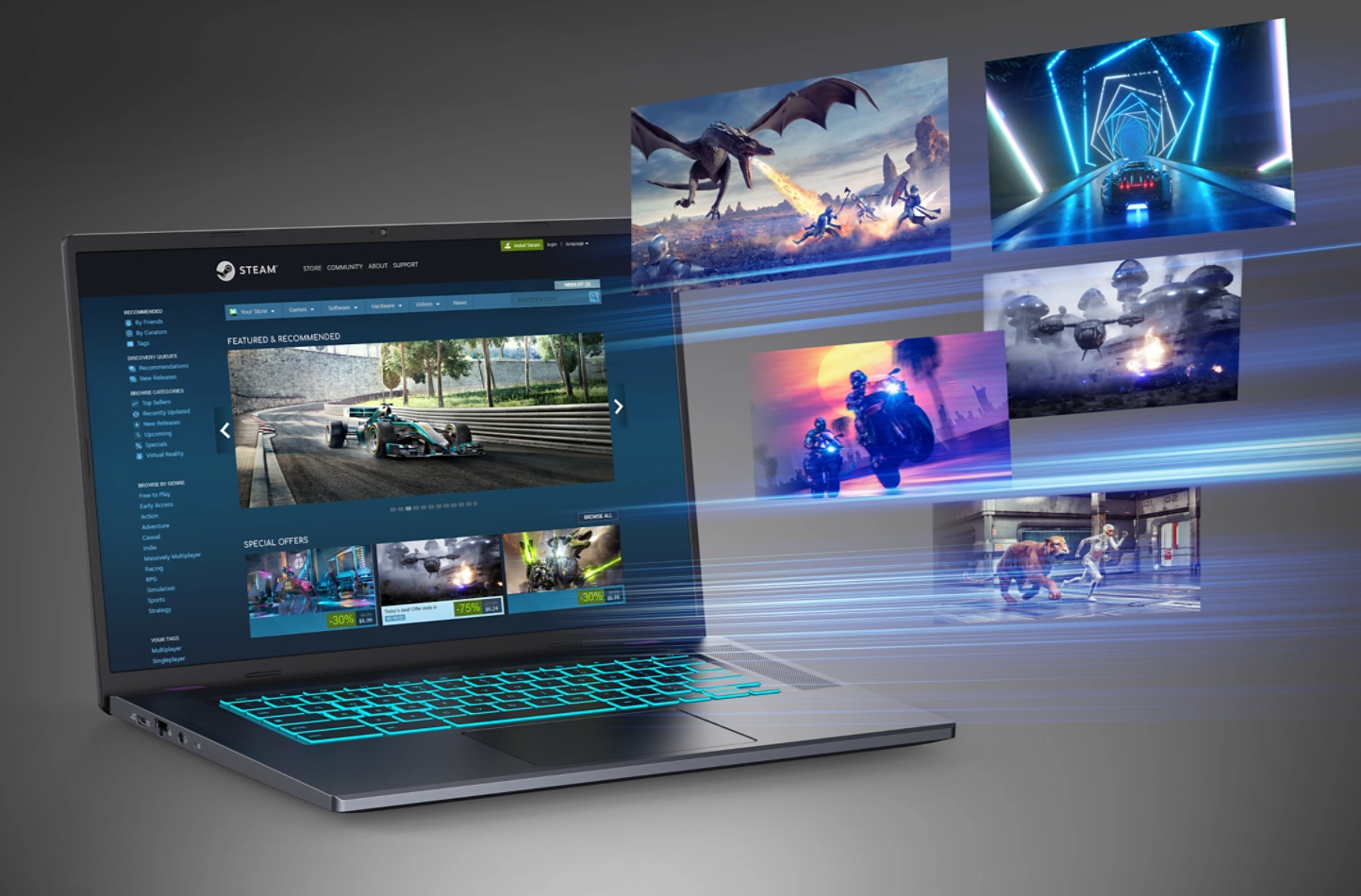
– Steam on ChromeOS and Android gaming could benefit from a 12-core Xe3 iGPU, especially at 1080p on a 16-inch display.
– Linux development and containerized workflows, including compiling large codebases, would finally have desktop-class headroom.
– AI-enhanced experiences and WebGPU-powered tasks could see measurable acceleration from both the CPU and iGPU.
– Heavier creative workloads in Android and web apps, like photo and video editing, would run more smoothly, especially with better hardware-accelerated encoding and effects.
– Multi-monitor setups and higher refresh rates would be easier to drive, potentially making this a viable creator or developer machine.
The 16-inch form factor is also notable. Bigger chassis usually means more thermal headroom and space for a larger battery, which could be essential for a PTL-H chip. It also signals an intent to compete directly with premium Windows and macOS laptops in screen real estate, performance, and overall capability.
There are caveats. ChromeOS needs software support to fully take advantage of 16 CPU cores and a robust iGPU. While the platform has matured rapidly—adding virtual desktops, better windowing, Linux support, and improvements to Android app integration—some specialized tools and games still run best on Windows or macOS. Battery life and thermals will also be critical; the efficiency that defines Chromebooks can be hard to maintain with higher-wattage silicon. And then there’s price: a PTL-H Chromebook would almost certainly sit at the top of the market.
Still, the benefits could be substantial for the right audience. Enterprises running Parallels on ChromeOS, developers using Linux containers, students in engineering and media programs, and enthusiasts who want a single machine for cloud work by day and casual gaming by night could all find real value here. With Panther Lake’s architecture and those 12 Xe3 GPU cores, this prototype Chromebook looks less like a typical classroom device and more like a full-fledged performance laptop that happens to run ChromeOS.
Details like RAM configurations, storage options, display specs, and battery capacity remain under wraps. The chip ID and GPU core count are the biggest clues we have, and they strongly suggest the top PTL-H SKU. If this model makes it to retail without being toned down, it could redefine what a premium Chromebook looks like in 2025—pushing ChromeOS into territory once reserved for high-end ultrabooks and creator laptops.
Watch for official confirmation of the Panther Lake variant, the final core layout, and whether the 12-core Xe3 iGPU sticks. If it does, the Chromebook category may be on the verge of its biggest performance leap yet.