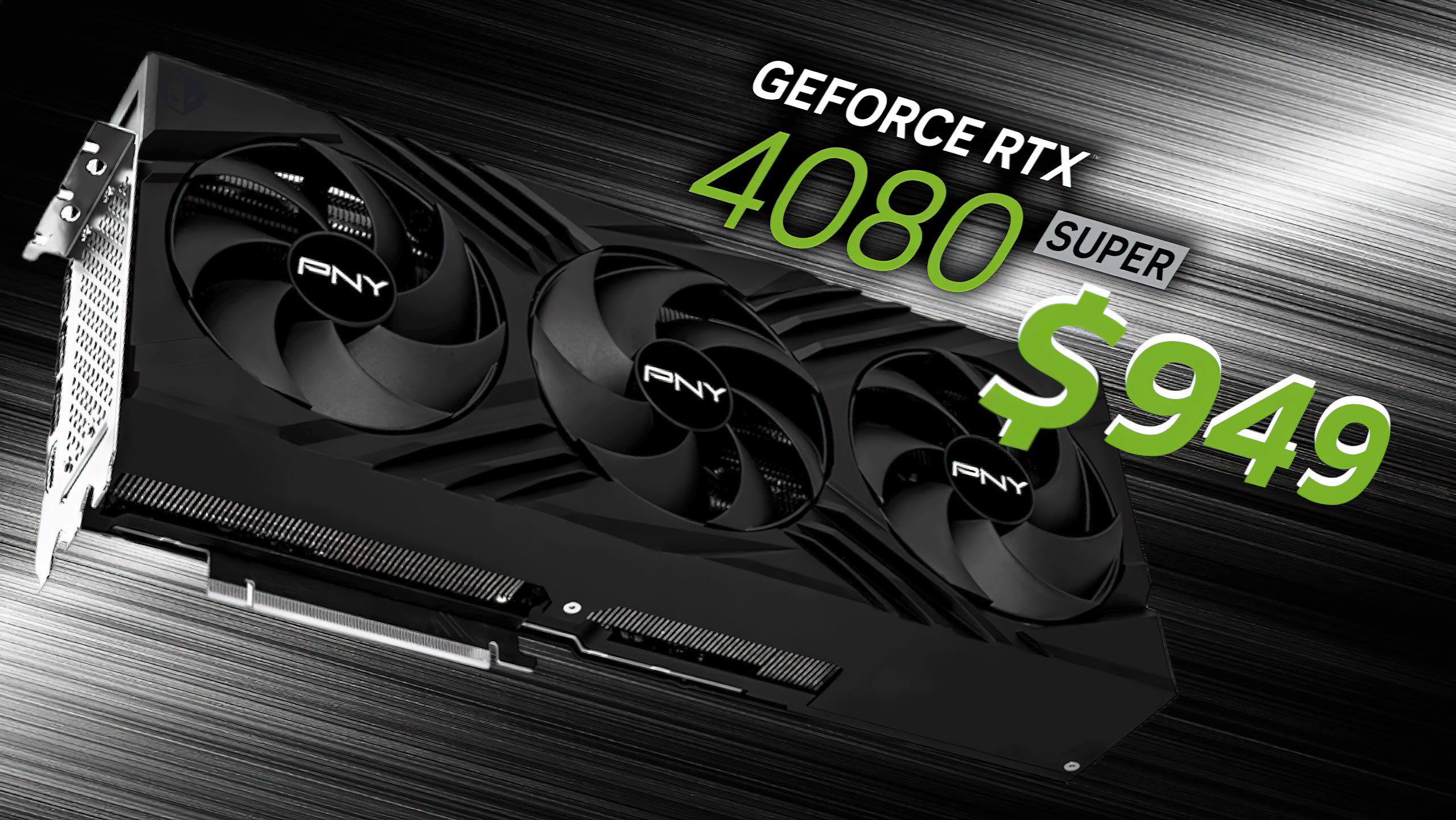
The NVIDIA GeForce RTX 4080 SUPER GPU has recently become available again at a competitive price of $949, which is a $50 reduction from its original manufacturer’s suggested retail price (MSRP). This price adjustment suggests that NVIDIA may be preparing for the launch of its RTX 50 series, causing speculation among consumers and tech enthusiasts alike.
Regarded as one of the fastest gaming graphics cards on the market, the RTX 4080 SUPER surpasses its non-SUPER version in all technical aspects. It is equipped with the full AD103-400 GPU, boasting 10,240 cores, 320 Texture Mapping Units (TMUs), 112 Raster Operations Pipelines (ROPs), and a substantial 64 MB of L2 cache. Additionally, this GPU impressively features a boost clock of up to 2550 MHz and comes with 16 GB of GDDR6X video memory running at 23 Gbps on a 256-bit bus, yielding a total bandwidth capacity of 736 GB/s. Despite having a total graphics power (TGP) of 320W, the card’s average consumption is generally efficient, commonly in the 250-300W range.
For those seeking performance improvements, the RTNX 4080 SUPER offers a modest enhancement of 3-5% over its non-SUPER counterpart. Notably, its initial launch price was also set $200 less than the non-SUPER model, compelling retailers and partners to reduce the price of the older variant. With the focus shifted towards the new SUPER models, production of the non-SUPER versions has been discontinued.
PNY has released some notable GeForce RTX 4080 SUPER models such as the XLR8 and Verto, which feature a powerful triple-fan cooling system. Despite its top-notch specifications, the card has witnessed periodic discounts, and now, shoppers can find it at an accessible price once more.
In terms of competition, the NVIDIA GeForce RTX 4080 SUPER goes head-to-head with the AMD Radeon RX 7900 XTX. Although the AMD option presents a strong set of features, such as FSR 3 (FidelityFX Super Resolution), Frame Generation, and formidable rasterization, NVIDIA’s advantage lies in its proprietary DLSS (Deep Learning Super Sampling), RT (Ray Tracing), and overall frame generation qualities. When it comes to selection, NVIDIA offers numerous designs, catering to a variety of preferences, and is also known for its energy efficiency.
AMD does maintain a price advantage, with their Radeon RX 7900 XTX models being available starting at $899 and having dipped to as low as $799 in the past. This price point challenges NVIDIA’s options, leaving it to the consumers to determine whether they prioritize the enhanced experience and features of the RTX 4080 SUPER or the value proposition of AMD’s offerings.
As competition in the graphics card market continues, interested buyers should carefully assess their needs against the pricing and features of both NVIDIA and AMD offerings to make the most informed decision for their gaming or professional requirements.