MSI Reveals Next-Gen GPU Cooling and Power Tech for Future NVIDIA RTX Graphics Cards
MSI is preparing a major upgrade for its future graphics cards, with new cooling, power delivery, and protection technologies designed for upcoming NVIDIA RTX GPUs. While gamers may not see a huge new GPU launch this year, MSI is already showing what its next wave of high-end graphics cards could bring to the table.
The company has introduced several new design ideas focused on keeping GPUs cooler, improving power safety, and increasing long-term reliability. These upgrades are expected to appear in future premium MSI graphics cards, including next-generation Gaming Trio and SUPRIM models.
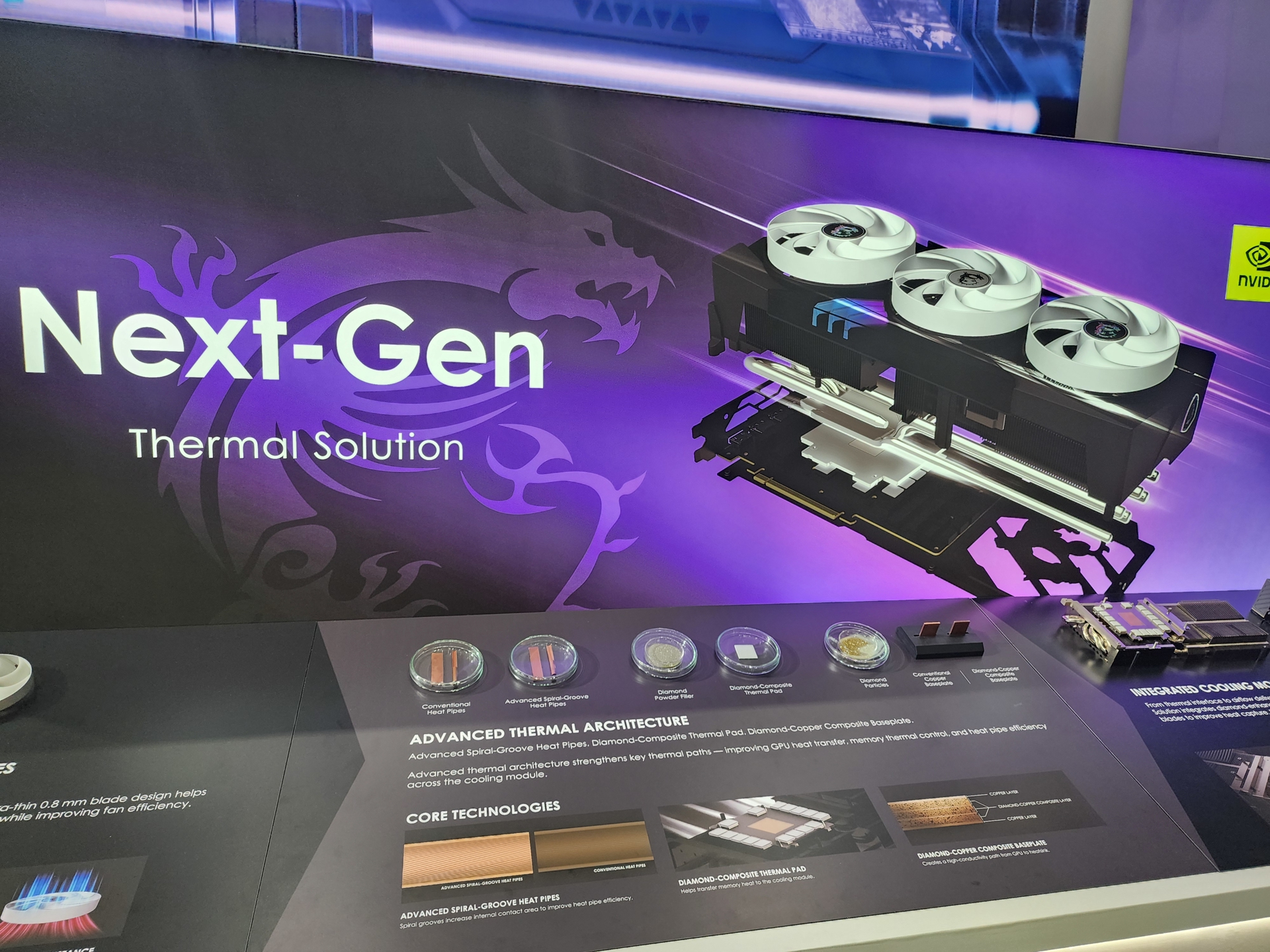
One of the biggest highlights is MSI’s new thermal design. The company is working on a more advanced cooling system that combines redesigned fans, improved heat pipes, upgraded thermal pads, and a new baseplate structure. Together, these changes are built to improve heat transfer from the GPU, memory, and PCB while allowing the graphics card to operate more efficiently under heavy gaming or workstation loads.
A key part of the new cooling system is MSI’s ultra-thin metal fan blade design. The fan still uses a 7-blade layout, but the blades are now made with a high-rigidity metal structure. According to MSI, this design can deliver up to 40% better airflow compared to its previous approach.
The blades are only 0.8 mm thick, allowing more open space for air to pass through. Because the metal structure is more resistant to bending at high speeds, the fan can maintain stable airflow even when spinning aggressively during demanding workloads. The thinner blade profile also helps reduce airflow resistance, which should improve cooling performance when the GPU is pushed to its limits.
MSI is also improving the heatsink with advanced spiral-groove heat pipes. These heat pipes are designed to increase the contact area, helping them move heat more efficiently than traditional heat pipe designs. Better heat pipe efficiency can make a noticeable difference in high-performance graphics cards, especially as modern GPUs continue to draw more power and generate more heat.
Memory cooling is getting attention as well. MSI is developing a diamond-composite thermal pad for graphics memory modules. This material is intended to improve heat dissipation from memory chips, which is important for maintaining stability during gaming, rendering, AI workloads, and overclocking.
Another major upgrade is the diamond-copper composite baseplate. This design uses a diamond-copper layer placed between two copper layers, creating a more effective thermal pathway from the GPU to the heatsink. Since the baseplate is one of the most important contact points in a graphics card cooler, improving its conductivity could help lower GPU temperatures and improve sustained performance.
MSI has already demonstrated these cooling technologies in a prototype next-generation Gaming Trio graphics card. The prototype was shown using an RTX 5090 32 GB GPU as the base platform, but the design is not expected to launch in that exact form. Instead, these innovations are being prepared for future NVIDIA RTX graphics cards.
Beyond cooling, MSI is also bringing new power safety features directly to its graphics cards. The company is integrating its Safeguard-style protection technology into high-end GPUs, moving the feature closer to the 16-pin power connector on the graphics card itself.
This is important because users would no longer need a specific compatible power supply to benefit from the protection system. By placing the monitoring and control features directly on the GPU, MSI can offer better hardware and software-based power management from the graphics card side.
MSI is currently validating this technology with more power supplies and may introduce it under a new name in future products. The goal is to give users extra protection and better control over power delivery, especially as flagship graphics cards continue to rely on high-power connectors.
The company is also introducing reusable server-grade fuses, known as eFuse, for future GPUs. These fuses are designed to help protect the graphics card from electrical damage. Unlike traditional fuses that may permanently fail after a fault, eFuse technology includes an internal reset mechanism.
MSI says these reusable fuses can respond to short circuits in around 200 nanoseconds. That extremely fast reaction time is intended to protect the GPU and its power circuitry before damage occurs. Since the fuses can be reset and reused, they could also improve the durability and service life of high-end graphics cards.
MSI has shown this protection system on an RTX 5090 SUPRIM prototype with Safeguard-style power features, but like the new cooling design, it is expected to appear in future graphics cards rather than current retail models.
Overall, MSI appears to be preparing a strong set of upgrades for its next generation of NVIDIA RTX graphics cards. The combination of ultra-thin metal fan blades, spiral-groove heat pipes, diamond-based thermal materials, improved power connector protection, and reusable eFuse technology points to a clear focus on cooler, safer, and more reliable GPU performance.
For gamers, creators, and PC enthusiasts, these changes could mean better thermal control, more stable boost clocks, improved protection against power-related issues, and longer-lasting graphics cards. While MSI has not yet confirmed exact launch dates or final product names, its latest showcase gives a strong preview of where premium GPU design is heading next.