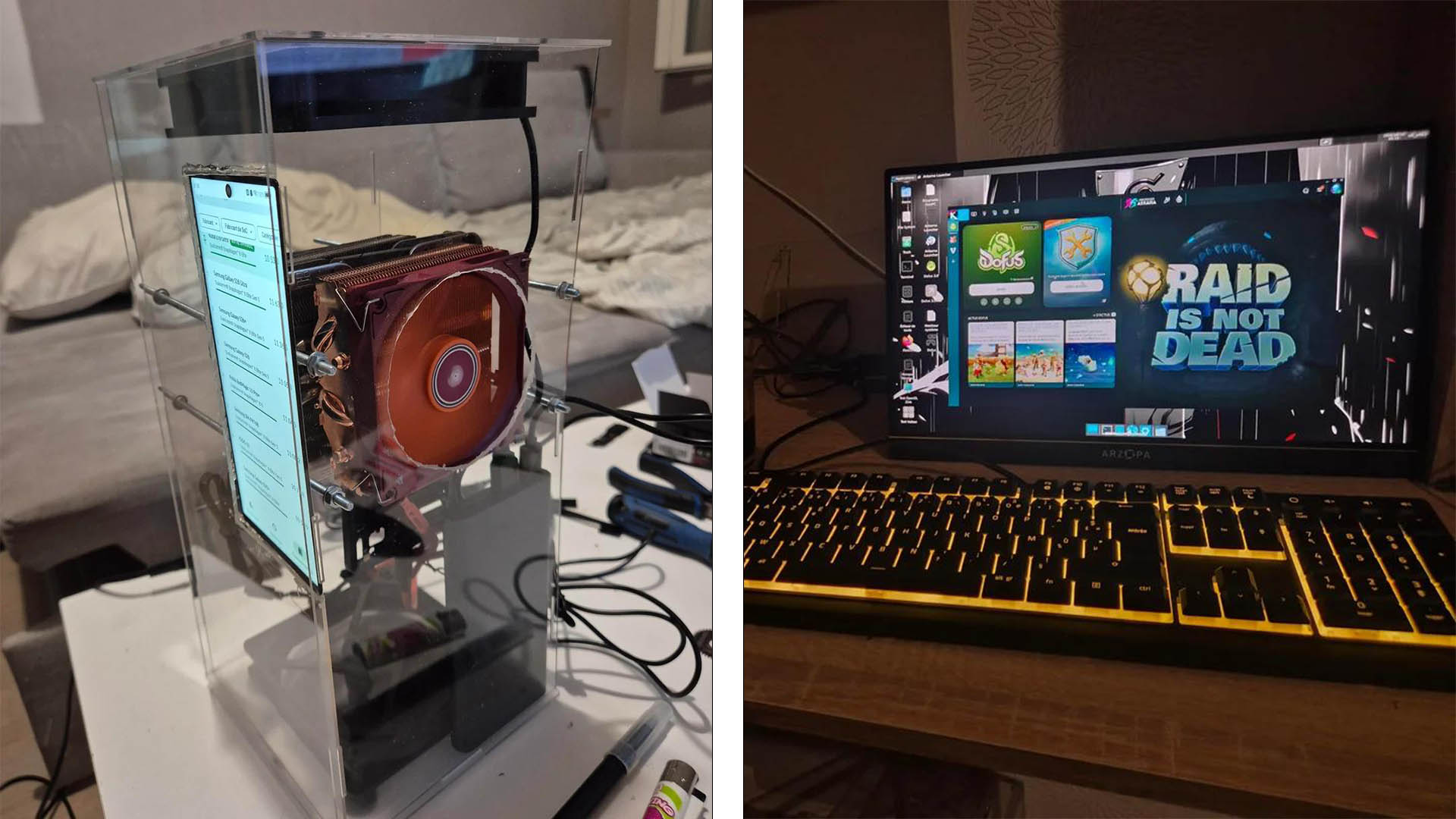
A modded ZTE Nubia Z70 Ultra has shown just how far modern Android phones can be pushed when powerful hardware is paired with serious cooling. Using two CPU coolers, a custom acrylic enclosure, and a power bank, one smartphone enthusiast transformed the flagship handset into a compact PC capable of running The Witcher 3 at 1080p resolution on Ultra settings.
The project highlights the growing potential of high-end Android devices as desktop-style machines. The Nubia Z70 Ultra is powered by Qualcomm’s Snapdragon 8 Elite, a powerful octa-core chipset with clock speeds reaching up to 4.32GHz. While it is not the newest chip in Qualcomm’s lineup, it still delivers enough CPU and GPU performance to handle demanding workloads when thermal limits are kept under control.
The modder, known on Reddit as “ntsow,” had previously demonstrated the same Nubia Z70 Ultra with a dual-cooler setup designed to improve sustained performance during heavy stress tests. Instead of focusing only on benchmark numbers, the next goal was more practical: finding out whether the phone could behave like a real PC when given enough cooling and the right software environment.
The answer appears to be yes.
With the phone installed inside a custom case, ntsow managed to run native Termux along with the XFCE4 Linux desktop environment directly on the Android device. This allowed the Nubia Z70 Ultra to operate much more like a traditional computer, especially when connected to an external monitor with keyboard and mouse support.
The most impressive part of the experiment came during gaming tests. With active cooling keeping the Snapdragon 8 Elite stable, and with 24GB of RAM available, the modified Nubia Z70 Ultra was able to run The Witcher 3 at 1080p using Ultra visual settings. Performance ranged between roughly 20 and 30 frames per second, while the Adreno GPU was reportedly running at around 99 percent utilization.
That may not match a dedicated gaming PC or modern console, but for a smartphone running a demanding PC game, the result is remarkable. It also shows how much performance is often hidden behind the thermal limits of slim mobile devices. When heat is properly managed, flagship Android phones can maintain higher speeds for longer periods and handle tasks that would normally seem unrealistic for a handset.
The setup also points toward a future where smartphones could serve as portable desktop replacements for certain users. With USB-C display output, external peripherals, Linux support, and enough processing power, a phone like the Nubia Z70 Ultra can become more than just a mobile device. It can function as a lightweight workstation, entertainment hub, or experimental gaming machine.
There are still limitations. The software experience is not yet as polished as a regular Windows or Linux PC, and running PC games on Android hardware requires technical knowledge and patience. Compatibility, performance tuning, power delivery, and cooling all remain important challenges. However, this project proves that the concept is not only possible but increasingly practical with today’s flagship mobile hardware.
The modified Nubia Z70 Ultra is a strong example of what can happen when enthusiast creativity meets powerful smartphone technology. With the Snapdragon 8 Elite, 24GB of RAM, external display support, and an aggressive cooling setup, this Android phone successfully crossed into PC territory and even managed to play The Witcher 3 at high settings.
As mobile processors continue to improve, experiments like this may become less of a novelty and more of a preview of what future smartphones could offer. For now, the Nubia Z70 Ultra mod stands as an impressive demonstration of Android performance, mobile gaming potential, and the surprising versatility of modern flagship phones.