MIT’s WorldParticle AI Could Transform How We Simulate the Physical World
MIT researchers have developed a new artificial intelligence system that could change the way scientists simulate real-world materials and physical behavior. The system, called WorldParticle, is designed to model how different materials move, bend, flow, collide, and interact without requiring a separate hand-built physics simulator for each one.
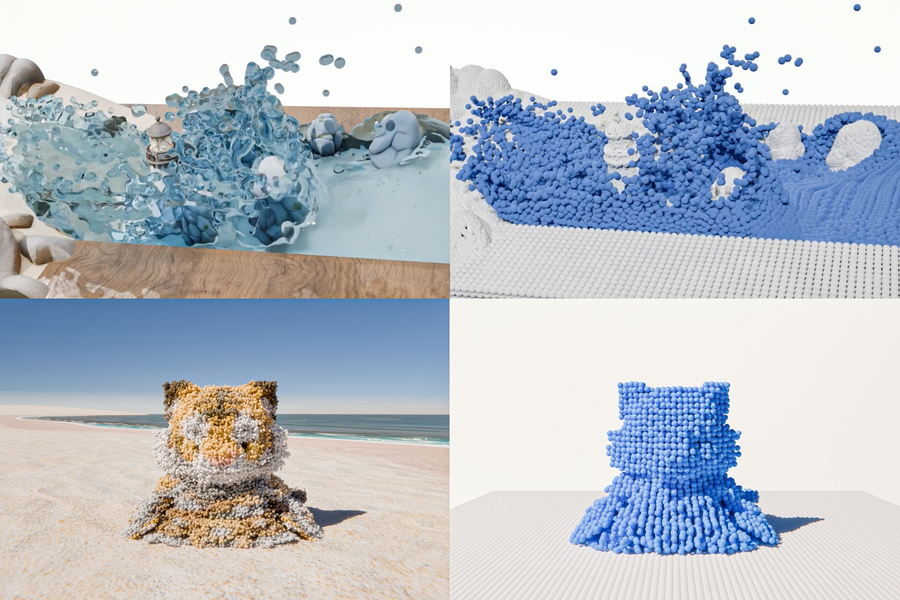
Traditional simulation methods often depend on custom equations and specialized coding for every type of material. Sand, water, rubber-like objects, and proteins all behave differently, so researchers typically need different models to predict their motion accurately. WorldParticle takes a more flexible approach by representing objects as collections of tiny three-dimensional particles.
Each particle carries key information, including its position in space, speed, physical properties, and how it interacts with nearby particles or outside forces. Instead of predicting words like a language model, WorldParticle predicts how each particle will move next. This allows the AI to simulate complex physical systems in a unified way.
The system has already shown the ability to simulate six types of physical phenomena. These include granular materials such as sand and soil, liquids, deformable solids like elastic objects, and proteins, where the model can track how molecular structures shift over time.
One of the most impressive early results involves protein motion. According to the research, WorldParticle was able to simulate protein movements roughly 100 times faster than conventional comparison methods. That speed could be especially valuable in fields such as biology, drug discovery, materials science, robotics, and engineering, where accurate simulations can save time and reduce the need for expensive physical testing.
The promise of WorldParticle lies in its general-purpose design. Rather than building a new simulator from scratch for every material, researchers may eventually use a single AI-powered system to study many different kinds of physical behavior. This could make advanced simulation tools more accessible and accelerate research across multiple scientific fields.
While the technology is still developing, WorldParticle represents an important step toward AI systems that can better understand and predict the physical world. If improved further, it could help scientists model everything from flowing liquids and shifting soil to flexible materials and biological molecules with greater speed and efficiency.