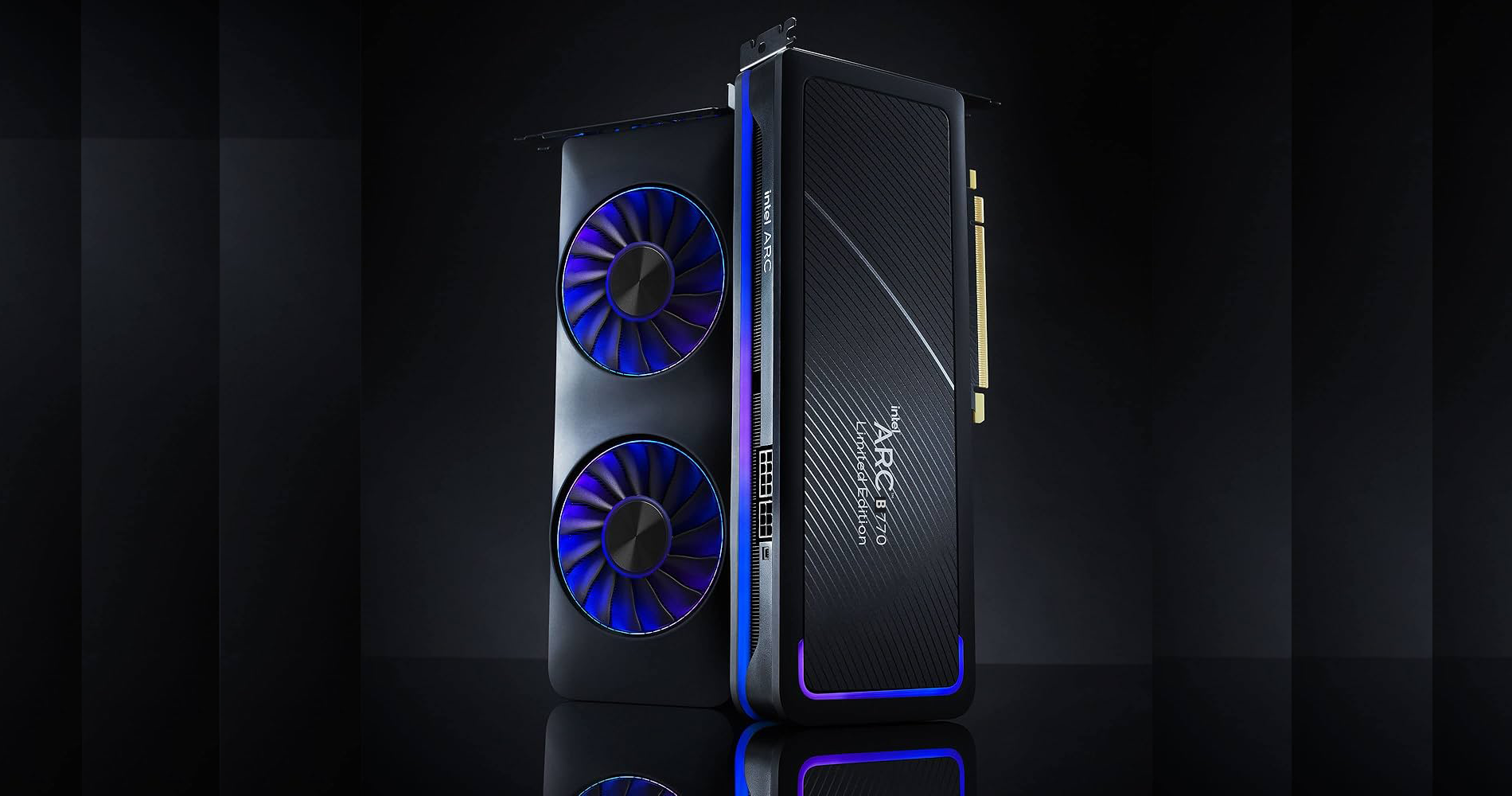
Intel’s next-gen Battlemage graphics card just popped up in a Linux boot log, and the details line up with what many have been expecting: a discrete GPU with 16 GB of VRAM, likely the flagship Arc B770. The entry shows the “BATTLEMAGE” PCI Device ID E221, one of the IDs previously associated with the BMG-G31 silicon, reinforcing the idea that this is the successor to the Arc A770 and a step up from today’s Arc B580.
A 16 GB frame buffer strongly points to a 256-bit memory bus, and the rumored configuration includes 32 Xe2 cores. For context, the current top Battlemage-based desktop card, the Arc B580, ships with 20 Xe2 cores and 12 GB of VRAM on a 192-bit bus. If the B770 lands with a wider bus, faster memory, and more compute, it should slot neatly into the sweet spot for 1440p gaming, with the bandwidth headroom to handle modern textures and heavier ray-tracing workloads at reasonable settings.
The naming isn’t official yet, but B770 makes sense as a follow-up to the A770 and a tier above the B580. Intel hasn’t shared a launch date, though the latest chatter suggests a debut before year’s end, with a strong possibility we’ll see Battlemage as one of Intel’s first discrete GPUs to appear in laptops as well as desktops.
For comparison, Arc B580 is based on BMG-G21 at 5 nm with 20 Xe2 cores (2560 shading units), 12 GB GDDR6 at 19 Gbps on a 192-bit bus for up to 456 GB/s, and a listed graphics clock around 2.67 GHz with a 190 W TGP. The older Arc A770 used ACM-G10 on 6 nm with 32 Xe cores, 16 GB GDDR6 at 17.5 Gbps on a 256-bit bus for up to 560 GB/s, around a 2.10 GHz graphics clock, and a 225 W TGP.
If these numbers hold, the Arc B770 could deliver a meaningful uplift over the B580, pairing a larger core count with a wider bus and higher memory bandwidth. That combination is exactly what helps stabilize performance at 1440p with high settings, especially in newer games that lean on VRAM capacity.
As always with pre-release hardware, details can shift before launch. But the Linux log sighting and matching device ID make a strong case that a 16 GB, 256-bit Battlemage card is getting close. Gamers eyeing a midrange upgrade for smooth 1440p play should keep this one on their radar.