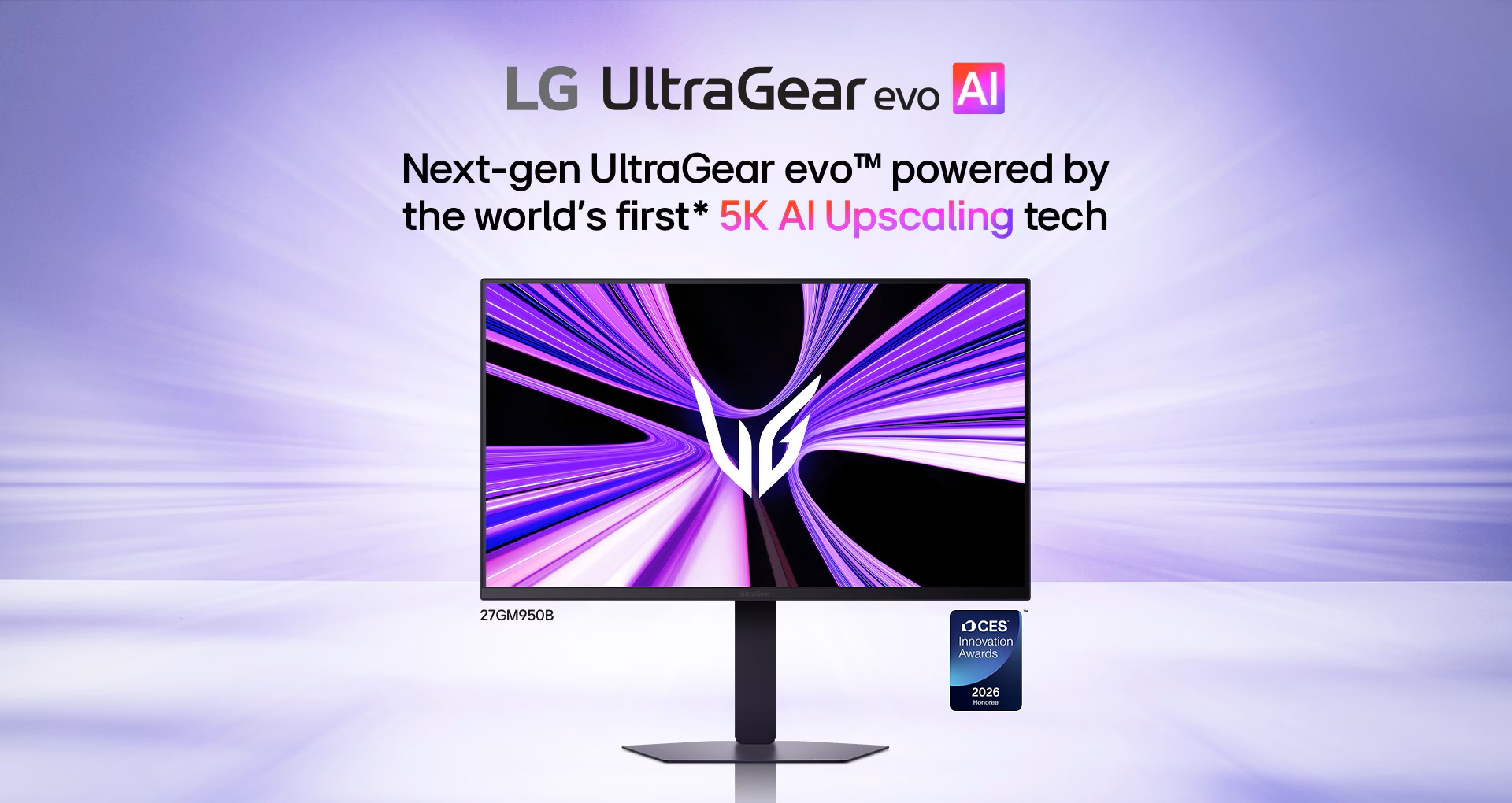
LG is getting serious about high-end PC gaming displays with its new UltraGear evo lineup, a fresh series aimed squarely at enthusiasts who want sharper visuals, faster refresh rates, and more immersive screen sizes. The company has now revealed full specs for five upcoming UltraGear evo gaming monitors, including massive ultrawides, cutting-edge OLED panels, and Mini LED backlighting with heavy local dimming. A common theme across the range is LG’s built-in AI-driven enhancements, designed to upscale content, optimize scenes, and even tune audio for a more polished experience.
The headline-grabber is the LG UltraGear evo 39GX950B, a 39-inch ultrawide OLED gaming monitor that pairs a crisp 5K2K resolution (5120×2160) with LG’s 4th-gen Primary RGB Tandem OLED technology. This panel design uses multiple OLED layers to help push brightness and visual clarity further, which is especially important for HDR gaming and high-contrast scenes. The 39GX950B also adds a deep-immersion 1500R curve and an ultra-fast 0.03ms GtG response time, making it a strong fit for fast-paced competitive titles and cinematic single-player games alike.
One of its most gamer-friendly tricks is Dual-Mode switching: you can run it at WUHD 5K2K 165Hz for maximum detail, or drop to WFHD for a blistering 330Hz refresh rate when you want motion clarity over resolution. On top of that, LG is bundling in 5K2K AI Upscaling, AI Scene Optimization, and AI Sound to help enhance content quality in real time. Connectivity is also modern and future-ready, with DisplayPort 2.1, two HDMI 2.1 ports, and USB-C with up to 90W Power Delivery for laptop-friendly setups.
If your priority is pixel density and HDR punch in a more traditional size, LG’s UltraGear evo 27GM950B brings a 27-inch 5K (5120×2880) Mini LED panel to the table. Mini LED is all about control, and this model leans hard into that with 2,304 local dimming zones plus “Zero Optical Distance” technology to reduce blooming and improve precision in bright highlights against dark scenes. Like the 39-inch OLED, it also features a Dual-Mode setup: 5K at 165Hz for sharpness, or QHD at 330Hz for high-refresh esports performance. It supports VESA DisplayHDR 1000 and covers 99% of the DCI-P3 color space (typical), while also offering DisplayPort 2.1, dual HDMI 2.1, and USB-C with 90W charging.
For gamers who want an ultra-cinematic desk setup (or a statement piece for a sim rig), LG is also launching the UltraGear evo 52G930B. LG calls it the world’s largest 52-inch 5K2K gaming monitor, featuring a 21:9 aspect ratio at 5120×2160. It runs at a fast 240Hz refresh rate with 1ms GtG response time, and it’s built for immersion with a dramatic 1000R curvature—much tighter than typical curved monitors, wrapping more of the image into your peripheral vision. HDR support comes in at VESA DisplayHDR 600 with 95% DCI-P3 (typical). Like the others, it includes DisplayPort 2.1, two HDMI 2.1 ports, and USB-C with 90W Power Delivery.
On the 4K OLED front, LG is introducing the UltraGear evo 32GX870B, a 32-inch UHD (3840×2160) OLED gaming monitor built around the same 4th-gen Primary RGB Tandem OLED approach. It’s positioned as the first 32-inch 4K OLED monitor in its class to feature LG’s AI upscaling suite, including 4K AI Upscaling, AI Scene Optimization, and AI Sound. It also supports Dual-Mode operation: 4K at 240Hz for sharpness and high-end smoothness, or Full HD at an eye-watering 480Hz for pure speed. Response time is rated at 0.03ms GtG, and it carries VESA DisplayHDR True Black 500 plus a wide 99.5% DCI-P3 color gamut (typical). For connectivity, expect DisplayPort 2.1, dual HDMI 2.1, and USB-C with 90W Power Delivery.
Finally, the model most likely to catch the attention of competitive players is the UltraGear evo 27GX790B. LG frames it as a more mainstream option, but the specs are anything but timid. It’s a 27-inch QHD (2560×1440) OLED display using the 4th-gen RGB Tandem OLED tech, and it targets extreme refresh-rate gaming with Dual-Mode switching that hits 540Hz at QHD. For those who want the highest possible refresh rate regardless of resolution, it can also reach 720Hz at 720p (HD). Response time is rated at 0.02ms GtG, and it includes VESA ClearMR 21000, plus VESA DisplayHDR True Black 500 and 99.5% DCI-P3 color coverage (typical). Connectivity includes DisplayPort 2.1, two HDMI 2.1 ports, and USB-C.
LG plans to showcase these UltraGear evo monitors at CES, where pricing and release timing may also be revealed. With 5K and 5K2K options, next-gen DisplayPort 2.1 connectivity, OLED and Mini LED choices, and refresh rates that stretch from 165Hz all the way up to 720Hz in Dual-Mode configurations, the UltraGear evo lineup is shaping up to be one of the most ambitious gaming monitor pushes LG has made in years.