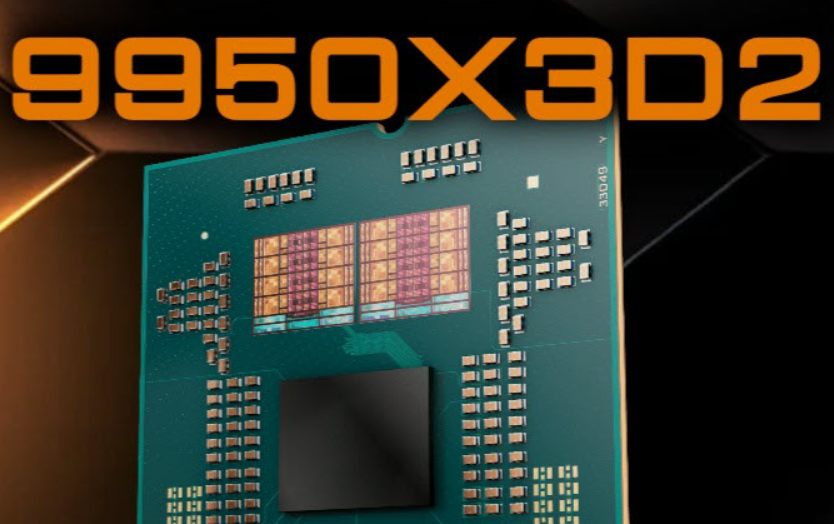
Early benchmark entries are stirring fresh excitement around AMD’s next potential gaming powerhouse: the Ryzen 9 9950X3D2. While the listing should be treated cautiously—public benchmark databases can be manipulated—the details match what many enthusiasts have been expecting from a Ryzen 9000X3D refresh: more 3D V-Cache, slightly adjusted clocks, and flagship positioning for Zen 5 on the AM5 platform.
A refreshed Ryzen 9000X3D lineup has been widely anticipated, and one chip in particular has already been easy to track: the Ryzen 7 9850X3D has shown up in multiple places and has effectively moved out of “mystery” territory. The Ryzen 9 9950X3D2, however, hasn’t appeared in retail listings yet, leaving its launch timing uncertain even as the rumored specifications start to look more consistent.
What makes the Ryzen 9 9950X3D2 stand out is cache—lots of it. The leaked information points to a 16-core, 32-thread Zen 5 processor designed to sit at the very top of AMD’s mainstream desktop stack. The headline feature is an eye-catching 192 MB total cache configuration enabled by dual 3D V-Cache chiplets (dual X3D CCDs). If accurate, that would make it the highest cache amount ever seen on a mainstream desktop CPU, aimed squarely at games and cache-sensitive workloads that benefit from keeping more data close to the cores.
Here are the key rumored specs that appear in the leaked listings:
– 16 Zen 5 cores / 32 threads
– Up to 192 MB cache (reported as dual 3D V-Cache dies)
– 4.30 GHz base clock
– Up to 5.6 GHz boost clock
– Up to 200W TDP
Compared with the existing Ryzen 9 9950X3D, the proposed 9950X3D2 looks like a “more cache, slightly less boost” approach. The current 9950X3D is known for pairing one cache-stacked CCD with a standard CCD, reaching 128 MB of L3 cache overall. The newer part is said to add another 64 MB of 3D V-Cache on the second die as well, lifting the total to 192 MB. The tradeoff appears to be a small 100 MHz reduction in peak boost (5.6 GHz vs. 5.7 GHz on the 9950X3D and 9950X).
So what about performance? The early synthetic results suggest the 9950X3D2 lands in the same general range as the Ryzen 9 9950X3D for single-threaded and multi-threaded compute. That’s not surprising: synthetic CPU tests tend to reflect core count and clock behavior more than they reflect the gaming advantages of massive L3 cache. With similar core specs and a slightly lower top boost clock, you wouldn’t expect a dramatic leap in everyday app benchmarks.
Where the extra cache could matter most is gaming performance—especially in titles that scale well with large L3 cache pools. In those scenarios, the benefit isn’t just a small bump; it can translate into smoother frame pacing or higher minimum FPS when the CPU is the limiting factor. Some productivity workloads may also benefit from additional cache, but in many non-cache-sensitive tasks, performance could end up very close to the 9950X3D.
A separate benchmark entry also aligns with the idea of 192 MB cache, reportedly shown as “96 MB x 2,” which fits the dual-die cache concept. That test platform reportedly used a B850 motherboard and 96 GB of DDR5-4800 memory. Since Ryzen 9000 chips often perform best with faster, well-tuned DDR5 (many builders aim higher than DDR5-4800), the numbers seen there may not reflect the CPU’s best-case performance.
As for when this Ryzen 9000X3D refresh might arrive, expectations point toward an announcement window around CES, which has historically been a major stage for CPU reveals and platform updates. Until AMD confirms the product and pricing, it’s best to view the Ryzen 9 9950X3D2 as a strong rumor backed by plausible details and early—but unverified—benchmark sightings.
If the 192 MB cache configuration turns out to be real, the Ryzen 9 9950X3D2 could become one of the most interesting Zen 5 desktop CPUs for high-end gaming builds and enthusiasts chasing top-tier performance on AM5—especially for workloads that can actually exploit that much on-chip cache.