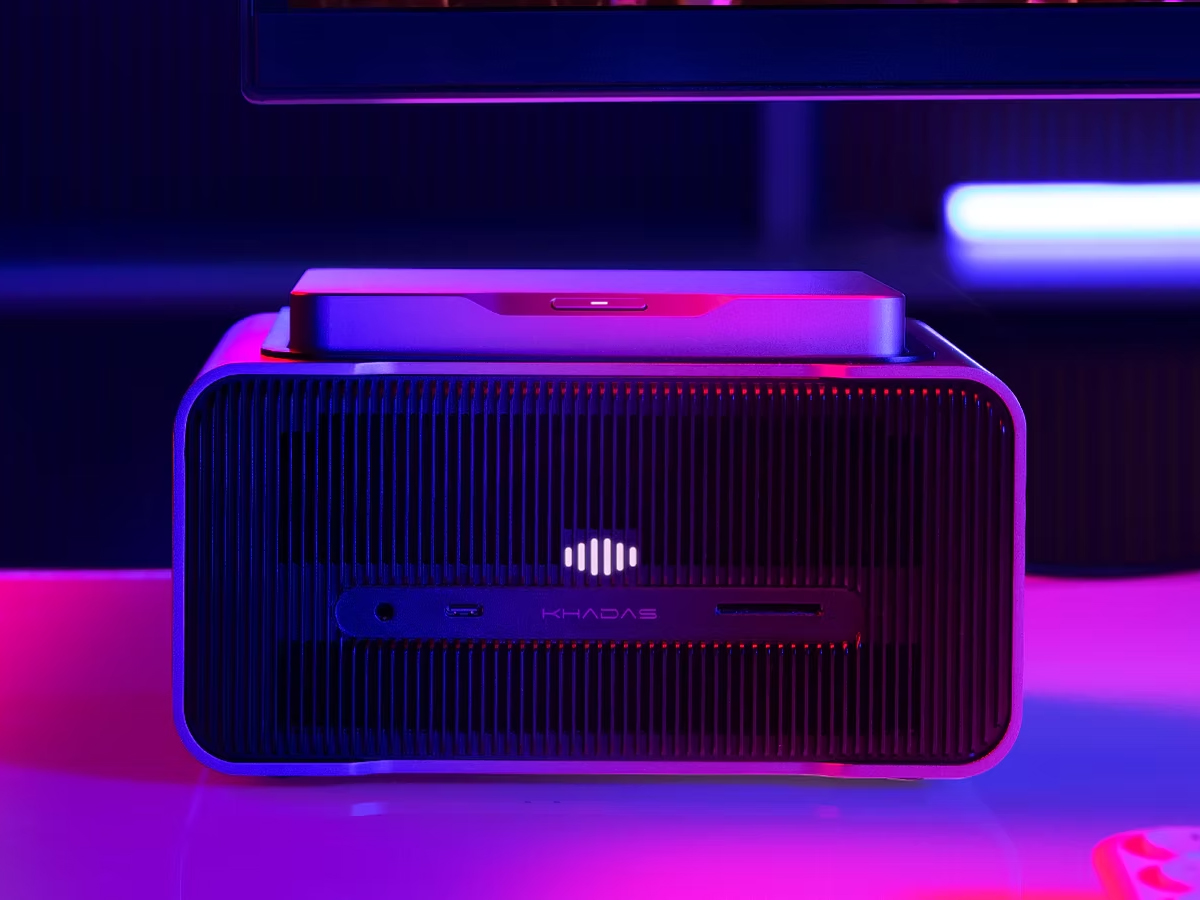
Khadas is expanding its compact PC ecosystem in a big way for 2026. Alongside the newly refreshed Mind Pro mini PC powered by Intel’s Panther Lake platform, the company has unveiled Mind Graphics 2, a new external GPU (eGPU) built around a desktop-class NVIDIA GeForce RTX 5060 Ti with 16GB of VRAM.
What makes Mind Graphics 2 stand out in the crowded eGPU space isn’t just the GPU inside—it’s the connection method. When paired with supported systems in the Khadas Mind lineup, Mind Graphics 2 uses a proprietary interface called Mind Link that targets native-like PCIe 4.0 x8 performance. In practical terms, PCIe 4.0 x8 can deliver up to around 31.51GBps of bidirectional bandwidth (252.08Gbps). That’s dramatically higher than what most mainstream eGPU solutions can push through common external connections. Even newer high-speed external standards typically top out around 80Gbps, so the Mind Link approach is designed to reduce the bandwidth bottlenecks that often keep eGPUs from performing like an internal desktop GPU.
There is an important catch: Mind Link is not a universal standard. You won’t find it on typical mini PCs, gaming laptops, or handheld gaming PCs outside the Khadas Mind family. If your setup doesn’t include Mind Link support, Mind Graphics 2 can still connect over USB4—but that comes with the familiar USB4 limitation of 40Gbps, which is a much narrower lane for a desktop GPU.
The good news is that USB4 makes the Mind Graphics 2 compatible with a wider range of devices, including many mini PCs and gaming handhelds that support USB4. The trade-off is value and performance. If you’re not using Mind Link, other eGPU approaches that prioritize higher bandwidth connections may be more compelling—especially if you’re trying to squeeze the most gaming or creator performance out of an RTX 5060 Ti-class GPU.
Price is another key consideration. Mind Graphics 2 is positioned as a premium expansion module rather than a budget-friendly way to add graphics power. Khadas lists it at $1,349, which is far above the going rate of a standalone desktop RTX 5060 Ti 16GB. That premium may be easier to justify for Mind ecosystem owners, because the Mind Link bandwidth can help the GPU perform closer to how it would inside a desktop tower, while also offering a hub-like expansion experience.
And expansion is a major part of the Mind Graphics 2 pitch. Beyond acting as an external GPU enclosure, it functions like a connectivity dock with a generous selection of ports for multi-display setups, peripherals, and networking. Ports and connectivity include:
1x 10Gbps USB Type-C
2x 10Gbps USB 3.2 Gen2 Type-A
2x HDMI 2.1b
1x DisplayPort 2.1b
1x 2.5Gbps Ethernet
1x SD 4.0 card slot
1x 3.5mm audio jack
Plus USB4 for broad device compatibility
In short, Khadas Mind Graphics 2 is aimed at users who want desktop-level NVIDIA RTX 5060 Ti 16GB graphics in a more modular mini PC setup—especially those invested in the Khadas Mind platform who can take advantage of Mind Link’s higher-speed, PCIe-style connection. For everyone else, the USB4 mode keeps it usable, but the performance and price equation becomes harder to justify compared to other external GPU routes.