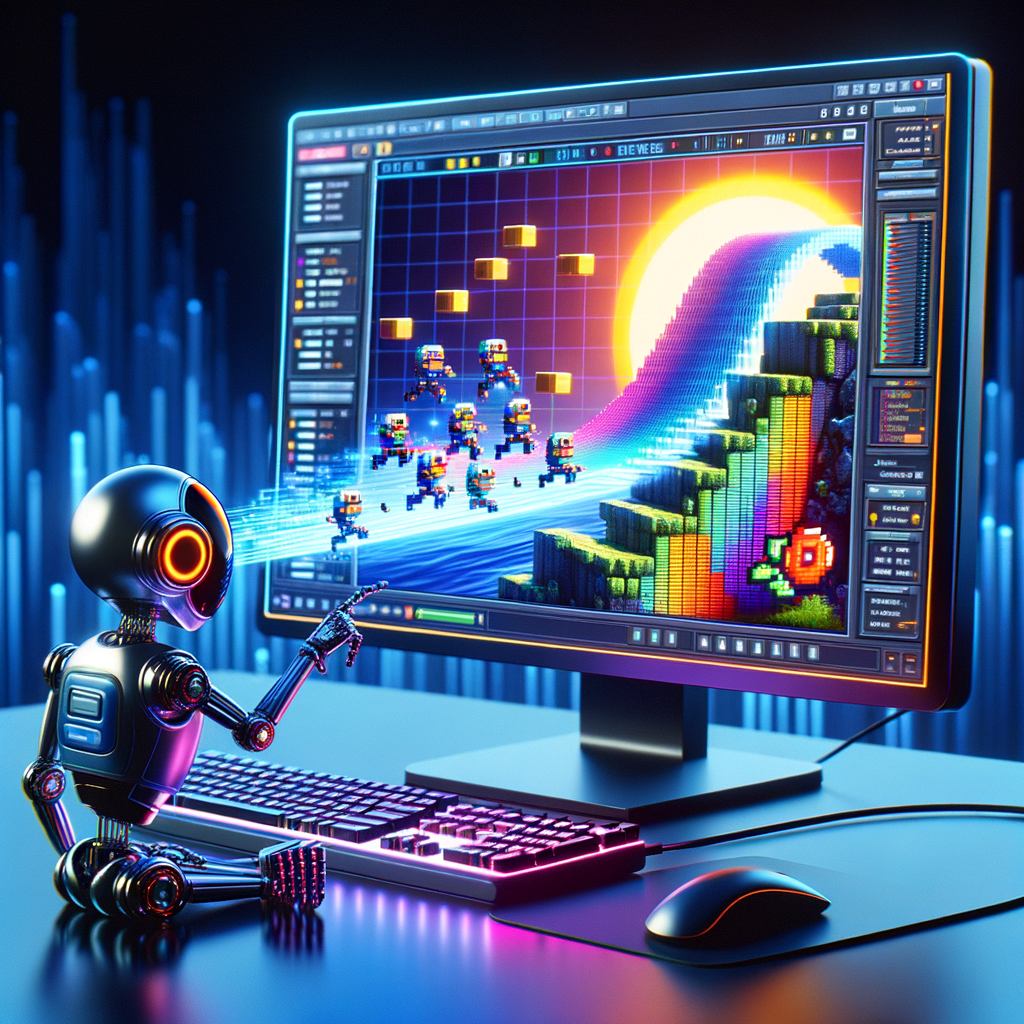
Google DeepMind has introduced an innovative AI called Genie that is capable of crafting playable mini-game scenes by simply analyzing an example image of a game. This advancement paves the way for individuals to create custom games without the prerequisite of coding skills.
Genie has been meticulously trained on 2D platformer games by studying an extensive library of gameplay footage amounting to 30,000 hours. This training process involves the AI interpreting the video images and in-game actions as numerical data, replicating the way humans would describe a game scene with words.
Once Genie has completed its training with just one example of a game scene, it can independently generate a playable version of that scene. It utilizes advanced image generation techniques to fill in any missing parts of the scene, enabling it to dynamically craft new areas of the game world in response to the player’s movement. The AI accomplishes this by recalling the millions of clips it has observed, allowing the game character to perform actions such as running or jumping.
A notable attribute of Genie is its ability to learn in-game actions by observing gameplay rather than relying on human instructions. For instance, when the AI encounters a bridge with a gap in a game, it understands from its training that the character will need to jump, and it executes this action when prompted by the player’s input.
The computational power required for training Genie is quite significant as it needs thousands of teraflops over several weeks, using machines equipped with hundreds of processors. Even during actual gameplay, the current computing capabilities restrict the AI to operate at the rate of one frame per second.
For those with an interest in the technical intricacies, Google’s Genie uses various state-of-the-art methods such as van den Oord’s VQ-VAE for tokenizing video frames and actions, Chang’s MaskGIT transformer, Gupta’s MaskViT, and Xu’s ST-transformers for incorporating temporal attention to refine predictions and diminish memory usage.
In conclusion, although we are not yet at the stage where computers can autonomously generate full 2D platformer games, advancements like Genie are promising glimpses into a future of enhanced interactive gaming experiences. Meanwhile, players can continue to enjoy traditional platformers on their favorite handheld game consoles.