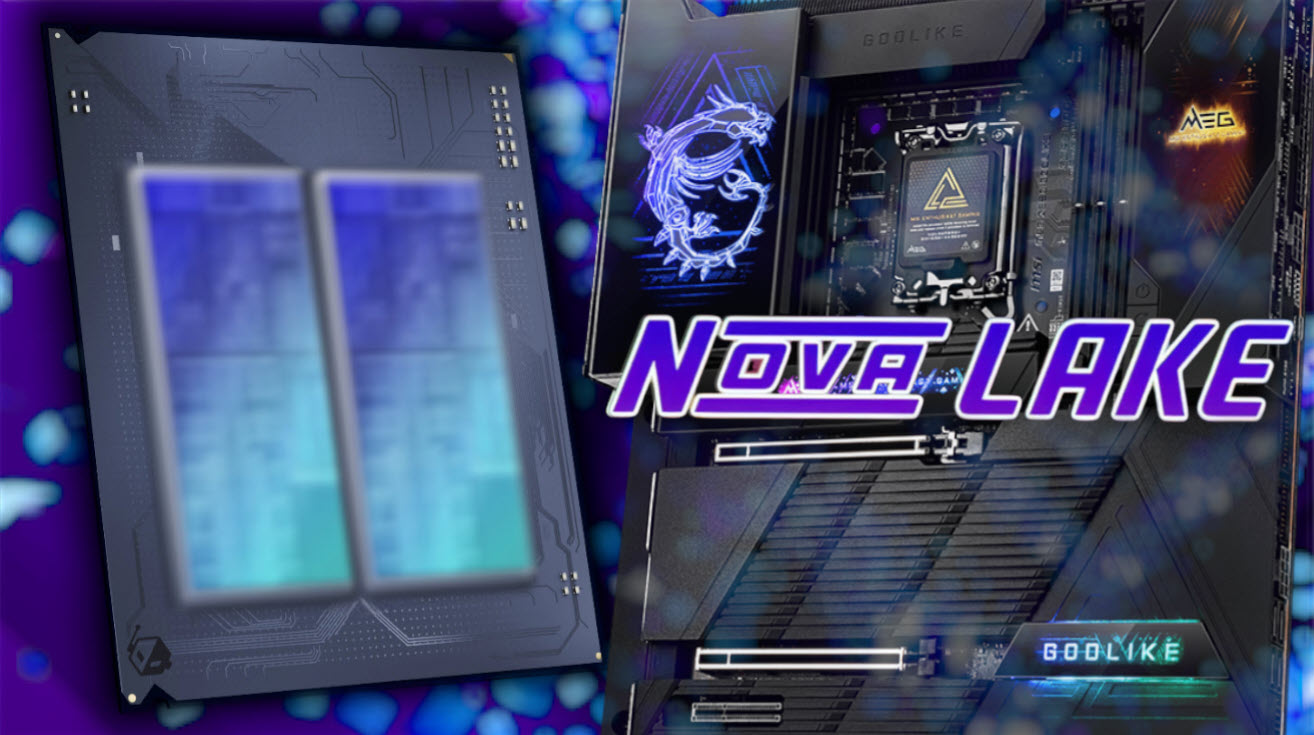
Fresh details about Intel’s upcoming Nova Lake-S desktop CPUs suggest that not every motherboard in the 900-series lineup will be able to unleash their full potential. If you’re eyeing the rumored top-end 52-core Nova Lake-S chip for a high-performance gaming PC, content creation rig, or overclocking build, your motherboard choice may matter more than ever.
According to new platform chatter shared by well-known hardware leaker Jaykihn, only a select group of premium 900-series motherboards will support the “full-power” 52-core Nova Lake-S platform. In practical terms, that implies certain flagship boards, likely in the Z990-class tier, will be designed with the electrical delivery and cooling overhead necessary to run these CPUs without heavy platform-imposed limits. Other 900-series boards may boot and support the processor, but could restrict its power and performance to stay within their design capabilities.
Why would that happen? Because Nova Lake-S at the top end is expected to be an extreme desktop design. The leading chips are rumored to use a dual compute tile configuration, with each compute tile carrying 8 performance cores (P-cores) and 16 efficiency cores (E-cores). On top of that, the package is said to include an additional 4 low-power efficiency cores (LP-E cores). In total, that points to a maximum configuration of 52 cores.
Power draw is the other big headline. Early reports indicate that with power limits removed, a 52-core Nova Lake-S CPU could push beyond 700 watts, which is far beyond what mainstream motherboards are typically built to handle comfortably over long periods. Even if real-world default settings land lower, the very existence of “unlocked” behavior at that level would explain why only the most robust 900-series boards may be cleared for full-power operation.
This sets the stage for a new wave of ultra-premium Intel 900-series motherboards from leading board partners. Expect heavy-duty VRM designs, more substantial VRM heatsinks, and likely higher pricing aimed at enthusiasts who chase maximum boost behavior, sustained all-core workloads, and overclocking headroom. If the leak is accurate, buyers who choose more affordable 900-series boards could still run the 52-core CPU, but may see reduced peak performance or lower sustained clocks under heavy load due to enforced power limits.
There’s also a notable architectural detail floating around: Nova Lake-S reportedly will not include Intel AMX (Advanced Matrix Extensions). For some specialized AI or matrix-heavy workloads, that could matter, but for many desktop users the bigger story will likely be core count, platform features, and power behavior.
On the packaging side, the 52-core Nova Lake-S chips are rumored to use a 5-tile layout: two compute tiles, plus separate tiles for the integrated graphics, the SoC portion, and a platform controller die. Despite the more complex multi-tile approach, the processor is still expected to use the LGA 1954 socket, paired with Intel’s 900-series motherboards.
If these specs hold, Nova Lake-S represents a major jump over Intel’s Arrow Lake-S in raw core count. The comparison being discussed includes a rise from a 24-core maximum on Arrow Lake-S to as many as 52 cores on Nova Lake-S, along with increases to platform connectivity such as more PCIe 5.0 lanes and faster DDR5 memory support. Power targets also scale sharply, with Nova Lake-S rumored to range around 125–175W for PL1 depending on SKU, but with extreme headroom that could climb dramatically when limits are removed.
Intel’s Nova Lake-S CPUs and 900-series motherboards are currently expected to arrive in the second half of 2026, setting up a high-stakes showdown in the enthusiast desktop market against AMD’s next-generation Zen 6-based Ryzen lineup. If you’re planning a future-proof upgrade, the early takeaway is clear: with a 52-core desktop CPU on the horizon, the “right” 900-series motherboard may be the difference between simply running the chip and truly getting everything it can deliver.