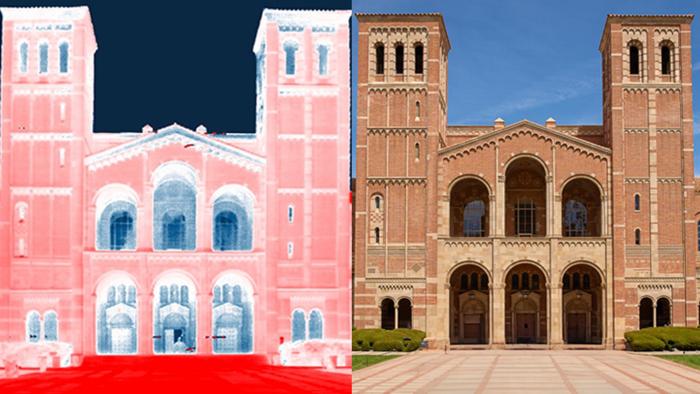
The quest for sustainable and energy-efficient temperature regulation in buildings has taken a leap forward with an innovative passive cooling technology developed by researchers at UCLA. The technology focuses on redefining how buildings manage radiant heat transfer, which could significantly lower the dependence on traditional air conditioning systems—a welcome development as AC costs soar amid growing concerns over energy consumption and climate change.
Radiant heat transfer involves electromagnetic waves that greatly influence a building’s indoor temperature. Unlike previous research that targeted reflections from rooftop surfaces, this new approach dives into the dynamic of heat exchange at the ground level between buildings and their surroundings. By analyzing how radiant heat travels between buildings and the vast expanse of the sky, the UCLA team has found a way to refine temperature control strategies.
The core of this technology lies in specialized coatings developed by the research group. These unique materials are applied to building surfaces such as walls and windows, crafted to selectively absorb and radiate heat within a certain wavelength band. Dubbed the “atmospheric window,” this range has been identified as a critical channel for heat transfer. When these coatings are in place, they help cool buildings when it’s hot outside and keep them warm when the temperature drops, aiding energy conservation.
The material choice for these coatings is no less smart. Polypropylene, widely used in consumer packaging, offers an affordable and versatile base material. This ensures the technology can be scaled up and potentially implemented across a broad spectrum of buildings without incurring excessive costs.
While the complete replacement of air conditioning units is still not on the horizon, this new advancement promises significant energy savings, particularly in areas subject to extreme weather conditions. With a clear majority of US households reliant on air conditioning to combat heat, a more energy-efficient alternative has the potential to markedly reduce energy consumption and thereby, carbon footprints.
The beauty of this project lies not only in its functionality but also in its source of inspiration. Drawing from the color schemes of cities like Santorini in Greece and Jodhpur in India, the researchers recognize that managing cooling is a nuanced endeavor—more challenging than directing sunlight away from rooftops. What we’re seeing here is the convergence of historical wisdom with modern science to offer solutions that could redefine our interaction with our environments.
The implications for modern housing are significant. As new building technologies emerge, such as 3D-printed houses becoming commercially viable, integrating passive cooling systems early in the design process could set a new standard for the housing industry. It’s a promising frontier for real estate, opening pathways for more sustainable living guided by innovative science.
With ongoing efforts to verify the effectiveness of this passive cooling approach in larger buildings and the broader context of real-world applications, the focus is now on Southern California. Researchers hope to demonstrate tangible energy savings that could soon ripple out to transform how buildings across the globe handle their heating and cooling needs.
As studies and implementation progress, this new technique could signal a move towards greener, more self-regulating architecture, harmonizing the need for comfort with environmental stewardship. In the meantime, the potential for energy-efficiency strides is poised to make this technique an important topic among builders, architects, and property owners alike.


