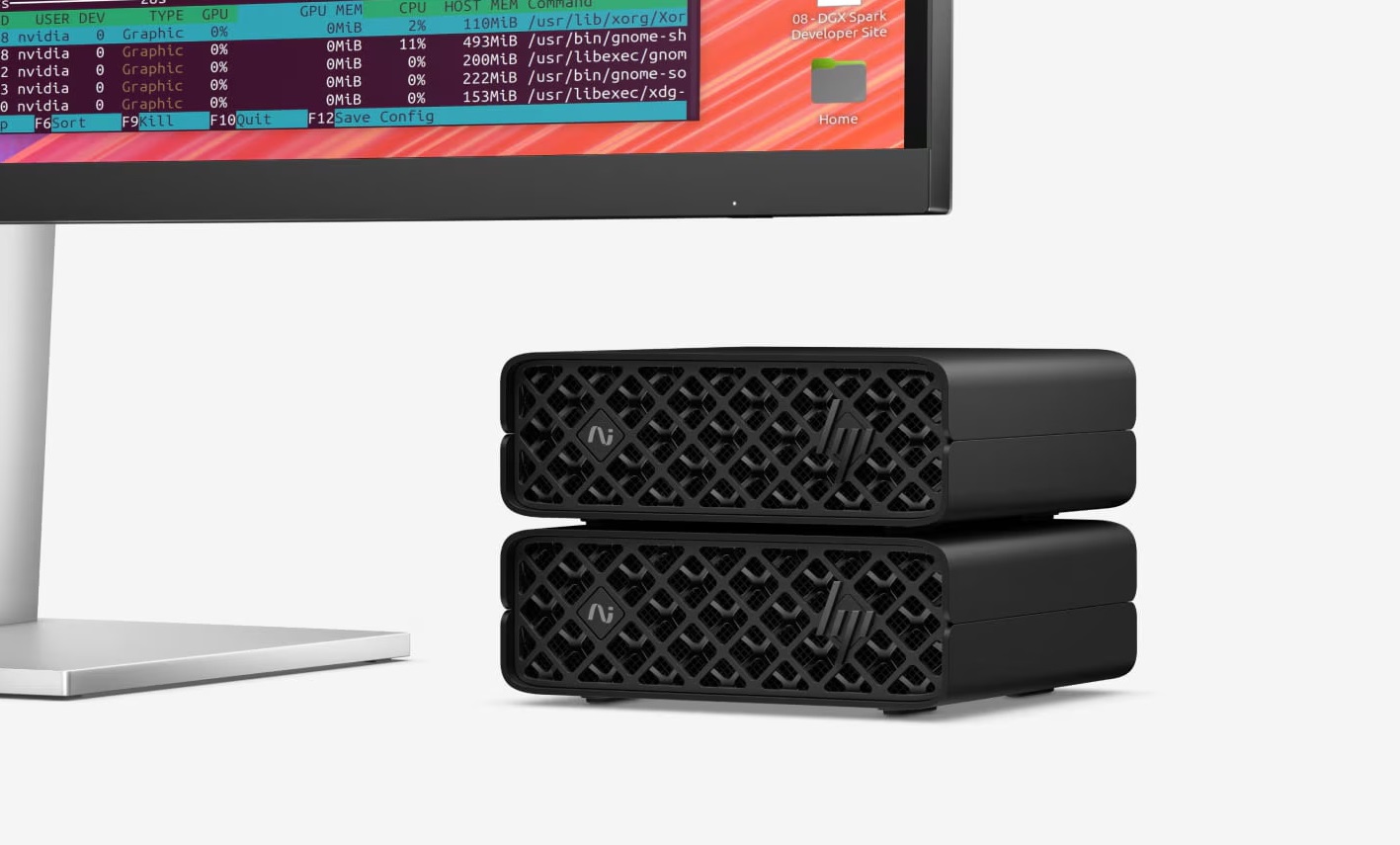
HP has unveiled a remarkably small yet powerful AI workstation, the ZGX Nano G1n, built around NVIDIA’s Blackwell architecture-based GB10 superchip. Designed for developers, creators, and AI teams who want serious performance in a tiny footprint, this compact system measures just 150 x 150 x 51 mm while packing the kind of compute you’d expect from much larger workstations.
At the heart of the ZGX Nano G1n is the GB10, a unified superchip pairing a 20-core NVIDIA Grace CPU with a Blackwell-based GPU over NVLink-C2C for ultra-fast chip-to-chip communication. The GPU brings 6144 CUDA cores and 5th-gen Tensor Cores, enabling up to 1000 TOPS of AI performance for accelerated training, fine-tuning, and high-throughput inference. Power efficiency is a headline feature, making it a strong fit for edge AI, on-prem labs, and space-constrained studios.
A standout spec is the unified 128 GB of LPDDR5X memory shared by the CPU and GPU. This design helps eliminate traditional CPU-GPU memory bottlenecks, improving throughput and latency for large models and complex pipelines. For teams that need more horsepower, the ZGX Nano G1n supports scalable clustering: two units can be linked via a 200 Gbps QSFP/ConnectX-7 interconnect, effectively doubling performance and opening the door to bigger models and heavier multi-user workloads.
To speed up deployment and development, HP bundles the ZGX Toolkit and support for NVIDIA’s AI Stack (DGX OS), providing a familiar software environment for data science, MLOps, and generative AI workflows.
Modern connectivity rounds out the package. The ZGX Nano G1n includes:
– USB-C ports rated at 20 Gbps for high-speed peripherals and external storage
– 10 Gb Ethernet for low-latency, wired networking
– Wi-Fi 7 for fast wireless connectivity
– Bluetooth 5.4 for accessories and device pairing
– A single HDMI display output (version not specified)
From computer vision at the edge to LLM prototyping, media and VFX acceleration, robotics, and CAD visualization, the ZGX Nano G1n targets users who need serious AI compute without dedicating a full rack or tower. HP plans to launch the system this autumn, with exact availability details to follow.


