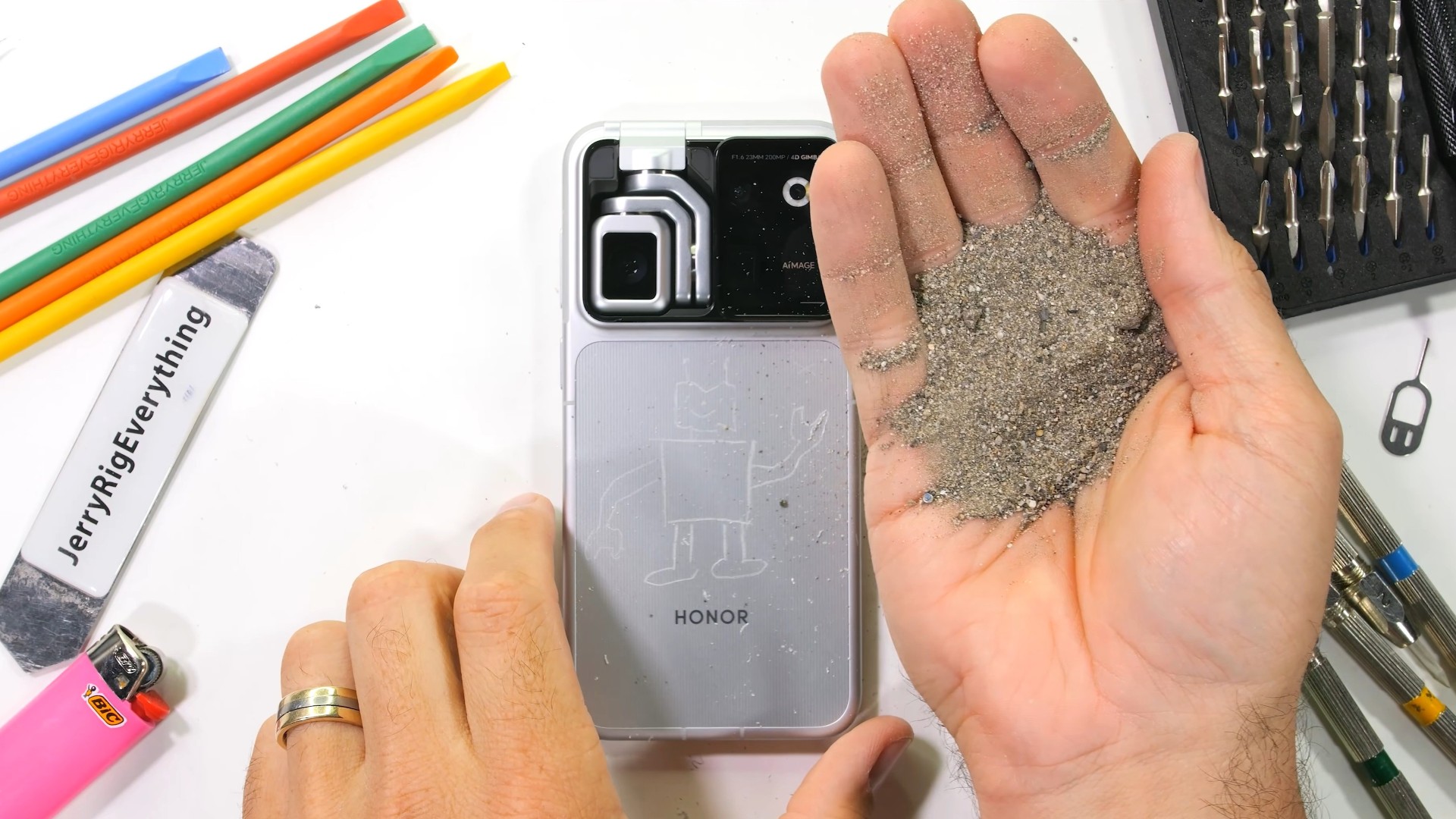
Honor Robot Phone durability test reveals a major weakness in its futuristic camera design
Honor’s Robot Phone stands out for one big reason: its unusual moving camera system with a micro gimbal. It is the kind of futuristic smartphone feature that instantly grabs attention, especially for users who want better stabilization and a more dynamic mobile photography experience. However, a recent durability test shows that this eye-catching design also comes with some important compromises.
The biggest concern is protection against dust and water. While many modern premium smartphones now offer an IP68 rating or higher, the Honor Robot Phone only comes with an IP54 rating. That means users should be far more cautious in certain environments, especially places like beaches, construction areas, dusty outdoor locations, or anywhere dirt and fine particles could reach the moving camera mechanism.
In the test, exposure to dirt caused serious trouble for the phone’s mechanical camera arm. Once debris entered the gimbal area, the moving arm became effectively disabled. Even using compressed air was not enough to restore it. This is a major point to consider because the Robot Phone’s signature feature depends on moving parts, and moving parts are naturally more vulnerable than sealed, fixed camera modules.
Water resistance is another limitation. The Honor Robot Phone is not designed to be fully waterproof, so everyday situations such as rain, splashes, spills, or humid environments require extra care. For users who are used to taking their phones near pools, beaches, or outdoor adventures, this may be a noticeable drawback.
The good news is that the phone appears to perform well when it comes to structural strength. During the bend test, the Honor Robot Phone did not show any major stability issues. Despite its complicated internal design and mechanical camera hardware, the body seems solid enough to handle normal physical pressure without concerning signs of weakness.
The teardown also gives an interesting look at how Honor built this unusual device. Inside, the back panel is revealed to be made of plastic rather than glass or metal. The battery is relatively easy to reach, although it is still glued into place. This could be a positive point for repairability compared with phones that make battery access much more difficult.
Because of the Robot Phone’s mechanical camera system, the internal layout is different from a standard smartphone. Honor uses several uncommon design choices to support the moving gimbal, including braided wires and specialized components around the camera mechanism. For anyone curious about how a micro gimbal works inside a smartphone, the teardown offers a rare look at the engineering behind the feature.
Overall, the Honor Robot Phone is an ambitious and visually impressive device, but its durability test makes one thing clear: innovation can come with trade-offs. The moving camera system may be exciting for mobile photography fans, but the lower IP54 rating and vulnerability to dirt mean this is not a phone for careless use in harsh environments.
If you are interested in the Honor Robot Phone, its camera technology and solid frame may be appealing. But if dustproofing, waterproofing, and rugged everyday durability are top priorities, this device requires more caution than many conventional flagship smartphones.