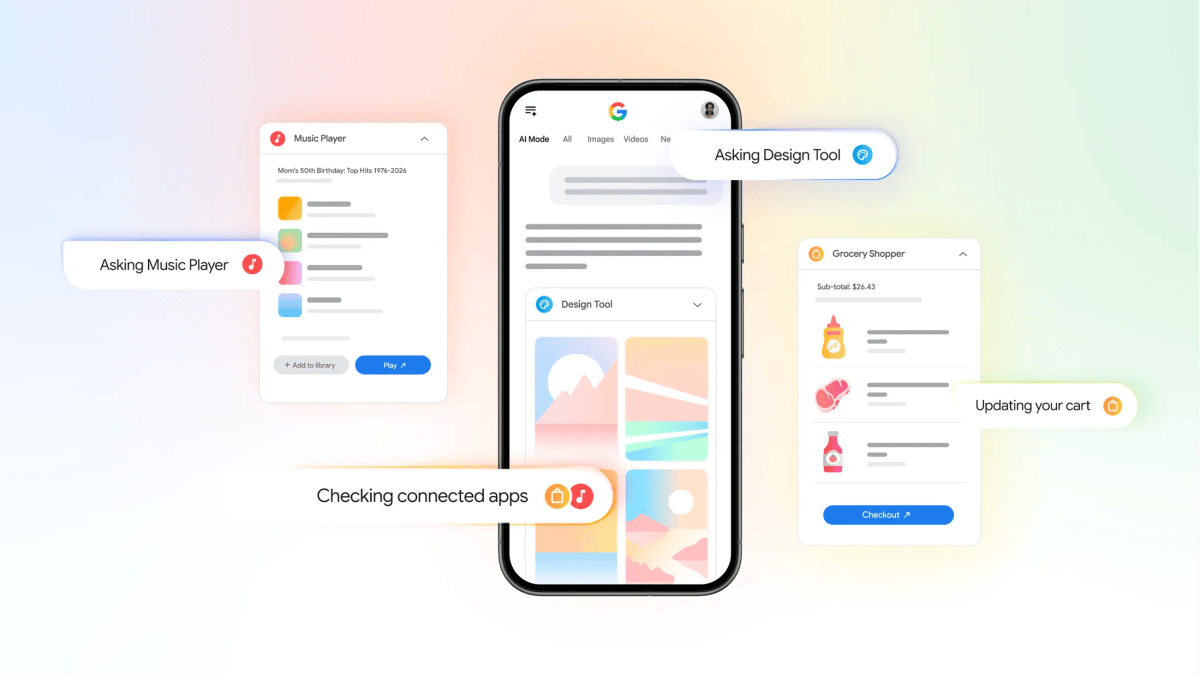
Google is opening a new path for businesses and developers to bring their apps directly into its AI-powered experiences with the launch of the Connected Apps Platform. The move could make Google Search and the Gemini app more useful by allowing people to interact with third-party services without leaving Google’s AI environment.
Connected apps were introduced earlier this year in Gemini and Google Search. The feature lets users securely link supported apps and services, then ask Google’s AI tools to perform specific tasks. For example, a user could connect Canva to create a flyer, use YouTube Music to build a playlist, or access other supported services through natural language prompts.
The bigger idea is simple: instead of opening several separate apps to complete everyday tasks, users may increasingly rely on AI assistants as the main interface for getting things done. Google wants Search and Gemini to become that central place where people can discover, connect, and use their favorite services more easily.
For that vision to work, Google needs a large selection of connected apps. That is where the new Connected Apps Platform comes in. It gives businesses and developers a way to submit their own apps for use across Google’s AI products, potentially increasing their visibility to millions of users who already rely on Search and Gemini.
The platform is currently available in beta as a public preview for developers in the United States. Developers who join the waitlist can begin building and submitting apps designed to work with Google’s AI experiences.
To get started, developers can connect their app using a cloud-hosted MCP, or Model Context Protocol, server. Android developers can also use Android MCP through AppFunctions APIs. From there, they can use the Google Connected Console to register, test, and submit their connected app.
In practical terms, this setup allows an app to communicate with Google’s AI features so users can take actions through Search, Gemini, or both. Developers can decide where they want their app to appear, giving them more control over how their service reaches users.
Once an app is live, developers can monitor important performance data such as traffic, latency, and error rates. They can also manage brand details, including verified logos and authenticated accounts. This could be especially important as users begin interacting with more services through AI assistants rather than traditional app icons or websites.
For businesses, the Connected Apps Platform may become an important new discovery channel. In the same way search engine optimization helped websites become more visible in Google Search, connected apps could help companies appear inside AI-driven search and assistant experiences. As the web becomes more agent-based, businesses may need to think not only about ranking in search results, but also about being available inside AI workflows.
Google already offers more than 50 connected apps in Gemini. Current partners include Adobe, Experian, Localiza, Peloton, and others. Google’s own services are also part of the experience, including Workspace, Google Photos, YouTube Music, and Google Home.
These Gemini connected apps are expected to expand into Google Search over the coming weeks. At the moment, Search has a smaller number of integrations, including services such as Instacart, Canva, YouTube Music, and Yahoo Fantasy Football.
Google also confirmed that the meditation app Calm is joining the connected apps ecosystem. Calm is expected to launch support for both Gemini and Search soon, giving users another example of how third-party apps can work inside Google’s AI experiences.
The Connected Apps Platform is still in its early stages, and Google has not announced when it will become available more broadly outside the current U.S. developer preview. Even so, the launch signals an important shift in how apps may be discovered and used in the future.
If Google succeeds, Search and Gemini could become more than tools for finding information. They could become gateways for completing tasks, accessing services, and interacting with apps through AI-powered conversations. For developers and businesses, that could create a new opportunity to reach users at the exact moment they are ready to take action.


