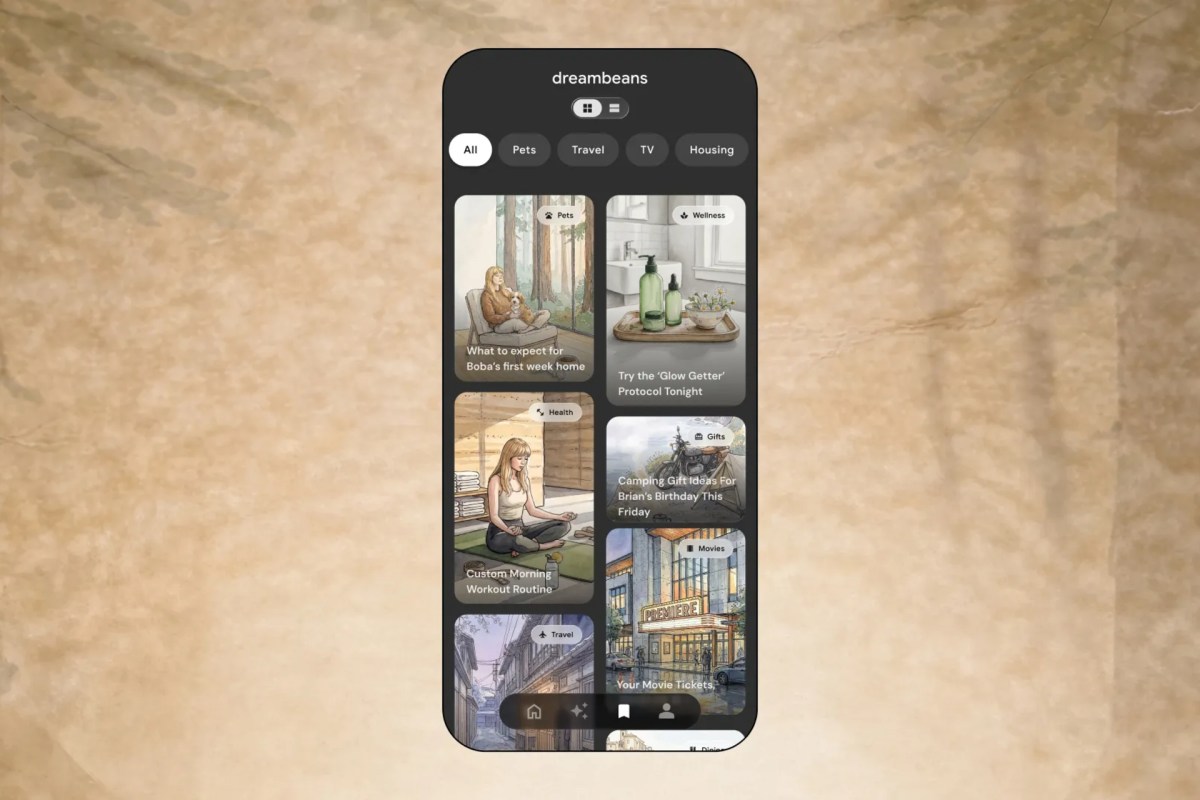
Google Dreambeans Launches in India With AI-Powered Personalized Stories in 13 Languages
Google has launched its experimental AI app Dreambeans in India, marking the app’s first expansion outside the United States. The move brings Google’s personalized visual storytelling experience to one of the world’s largest and fastest-growing internet markets.
Dreambeans is now available for Android and iOS users in India, with support for 13 languages, including Hindi, Tamil, Telugu, Bengali, Punjabi, and English. The India rollout comes shortly after Google opened access to all eligible users aged 18 and above in the U.S.
What makes Dreambeans different from many other AI apps is that it does not rely on users typing prompts. Instead, the app creates personalized illustrated stories automatically by drawing from connected Google services such as Gmail, Calendar, Photos, Search, YouTube, and Gemini.
The idea is to turn a user’s digital activity into visual stories about their interests, memories, plans, and daily life. For example, Dreambeans may create a story inspired by recent travel photos, upcoming calendar events, saved interests, or videos watched on YouTube.
Google first introduced Dreambeans in June with static AI-generated illustrations. More recently, the company added animated story support using its Veo video-generation technology, allowing select stories to come alive with short AI-generated motion.
Why Google chose India for Dreambeans’ global expansion
Google says India was selected as Dreambeans’ first international market because of strong user interest and the widespread use of Google services across the country. India has a large base of users who actively use Gmail, Google Photos, Gemini, Search, and YouTube, making it a natural fit for an app built around personalized AI experiences.
According to Google product manager Gozde Oznur, India also showed significant overlap among users of Gemini, Gmail, and Google Photos. That combination gives Dreambeans more context to create personalized stories that feel relevant to each user.
The launch also reflects Google’s broader focus on India as a key market for AI products. With hundreds of millions of internet users and growing adoption of smartphones, India offers a major opportunity for AI apps designed around everyday digital behavior.
Dreambeans supports Indian languages, but there is a catch
One of the biggest additions for the India launch is support for 13 local languages. This could help Dreambeans reach users beyond English-speaking audiences and make AI-generated stories more accessible across different regions.
However, the app currently allows users to choose only one language at a time for generated stories. While Dreambeans can understand and use information from Google services in different languages, it does not yet create stories that naturally mix multiple languages.
That could be a limitation in India, where many users regularly switch between languages in daily conversations. Hindi and English, for example, are often blended together in casual communication, commonly known as Hinglish. For Dreambeans to feel truly natural in India, multilingual story generation may become an important feature in the future.
How popular is Dreambeans so far?
Dreambeans is still an experimental app, and its early download numbers show that it has a long way to go before becoming a mainstream AI product.
Market intelligence estimates suggest the app has recorded around 55,000 downloads in the U.S. since its June debut. A large share of those downloads came in September, after Google expanded access to all eligible U.S. users aged 18 and older. However, downloads reportedly declined sharply the following month.
In its first 30 days after wider U.S. availability, Dreambeans reached an estimated 29,000 downloads. That is much smaller than the early download figures seen by several general-purpose AI apps. However, Dreambeans is not designed to compete directly with chatbots that answer questions, write text, or generate code. Its focus is narrower: creating personal, visual, AI-powered stories from a user’s own digital life.
Privacy questions around personalized AI stories
Because Dreambeans relies on personal data from connected Google services, privacy is one of the biggest questions around the app.
The app uses Google’s Personal Intelligence technology to generate stories based on information from a user’s account. That may include details from emails, photos, calendar events, searches, videos, and other connected activity. For some users, that level of personalization may feel useful and fun. For others, it may raise concerns about how much personal information an AI app should access.
Google says users remain in control of what they connect to Dreambeans. They can choose which services the app can use and disconnect them at any time. Users can also delete Dreambeans data directly from the app.
Google also says that if information is deleted from the original connected service, it is removed from Dreambeans’ personalization system as well.
The company has added controls that allow users to tell Dreambeans to avoid certain topics. For example, someone may ask the app not to include work-related or business-related information in stories. Google says Dreambeans will try to adjust its future content based on those preferences.
Dreambeans is currently available only for personal Gmail accounts. It is not available for enterprise accounts, and Google says the stories generated by the app are visible only to the account holder.
Personalized memories can be powerful, but also sensitive
Dreambeans’ proactive storytelling approach could be appealing because it creates content without requiring effort from the user. But it also comes with emotional risks.
Since the app can use personal photos and activity, it may surface memories that users find painful or upsetting. For instance, it could generate stories involving someone who has passed away or highlight moments a user may not want to revisit.
Google acknowledges this possibility and says users can ask Dreambeans to stop showing certain people, topics, or memories. This is similar to memory controls available in Google Photos, where users can limit what appears in automatically generated reminders.
For an AI app built around personal life moments, these controls will be important. The success of Dreambeans may depend not only on how creative its stories are, but also on how carefully it handles sensitive personal information.
What comes next for Dreambeans?
Google is already exploring ways to make Dreambeans more useful beyond personalized stories. The company is looking at features that could make the app more actionable, helping users do something with the suggestions or memories it generates.
That could mean turning a story about a trip into travel recommendations, helping users follow up on personal goals, or suggesting next steps based on interests and routines. Google has not confirmed specific future features, but the direction suggests Dreambeans may eventually become more than a storytelling app.
For now, Dreambeans arrives in India as a new kind of AI experiment: one that turns everyday digital activity into personalized visual stories. With support for Indian languages, deep integration with Google services, and a focus on personal memories, the app could attract curious users looking for a more creative AI experience.
At the same time, its success in India will depend on whether users feel comfortable giving an AI app access to personal data, whether language support feels natural enough, and whether the stories it creates are genuinely meaningful.