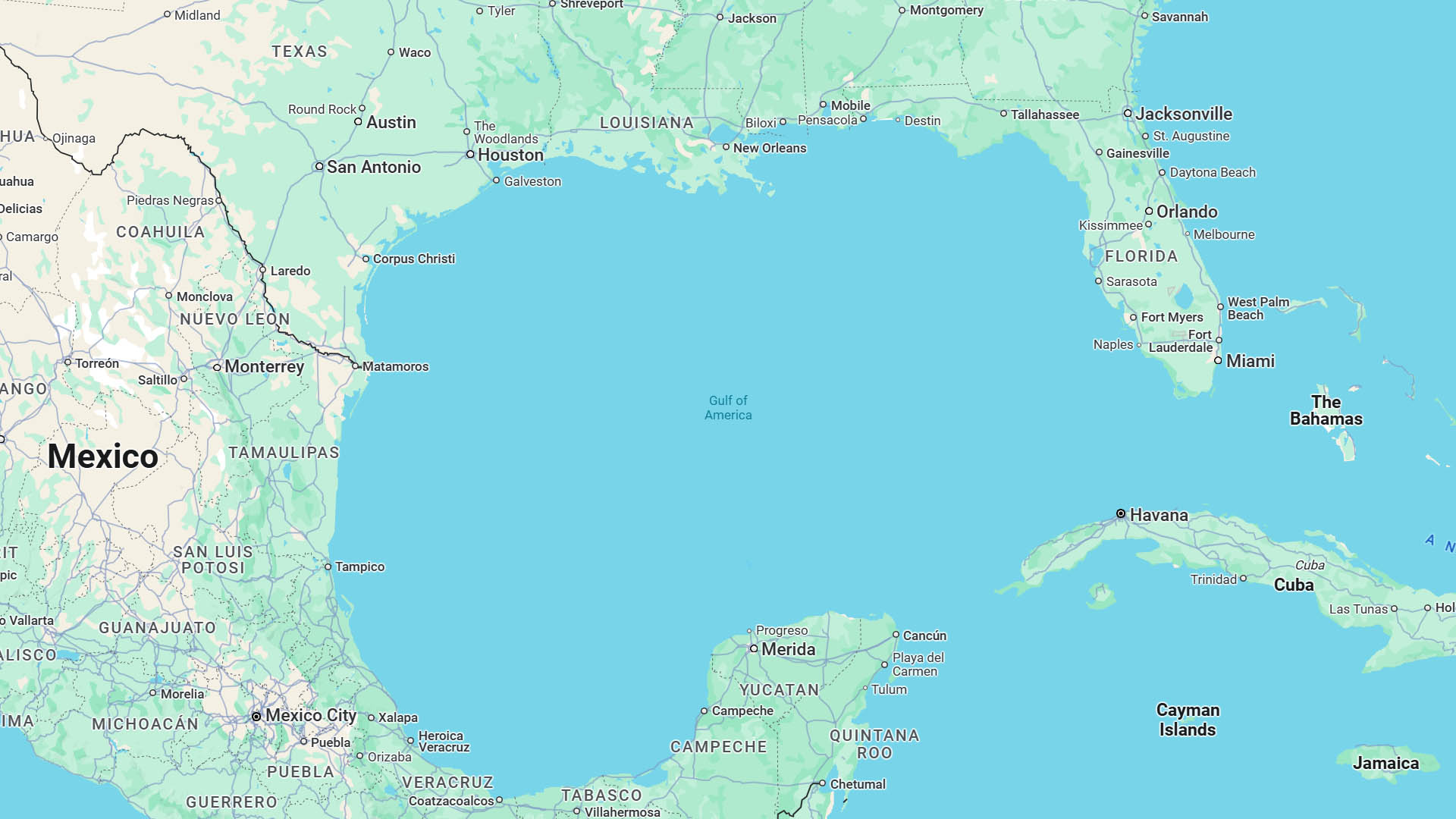
In a surprising turn of events, tech titans Google and Apple have had to adapt their mapping services following an unexpected declaration by President Trump, who has renamed the Gulf of Mexico to the Gulf of America. Although the presidential order was issued earlier, only recently have these tech companies updated their widely-used navigation apps to reflect the change.
As you fire up Google Maps or Apple Maps, you’ll notice that the Gulf of Mexico has been relabeled as the Gulf of America. This vast body of water, located just east of Mexico and south of the United States, has a profound geographical significance. With an average depth of 5,300 feet, the newly named Gulf of America is bordered by the U.S. on its eastern, northern, and northwestern shores, and by Mexico to the south and southwest. It also touches Cuba on the southeast, offering a crucial connection to the Atlantic Ocean via the Florida Straits and to the Caribbean Sea through the Yucatan Channel.
Interestingly, this isn’t the only notable name change; the recent executive order also reverted Mt. Denali in Alaska to its former name, Mt. McKinley. However, this alteration hasn’t yet been mirrored in the digital maps of Google or Apple for U.S. users. Adding to the picture, while the maps show the new name in the U.S., they still reflect the original Gulf of Mexico name for users within Mexico. Internationally, users are greeted with the dual label “Gulf of Mexico (Gulf of America).”
The timeline of these changes is intriguing. The initial executive order was made on January 20th, and while the Geographic Names Information System promptly updated its database, the digital map changes lagged behind. It wasn’t until after Trump declared February 9th as “Gulf of America Day” that Google announced its update, soon followed by Apple.
In Mexico, these developments have sparked some diplomatic tension, with President Claudia Sheinbaum asserting that the U.S. lacks the authority to unilaterally rename an international body of water. As the discussion ensues, Wikipedia has yet to follow suit, listing the new designations only as footnotes while editors debate over how to address these official but contentious changes.
This twist in digital cartography highlights not just the power of political decisions but also the ripple effects on global tech platforms and their users. It also serves as a reminder of the complex interplay between modern technology and international relations. Keep an eye on this space as these updates continue to unfold.