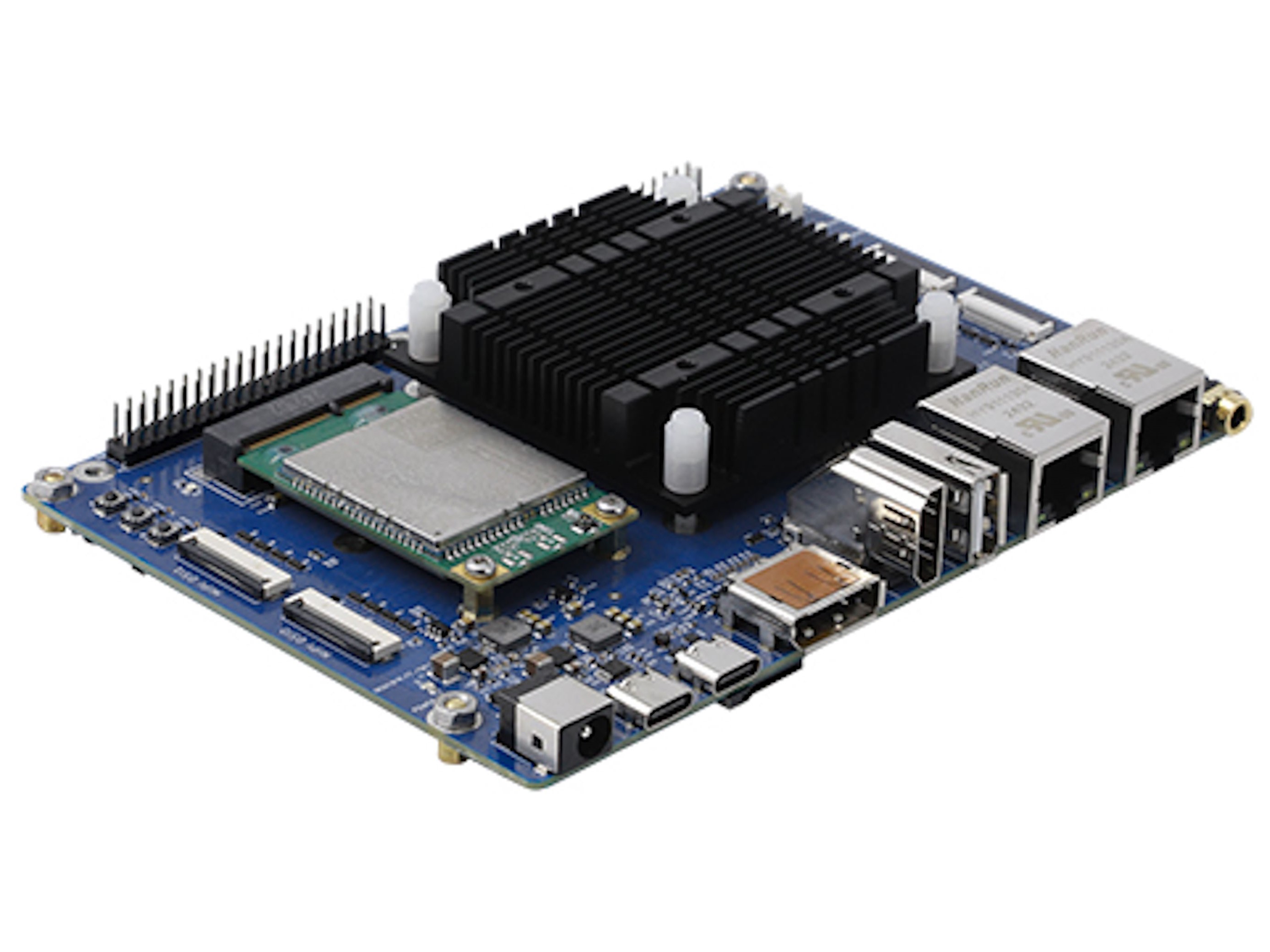
Looking for a Raspberry Pi 5 alternative with built-in storage and optional AI acceleration? Ebyte has introduced two compact single-board computers based on Allwinner’s T527 series that target makers, tinkerers, and embedded developers alike. The key difference between the two models is the presence of a neural processing unit in one variant, which can speed up lightweight AI workloads at the edge.
The ECB32-PGBN4E32-I uses the T527MN SoC, where the “N” denotes an integrated NPU. This NPU is rated up to 2 TOPS, making it suitable for modest on-device inference tasks like simple vision models, voice triggers, and sensor analytics. If you don’t need AI acceleration, the ECB32-PGB2E16-I with the T527M focuses on efficient general-purpose computing. Both are built around four ARM Cortex-A55 CPU cores for low-power, cooler-running operation in always-on projects.
Unlike many hobby boards, these Ebyte models include onboard storage. Depending on the configuration, you get 32 GB or 64 GB of internal storage for your operating system and apps, plus either 2 GB or 4 GB of RAM. That built-in capacity can simplify deployment for kiosks, gateways, and industrial controllers where microSD reliability or speed might be a concern.
Connectivity and expansion are a highlight. Each board provides dual 1 GbE ports for multi-network setups, routing, or high-availability services. There’s also a PCIe 2.1 x1 interface delivering up to 5 Gbps, opening the door to fast NVMe adapters, additional networking, or specialty accelerators. For displays, you can choose HDMI with 4K60 support or MIPI DSI with 4K up to 45 Hz, ideal for digital signage and information panels. Two 40‑pin headers increase flexibility for sensors, actuators, and custom HATs, giving you more I/O options than many competing SBCs.
Physical dimensions come in at roughly 5.75 x 3.98 inches (about 146 x 101 mm), providing ample real estate for connectors and expansion while remaining compact enough for enclosures and tight installations.
Who should pick which model?
– Choose the T527MN variant if you want on-board AI assistance for light inference tasks, computer vision counters, wake-word detection, or anomaly detection at the edge.
– Choose the T527M variant if your priorities are general-purpose computing, home servers, network appliances, or automation projects that don’t require AI offload.
Key takeaways
– Allwinner T527 series with four Cortex-A55 cores
– Optional NPU up to 2 TOPS for AI acceleration (T527MN model)
– 2 GB or 4 GB RAM with 32 GB or 64 GB internal storage
– Dual 1 GbE ports for routing, firewall, or multi-LAN projects
– PCIe 2.1 x1 at 5 Gbps for flexible expansion
– HDMI 4K60 and MIPI DSI up to 4K45 for display versatility
– Two 40‑pin headers for extensive GPIO and add-ons
– Available now through major online retailers, including Amazon Germany
For makers weighing a Raspberry Pi 5 alternative, these boards stand out with integrated storage, dual Gigabit Ethernet, and an optional NPU. If your project needs edge AI without the complexity of external accelerators, the T527MN variant is the smarter fit. For everything else—from DIY NAS and Docker hosts to industrial controls—the T527M model delivers a balanced, efficient platform.