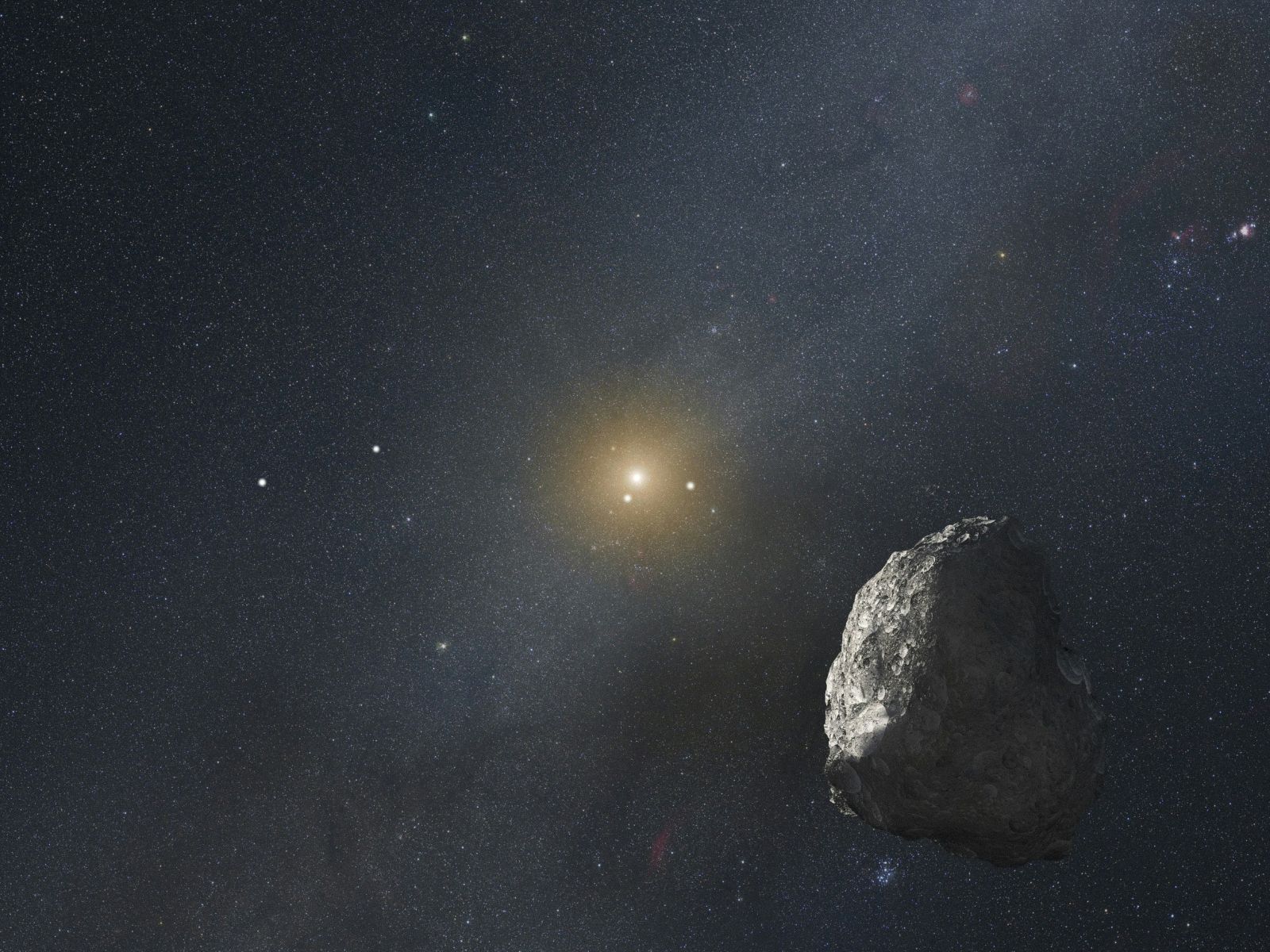
Mysterious Asteroid 1998 KY26 Is Accelerating, and Scientists Still Don’t Know Why
A tiny near-Earth asteroid is puzzling astronomers after showing motion that does not fully match expectations. Known as 1998 KY26, the object is only about 11 meters wide, but its strange behavior has made it an important target for future space exploration.
Discovered by the University of Arizona’s Spacewatch project, asteroid 1998 KY26 belongs to the Apollo group, a class of asteroids whose orbits cross Earth’s path around the Sun. While that may sound alarming, the real mystery is not its proximity to Earth, but the unusual acceleration detected in its movement in 2023.
Normally, astronomers can predict the path of an asteroid by calculating the gravitational pull of the Sun, planets, and other objects. But 1998 KY26 appears to be affected by an additional force. This kind of non-gravitational acceleration has raised a major question: what exactly is pushing this asteroid off its expected course?
One possible explanation was that 1998 KY26 might actually be a “dark comet.” Unlike typical comets, which often show bright tails of gas and dust when they approach the Sun, dark comets do not display a visible tail through telescopes. However, they can still experience acceleration if hidden ice inside them turns directly into gas, a process known as sublimation. As gas escapes, it can act like a tiny thruster, slowly changing the object’s orbit.
At first, this idea seemed promising. If 1998 KY26 contained water ice beneath its surface, sublimation could explain why it is moving in an unexpected way. But further study has made that theory less convincing.
Researchers examined the asteroid’s temperature and found that even its coldest regions average at least -78 °F, or about -61 °C, while it travels around the Sun. That is cold by human standards, but not cold enough for water ice to survive for extremely long periods. For ice to remain stable over billions of years, temperatures would need to stay below roughly -198 °F, or -128 °C.
There is another problem with the dark comet theory. If 1998 KY26’s acceleration were caused by escaping ice, the available supply would likely be depleted in only about 62 years. That timeline does not fit well with an asteroid believed to be several billion years old. In other words, if ice were responsible, it should have disappeared long ago.
This leaves astronomers with an intriguing mystery. If sublimating ice is not the source of the acceleration, something else must be influencing the asteroid’s movement. It may involve surface properties, rotation, heat effects, or another mechanism that is not yet fully understood.
Fortunately, scientists may not have to rely on distant observations forever. Japan’s Hayabusa2 spacecraft is expected to reach asteroid 1998 KY26 in July 2031. The mission could provide the close-up data needed to solve the puzzle.
Hayabusa2 will study the asteroid using onboard instruments including the ONC-W and ONC-T cameras, along with a Lidar laser altimeter. These tools will help researchers analyze the asteroid’s shape, surface, rotation, and physical characteristics in far greater detail than Earth-based telescopes can provide.
Because 1998 KY26 is so small, it offers a rare opportunity to study a compact near-Earth object up close. Understanding how such asteroids behave is important not only for planetary science, but also for improving long-term asteroid tracking and orbit prediction.
For now, asteroid 1998 KY26 remains one of the more curious objects in near-Earth space. It is small, ancient, and unexpectedly mobile. Whether it turns out to be a strange asteroid, a failed dark comet candidate, or something even more unusual, the upcoming Hayabusa2 encounter could reveal why this tiny space rock refuses to follow the rules.