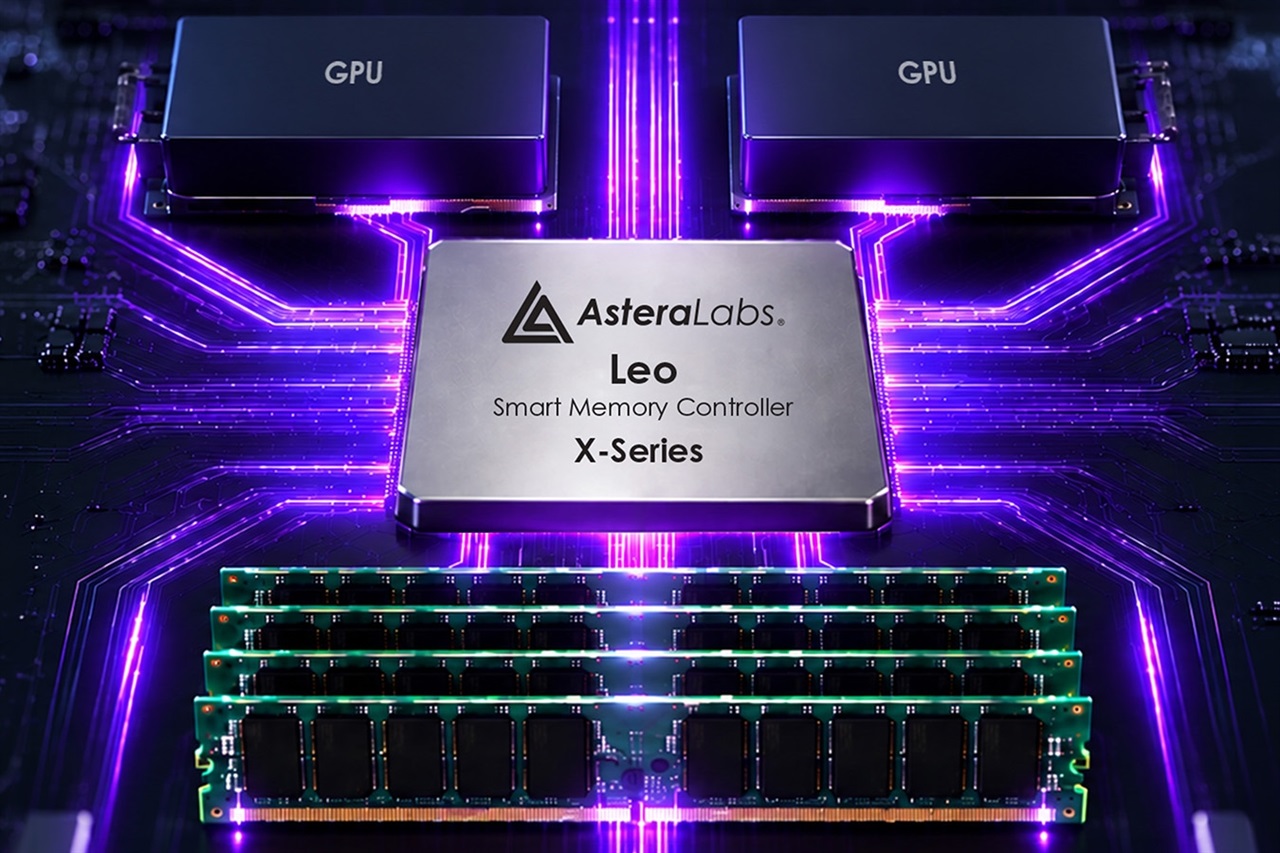
Astera Labs Expands Leo Memory Controller Line to Tackle the AI Inference Memory Bottleneck
Astera Labs is expanding its Leo memory controller family with three new products designed to address one of the biggest challenges emerging in modern AI infrastructure: the rapid growth of the key-value cache during inference.
As artificial intelligence moves beyond simple one-shot prompts and into agentic AI systems, memory demands are changing fast. Instead of answering a single query and stopping, agentic AI applications can run in continuous loops, plan tasks, use tools, remember context, and generate multiple rounds of responses. This makes inference far more memory-intensive, especially when models must keep track of long conversations, documents, codebases, or multi-step workflows.
The pressure point is the KV cache, short for key-value cache. During AI inference, large language models store attention data in this cache so they can generate responses efficiently without recalculating everything from scratch. The longer the context and the more active sessions running at once, the larger the KV cache becomes.
The problem is that this cache can quickly outgrow the high-bandwidth memory available on AI accelerators. HBM is extremely fast, but it is also expensive and limited in capacity. When the KV cache no longer fits comfortably inside accelerator memory, performance can suffer. Data may need to move to slower memory tiers, creating latency, reducing throughput, and leaving costly AI chips underused.
Astera Labs’ new Leo memory controller products are aimed directly at this issue. The goal is to help data centers attach larger pools of memory to AI systems, giving inference workloads more room to store KV cache data while keeping accelerators busy. By expanding available memory capacity around AI processors, the Leo lineup is positioned as a way to improve efficiency for large-scale inference deployments.
This matters because AI inference is becoming the center of enterprise AI spending. Training massive models remains important, but the real-world cost of AI often appears when those models are deployed and used by millions of people or by complex business applications. Every chatbot session, coding assistant request, AI search query, or autonomous agent workflow adds to inference demand.
For companies running large AI clusters, the memory bottleneck can translate into higher costs. If accelerators are waiting on data instead of processing tokens, organizations may need more hardware to achieve the same output. Better memory expansion can help improve token throughput, support longer context windows, and increase the number of simultaneous users a system can serve.
The rise of agentic AI makes this even more urgent. These systems do not simply generate a short answer. They may analyze a problem, call external tools, evaluate results, revise a plan, and continue working through multiple steps. Each step can increase the amount of context the model needs to retain, pushing KV cache requirements higher.
Astera Labs is targeting this shift with products built for the next phase of AI infrastructure. Rather than treating memory as a fixed resource limited to what is packaged with the accelerator, the Leo memory controller approach supports more flexible memory scaling. This can help cloud providers, hyperscalers, and enterprise AI operators build systems better suited for long-context and high-concurrency inference.
The expansion also reflects a broader trend in data center architecture. As AI models grow more capable, performance is no longer determined only by the raw compute power of GPUs or specialized accelerators. Memory capacity, memory bandwidth, interconnects, and system-level efficiency are becoming just as important.
HBM will remain essential for the fastest AI workloads, but it may not be practical or economical to keep every piece of inference data in HBM at all times. A tiered memory strategy, supported by advanced memory controllers, could allow AI systems to balance speed, capacity, and cost more effectively.
With three new additions to the Leo family, Astera Labs is positioning itself to serve a growing need in AI data centers: keeping large language models responsive as context windows expand and agentic workloads become more common.
The key message is clear. As AI inference evolves, memory is becoming one of the most important battlegrounds in performance optimization. Solving the KV cache bottleneck could help unlock faster, more scalable, and more cost-efficient AI services for the next generation of applications.