Arm unveils CSS for Mobile 2 with C2-Ultra CPU and Mali G2-Ultra NX GPU for next-gen flagship phones
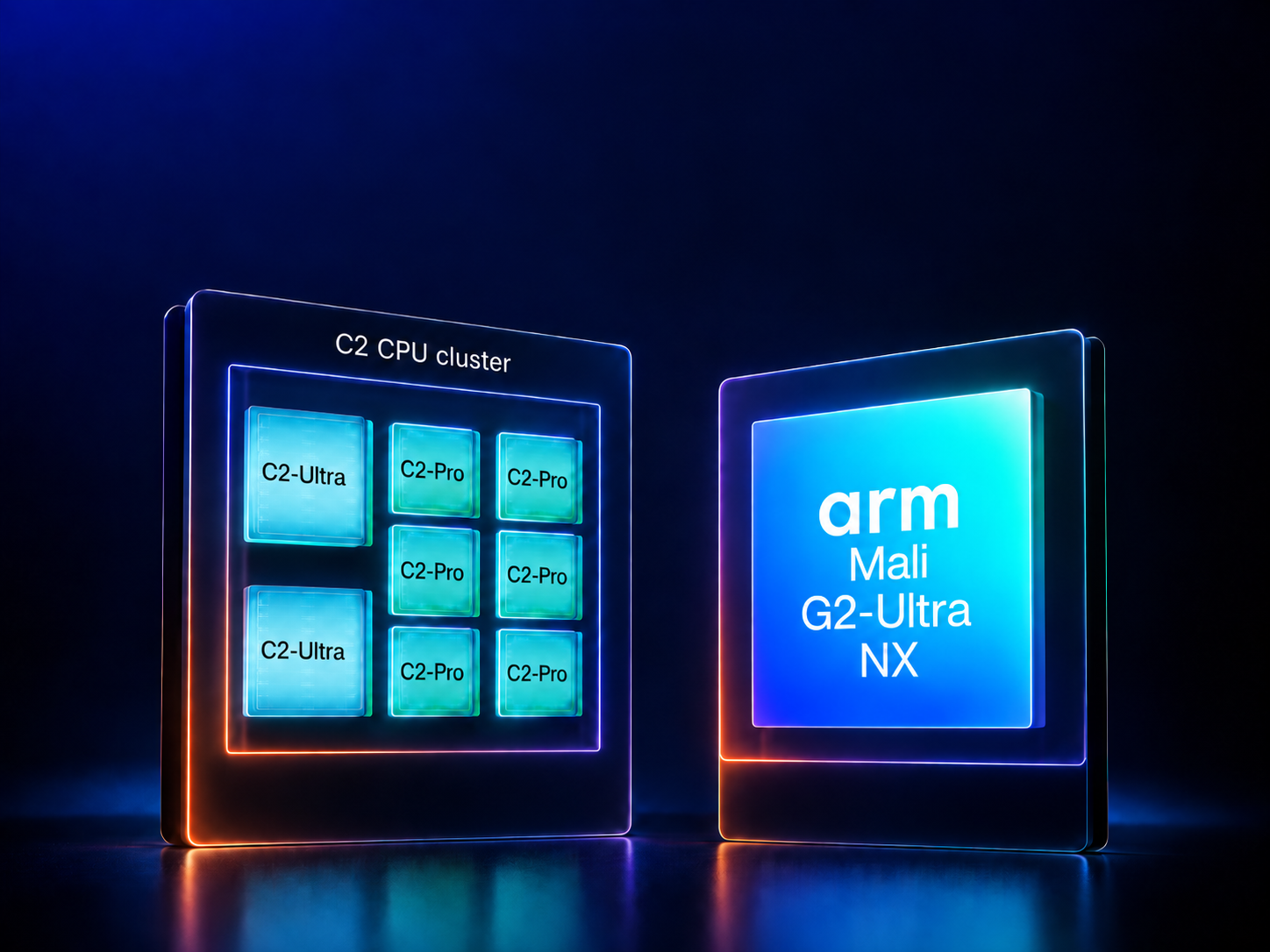
Arm has introduced CSS for Mobile 2, its newest mobile compute platform designed for upcoming flagship smartphones. The platform brings together the new Arm C2-Ultra and C2-Pro CPU cores, the Mali G2-Ultra NX GPU, an updated system interconnect, and a refreshed software stack built to handle the growing demand for on-device AI, advanced gaming, and faster everyday performance.
The launch marks a notable shift in Arm’s mobile strategy. After recently moving away from the long-running Cortex branding, Arm appears to be simplifying its naming again with the C2 CPU family. This time, the focus is clear: stronger single-core speed, better multi-core efficiency, and significantly more AI performance directly on the device.
At the heart of CSS for Mobile 2 is the Arm C2-Ultra, the new high-performance CPU core aimed at premium smartphones. It is joined by the C2-Pro, a smaller performance-oriented core that sits below the Ultra tier but still targets demanding mobile workloads. Arm says the new CPU setup can deliver up to 15% better single-thread performance and up to 12% stronger multi-thread performance compared with the previous generation.
For users, those improvements could translate into faster web browsing, quicker app launches, smoother multitasking, and better responsiveness across everyday smartphone tasks. Arm claims web browsing can improve by up to 15%, while app launch times may be reduced by up to 12%.
However, the biggest story is artificial intelligence. Arm is positioning CSS for Mobile 2 as a platform built for local AI processing, including speech recognition, reasoning, retrieval-based tasks, and agent-style workloads that need fast responses without constantly relying on the cloud.
A sample flagship configuration includes two C2-Ultra cores, six C2-Pro cores, and two SME2 units. SME2 is Arm’s scalable matrix extension technology, designed to accelerate AI and machine learning workloads directly on the CPU. With twice the SME2 capability of the prior high-end setup, Arm says the new CPU cluster can deliver up to 1.7x higher AI performance across its latest tested models.
This extra compute power is especially important as smartphones begin handling more complex AI tasks on-device. Instead of simply sending everything to a dedicated NPU or cloud server, Arm’s design allows the CPU to act as the coordination layer. It can manage context, track task state, and decide whether parts of a workflow should run through local apps, on-device models, other accelerators, or cloud services.
In one example shared by Arm, a configuration with two C2-Ultra cores and two SME2 units completed a full AI workflow 24% faster than a previous-generation C1-Ultra-based setup. That type of improvement could matter for real-time translation, intelligent assistants, personalized search, image tools, and other AI features where latency makes a noticeable difference.
The platform also includes Arm’s SI L2 system interconnect, which improves communication between the CPU, GPU, memory, and other compute blocks inside a chip. It provides coherency, quality-of-service controls, and higher-bandwidth, lower-latency data movement. In simpler terms, the different parts of the processor should be able to work together more efficiently, which is critical for modern smartphones that often run AI, graphics, camera, and background tasks at the same time.
Arm is also giving chipmakers flexibility. CSS for Mobile 2 is a reference platform, but manufacturers can customize it. They can use the full platform, pick individual components, combine Arm IP with third-party designs, or adjust the configuration to suit their own flagship chips. This means future premium processors from companies such as MediaTek, Samsung, Google, and others may use different combinations of Arm’s new CPU and GPU technology.
The other major part of the announcement is the Mali G2-Ultra NX GPU. Arm describes it as its first AI-native Mali graphics processor, and that label comes from the addition of dedicated neural accelerators inside the GPU shader cores.
These neural accelerators share the GPU’s existing memory system, coherent caches, and control structures. This matters because moving data around a chip can consume both time and power. By placing AI acceleration directly inside the graphics pipeline, Arm aims to reduce memory traffic while enabling new rendering techniques for mobile games and visual applications.
The Mali G2-Ultra NX is built around three neural graphics technologies.
Neural Super Sampling reconstructs a higher-resolution image from a lower-resolution render. This allows a game to render fewer pixels internally while still outputting a sharper image.
Neural Frame Rate Upscaling generates intermediate frames to increase the displayed frame rate. For example, a game rendered at 30 frames per second could be displayed at 60 frames per second.
Neural Super Sampling and Denoising combines upscaling with ray reconstruction and denoising, which is especially useful for ray-traced scenes where lighting, reflections, and transparency can be computationally expensive.
These features are similar in concept to the AI-assisted upscaling and frame-generation technologies already seen in PC gaming, but Arm is adapting the idea for mobile hardware. If implemented well, it could help smartphones deliver higher frame rates and more advanced visuals without dramatically increasing power draw.
In Arm’s Neural Dawn demo, combining neural frame rate upscaling with neural super sampling and denoising delivered up to four times better performance efficiency compared with native rendering. Arm also claims external memory traffic was reduced by as much as 70%. That reduction could help with both battery life and sustained gaming performance, two areas where mobile devices often struggle under heavy workloads.
Arm says this approach may make advanced Unreal Engine features such as MegaLights more practical on smartphones. It could also help future mobile games target sustained 120 FPS output without requiring every single frame to be rendered traditionally.
The Mali G2-Ultra NX is not relying only on neural rendering to improve performance. Arm has also redesigned the GPU execution engine, calling it the biggest change to the Mali instruction-set architecture in seven generations. One of the key upgrades is support for up to twice as many registers, giving complex shaders more room to operate efficiently.
For traditional graphics workloads, Arm claims the Mali G2-Ultra NX delivers up to 24% higher benchmark performance and up to 14% better non-AI gaming performance compared with the previous generation. That means even games and apps that do not use neural upscaling or frame generation should still benefit from the new GPU architecture.
Ray tracing is also getting an upgrade. The Mali G2-Ultra NX includes Arm’s third-generation Ray Tracing Unit and adds hardware support for Opacity Micromaps. This feature helps process complex transparent geometry more efficiently, reducing the cost of ray tracing in scenes with objects such as glass, foliage, particles, or layered materials.
Devices using the new Arm C2-Ultra, C2-Pro, and Mali G2-Ultra NX technology are expected to begin appearing soon in high-end mobile chipsets. MediaTek is likely to be among the first major companies to adopt the platform for a flagship smartphone processor, while future Exynos, Tensor, and other premium mobile chips may use parts of the new Arm design depending on each company’s roadmap.
The timing also sets up a busy period for the mobile processor market. Qualcomm is expected to continue advancing its custom CPU and Adreno GPU designs, while Apple is preparing its next generation of A-series silicon for future iPhones. With Arm pushing stronger on-device AI, neural graphics, and more efficient mobile gaming, the next wave of flagship smartphones could bring a meaningful jump in both performance and intelligent features.
Overall, CSS for Mobile 2 shows where Arm believes premium smartphones are heading. Raw CPU and GPU speed still matter, but the future is increasingly about how well a chip can coordinate AI, graphics, memory, and software together. With the C2-Ultra CPU and Mali G2-Ultra NX GPU, Arm is building a platform aimed at faster phones, smarter assistants, better gaming visuals, and more powerful on-device AI experiences.


