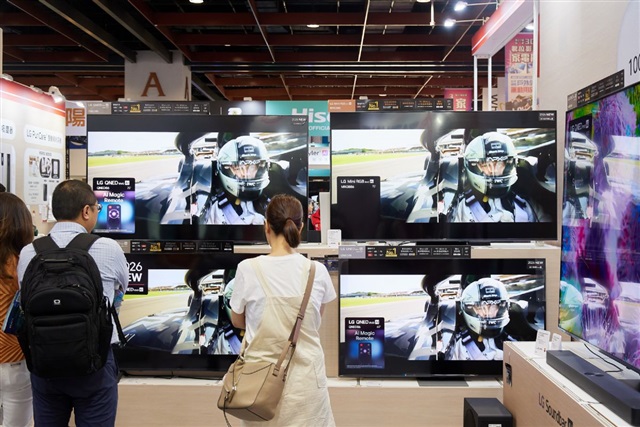
Taiwan’s display industry is entering a new era after decades of being known as one of the world’s most important LCD manufacturing hubs. Once celebrated for its massive production capacity and technical strength in flat-panel screens, the sector has faced repeated waves of disruption, including financial downturns, global pricing pressure, regulatory challenges, and intense competition from heavily supported Chinese manufacturers.
For years, Taiwanese panel makers built their reputation on LCD technology, supplying displays for televisions, monitors, laptops, smartphones, and industrial equipment. However, the global display market has become increasingly difficult as oversupply, shrinking margins, and aggressive expansion by competitors have changed the business landscape. What was once a high-growth industry has become a market where scale alone is no longer enough to guarantee long-term success.
Now, Taiwan’s leading display companies are shifting their focus beyond traditional screens. Instead of relying only on LCD panels, they are using their deep experience in precision manufacturing, materials engineering, optics, and large-scale production to move into higher-value industries. This transformation is turning the display sector into a key player in emerging technology fields such as automotive electronics, advanced semiconductor packaging, smart mobility, and artificial intelligence hardware.
One of the biggest opportunities is in automotive technology. Modern vehicles are increasingly becoming digital platforms, filled with dashboards, infotainment systems, head-up displays, sensors, and intelligent control interfaces. Taiwanese display manufacturers are well positioned to serve this market because carmakers demand high reliability, durability, and visual performance. As electric vehicles and autonomous driving systems continue to expand, demand for advanced displays and electronic modules inside vehicles is expected to grow steadily.
Another major growth area is advanced semiconductor packaging. As chips become more powerful and more complex, packaging technology is becoming just as important as chip design itself. Display manufacturers already have extensive knowledge in handling delicate materials, precision alignment, cleanroom operations, and high-yield mass production. These capabilities can be adapted to semiconductor packaging processes, especially as the industry looks for new ways to improve performance, reduce power consumption, and support next-generation computing.
Artificial intelligence is also opening new doors. The rise of AI servers, high-performance computing, edge devices, and smart manufacturing requires advanced components, efficient production methods, and highly reliable electronic systems. Taiwanese companies with roots in display manufacturing are now exploring how their technologies can support the AI supply chain, from specialized components to manufacturing solutions that help improve automation and efficiency.
This shift marks a major reinvention for Taiwan’s display industry. Rather than competing only in a crowded LCD market with thin profit margins, manufacturers are aiming to become technology partners in faster-growing sectors. Their experience in scaling complex production, managing global supply chains, and delivering high-quality electronic components gives them a strong foundation for this transition.
The journey has not been easy. Taiwan’s display sector has experienced three decades of boom-and-bust cycles, shaped by changing consumer demand, rapid technology shifts, and tough international competition. Yet these challenges have also forced companies to become more resilient and adaptable. Today, that adaptability may become one of their greatest advantages.
Taiwan’s display industry is no longer just about making screens. It is evolving into a broader technology ecosystem connected to electric vehicles, AI infrastructure, semiconductor innovation, and smart electronics. As global demand grows for more intelligent, connected, and energy-efficient devices, Taiwanese manufacturers are working to secure a new role at the center of the next wave of advanced technology.
The transformation from LCD powerhouse to AI-era enabler shows how an industry can reinvent itself when market conditions change. For Taiwan, the future of display manufacturing may depend not on producing more panels, but on applying decades of expertise to the technologies that will shape tomorrow’s digital economy.