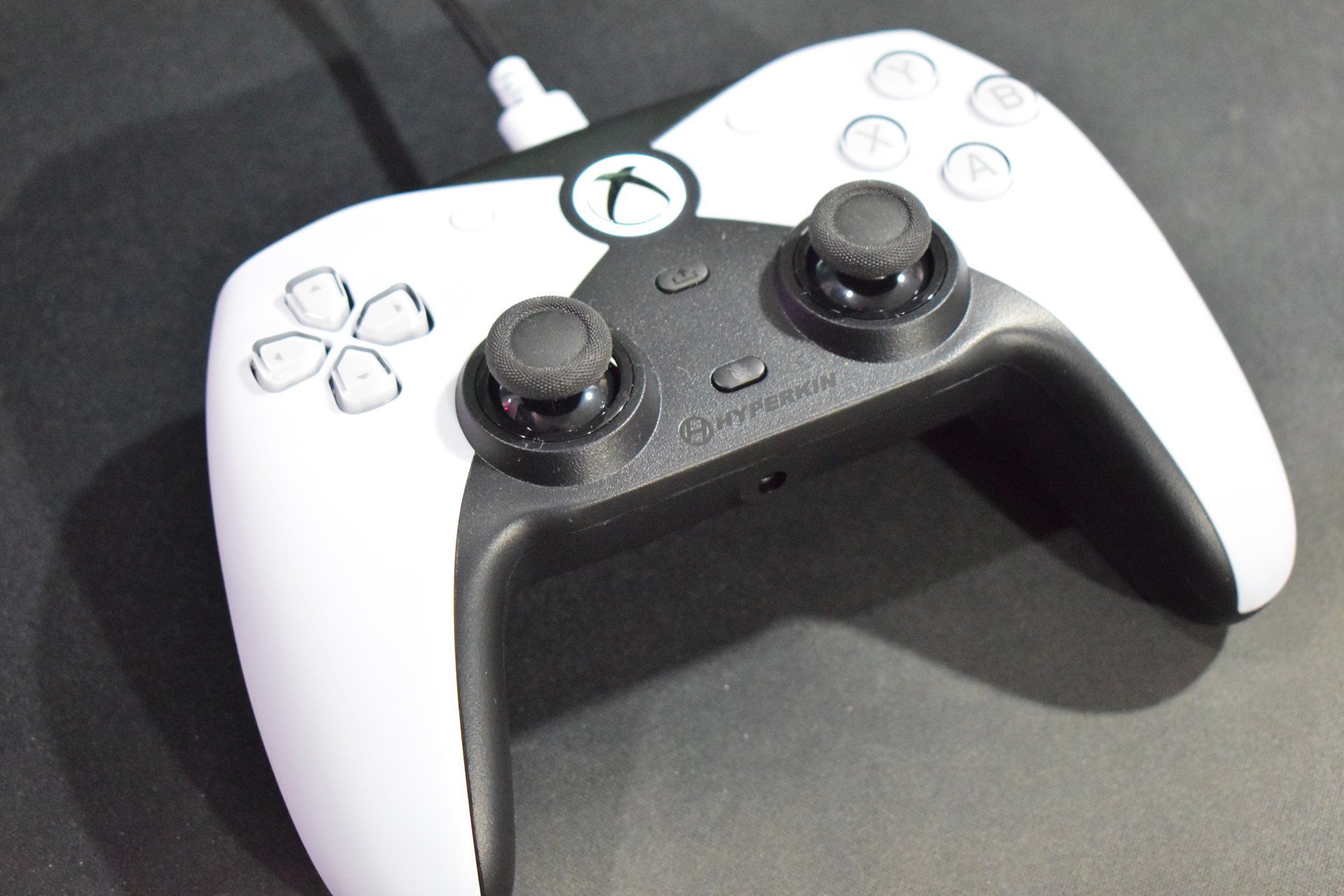
Hyperkin has built a reputation around making affordable controllers for popular platforms like Xbox, Nintendo, and PlayStation, often aiming squarely at the budget to mid-range crowd. Its latest release, The Competitor, arrives with an interesting twist: it’s designed for Xbox consoles and Windows PCs, but it borrows the analog stick placement many players associate with PlayStation-style controllers. You still get the familiar Xbox ABXY button layout, yet the overall shape, color blocking, and vibe lean heavily toward a DualSense-inspired look.
At $49, The Competitor enters a crowded field where value-focused controllers are expected to deliver more than just good looks. That makes the big question simple: is this controller actually competitive where it matters most—input response, accuracy, and everyday comfort—especially against other popular budget options?
What you get in the box feels generous for the price. Packaging is sturdy, and there’s a nice bonus included: a one-month Game Pass Ultimate subscription, which is a great perk if you want to jump into new games immediately. Inside, Hyperkin includes the controller itself, a long 10-foot USB-C to USB-A cable, two extra joystick caps, a user manual, and a sticker.
The feature list reads like exactly what modern players want from a wired controller. It supports Xbox Series X|S, Xbox One, and Windows 10/11. Hyperkin also advertises a 1000Hz polling rate, uses USB-C, and includes Hall Effect technology for both the joysticks and triggers—an increasingly popular upgrade that helps prevent stick drift and keeps movement smooth over time.
In-hand, the design influence is obvious. The black-and-white style and stick positioning are reminiscent of a PS5 controller, while the center Xbox home button and Xbox-style face button layout make it feel immediately familiar to Xbox players. Ergonomics are a highlight: textured grips, comfortable shaping, and easy reach to the controls make it well-suited for longer sessions without hand fatigue.
Button feel is mostly positive. The ABXY buttons are on the mushy side, but they still feel good during play and, importantly, don’t wobble. The D-pad looks similar to what you’d expect from a DualSense-like design, but it doesn’t quite reach that same premium feel. It’s fine for general use, just not a standout if you care deeply about crisp directional inputs.
Where the controller really earns points is in a couple of key hardware choices. The Hall Effect sticks feel smooth and consistent, and the triggers also use Hall Effect tech. Trigger resistance is slightly stronger than some competitors, but the pull remains smooth and pleasant. The bumpers, though, are one of the best parts of the controller: snappy, bouncy, and impressively stable with no wobble—arguably a standout compared to other budget controllers.
You also get two programmable back buttons, plus switches that let you disable them. Their placement is well thought out, making them easy to hit naturally without awkward finger repositioning. On the bottom, there’s a mute button and a 3.5mm headset jack, which is still a must-have feature for many console players. And that long cable matters more than it sounds—if you’re a couch gamer, 10 feet makes living-room setups far more convenient.
The biggest limitation is connectivity. The Competitor is wired-only. There’s no Bluetooth and no 2.4GHz wireless option, which is disappointing in a market where even cheaper controllers often offer both wired and wireless modes. The upside of wired is supposed to be performance—lower latency and higher responsiveness. Unfortunately, this is where The Competitor stumbles.
In real-world testing, the sticks perform well overall. There’s no noticeable inner deadzone, movement registers accurately even with tiny inputs, and drift is effectively zero. Circle error is extremely low, nearly flawless by typical controller testing standards. There is some snapback behavior, but nothing alarming for most players.
However, Hyperkin’s “no lag, no latency” messaging doesn’t hold up well under scrutiny. Despite advertising 1000Hz polling, testing shows the polling rate hovering around 250–260Hz, which is far below what many strong wired controllers can achieve. Average latency lands around 4ms. While that might not sound huge on paper, it’s not where a wired-only controller at this price should be—especially when competing controllers can deliver faster response and higher polling rates, sometimes even over wireless.
That performance gap is what keeps The Competitor from truly matching its name. If you’re buying a wired-only controller, the expectation is that it’s doing so to maximize responsiveness. Here, the controller gives up wireless flexibility but doesn’t provide the wired performance payoff many players are looking for.
The final takeaway is a bit mixed. The Competitor gets many important things right: strong ergonomics, a comfortable DualSense-inspired shape, excellent bumpers, smooth Hall Effect sticks and triggers, programmable back buttons, a useful headset jack, and an extra-long cable that fits couch gaming perfectly. If you don’t play competitively, aren’t sensitive to latency, or you simply love this PlayStation-style stick placement on an Xbox-ready controller, you’ll likely enjoy it.
But at $49, the value proposition becomes harder to justify. The lack of wireless connectivity and the surprisingly low polling rate make it difficult to recommend as the best budget Xbox/PC controller for performance-focused players. It’s a good controller with a great feel and smart features—held back by input performance that doesn’t match what buyers expect at this price point.


