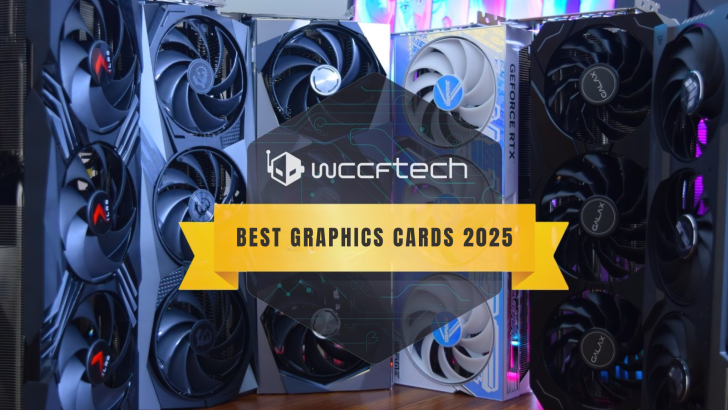
2025 ended up being one of the most eventful years in recent memory for graphics cards. AMD and NVIDIA both kicked off major launches around CES 2025, but what really shaped the year wasn’t just new hardware—it was a noticeable shift in strategy that changed what gamers actually bought.
AMD made a bold move by focusing almost entirely on the mainstream gaming GPU market instead of chasing the absolute fastest flagship crown. That left NVIDIA largely unchallenged at the very top end. Surprisingly, the decision worked out well for AMD in terms of consumer interest and adoption, mainly because the GPUs most people can realistically afford became the most competitive part of the market.
Of course, none of this happened in a perfect retail environment. Early in the year, availability was a real headache. Many graphics cards were out of stock, and even when they appeared, prices often sat far above MSRP. While supply constraints and inflated pricing were frustrating for gamers, they didn’t slow demand as much as many expected. If anything, the spotlight shifted even harder toward cards that offered strong value and were actually available to buy.
Below are the standout GPUs of the year across key tiers. These picks aren’t based only on raw frame rates—they also reflect real-world factors like retail availability and how buyers responded to these products throughout the year.
Best High-End GPU: NVIDIA GeForce RTX 5090
NVIDIA’s GeForce RTX 5090 claimed the high-end performance title in 2025 largely because it didn’t have to fight AMD for it. As the flagship Blackwell consumer GPU, it delivered top-tier gaming performance, with the kind of horsepower meant for maxed-out 4K gaming and even 8K scenarios for enthusiasts who want to push the limits.
Its specs paint the picture clearly: Blackwell GB202 silicon, 21,760 CUDA cores, a massive 98 MB L2 cache, and 32 GB of GDDR7 on a 512-bit bus delivering enormous bandwidth. It’s also a monster for ray tracing, and it doubles as a very capable option for professional workflows and AI-related tasks—one reason it stayed in such high demand.
The downside was hard to ignore: pricing and availability. At an MSRP of $1,999, the RTX 5090 rarely showed up at that price, and supply remained tight for much of the year. Between limited stock and inflated retail pricing, many buyers simply couldn’t get one. Still, if you’re judging purely on performance, the RTX 5090 stood above everything else in the consumer market in 2025.
Best Overall GPU: AMD Radeon RX 9070 XT
For most gamers, the best graphics card isn’t the fastest one money can buy—it’s the one that delivers the best balance of price, performance, and availability. In 2025, that “sweet spot” pick was AMD’s Radeon RX 9070 XT.
As the flagship RDNA 4 GPU, the RX 9070 XT landed in a place that made a lot of sense: powerful enough for smooth 1080p and 1440p gaming (and strong results in many demanding titles), while being priced in a market where competing NVIDIA options often felt expensive for what you got. It’s a big reason the card became popular not only with DIY gamers, but also with system integrators looking for dependable, high-volume builds.
On paper and in practice, the RX 9070 XT competed closely with the RTX 5070 Ti in many situations. Where it still struggled was path tracing, where NVIDIA’s technology stack continued to hold an advantage. But AMD made meaningful progress in ray tracing compared to previous generations, and the broader value proposition remained compelling—especially as the RX 9070 XT became more widely available and eventually began to show up below MSRP after initially selling higher.
AMD’s RDNA 4 momentum also benefited from ongoing platform improvements, including FSR 4 and other enhancements aimed at improving image quality and performance. While NVIDIA still owned the top-end crown, AMD’s approach made the RX 9070 XT one of the most sensible purchases of the year for mainstream gamers.
Best Budget GPU: AMD Radeon RX 9060 XT 16GB
Budget gamers finally got a graphics card that felt like a win again. The Radeon RX 9060 XT 16GB hit the sub-$400 segment with the kind of specs and pricing that made it immediately stand out, especially after a stretch of underwhelming budget releases across the market.
At $349, pairing 16 GB of VRAM with RDNA 4 improvements gave this card serious appeal for value-focused builds. It delivered strong performance at 1080p and surprisingly capable results at 1440p, helped by that generous VRAM capacity. It also managed to compete in the same general performance conversation as the 5060 Ti 16GB while coming in notably cheaper, which made the value argument hard to ignore.
There are some practical limits, though. With a 128-bit memory bus, performance can drop off once you start pushing beyond 1440p or leaning into the most demanding settings in heavy modern titles. And while AMD’s upscaling and ecosystem improved with FSR 4, it still trails NVIDIA’s DLSS 4 not only in overall results but also in how widely it’s supported across games.
Still, for anyone building a sub-$1000 gaming PC in 2025, the RX 9060 XT 16GB became one of the most recommended options—especially once it began hovering close to MSRP and became easier to find at reasonable pricing.
Best Mid-Range GPU: NVIDIA GeForce RTX 5070
No modern GPU lineup feels complete without NVIDIA’s “70-class” card, and the GeForce RTX 5070 filled that familiar mid-range role in 2025. It’s the kind of GPU aimed at gamers who want strong performance—especially at 1440p—while also tapping into NVIDIA’s feature stack, including DLSS 4.
Built on Blackwell GB205, the RTX 5070 brought 6,144 CUDA cores, a large 96 MB L2 cache, and 12 GB of GDDR7 on a 192-bit bus. It also stood out for being relatively power-efficient for its class, while still offering solid ray tracing capability.
Its biggest drawback in the current market is the 12 GB VRAM capacity, which can feel limiting compared to some competing options, particularly for buyers trying to “future-proof” for newer games that are increasingly VRAM-hungry. It can also come in a bit slower in traditional rasterized performance versus cards like the RX 9070 in certain scenarios, even though NVIDIA’s strengths show more clearly once ray tracing and upscaling enter the mix.
For players prioritizing a strong 1440p experience and access to DLSS 4 and NVIDIA’s ray tracing advantages, the RTX 5070 remained a very compelling mid-range option in 2025, especially when found at a fair price.NVIDIA has held a strong grip on the gaming GPU market for years, and it hasn’t been only about raw frame rates. For many PC gamers, the real draw is the company’s ray tracing performance and the strength of its software ecosystem, especially DLSS and frame generation. That’s why the GeForce RTX 5070 has attracted so much attention: it lands in a “middle ground” sweet spot where you can access DLSS 4 and modern frame-gen features without jumping straight to the most expensive tier.
That said, the GeForce RTX 5070 isn’t a huge leap in traditional performance. In many games, it can be around 5% faster than the RTX 4070 SUPER, which isn’t the kind of uplift that makes an immediate upgrade a no-brainer for current RTX 4070-class owners. In a handful of scenarios, it can even trade blows with (or occasionally edge past) higher-tier options like the RTX 4070 Ti, but overall the generational jump isn’t dramatic.
Where the RTX 5070 story gets more complicated is pricing. Early on, supply constraints pushed real-world prices above MSRP for months, hurting its value proposition. Now that seasonal deals are rolling in, the card is showing up at more appealing prices, which makes it easier to recommend—especially if you’re building a new PC and want a modern NVIDIA feature set from day one rather than chasing the absolute best price-to-performance chart.
There’s also a long-running perception among many builders that NVIDIA is the “safer” choice, largely due to its mature drivers, broad game support, and feature stack. If you’re planning a $1,200 to $1,500 gaming PC build and you strongly prefer an all-NVIDIA setup, the GeForce RTX 5070 can be a sensible centerpiece—particularly if you prioritize DLSS 4 and frame generation as part of your gaming experience.
Honorable mention: Intel Arc B580
It’s not every year that an Intel GPU earns a serious spot in mainstream gaming conversations, but the Arc B580 deserves recognition for shaking up the value segment. Intel delivered a surprisingly compelling graphics card for the money, and the standout headline is simple: 12GB of VRAM at a price that undercuts much of the competition. In an era where modern AAA games are increasingly memory-hungry, 12GB goes a long way toward keeping a GPU feeling “current” for the next couple of years.
Performance-wise, the Arc B580 is competitive in the bracket it targets. It goes up well against GPUs like the GeForce RTX 4060 and can even surpass Intel’s previous Arc A770 16GB in certain titles. It’s primarily aimed at 1080p gaming, but thanks to that 12GB VRAM buffer, it can also hold up better than you might expect at 1440p in plenty of games—especially for players willing to balance settings intelligently.
That combination of price and capability is exactly why the B580 has become an attractive pick for budget-to-midrange builds, particularly around the $800 to $1,000 total PC budget range. For buyers who don’t mind taking a slightly more adventurous route compared to the familiar AMD/NVIDIA path, it’s one of the most interesting value plays of the year.
The biggest drawback is still the software ecosystem. Intel’s XeSS upscaling continues to improve, but it isn’t as widely supported or as universally trusted as DLSS or FSR yet. Driver optimization has improved, but there’s still a “wait and see” factor for some gamers who want the most predictable experience across a wide range of new releases. If Intel keeps pushing updates and expands XeSS adoption, the Arc lineup could become far more competitive in the mainstream segment going forward.
How to choose your next gaming GPU in 2025: quick pointers that actually help
The GPU market has been packed with strong options, but the variety can make picking the right model confusing. If you want to feel confident about your purchase (and avoid paying for performance you’ll never use), focus on these core decision points.
First, figure out how much GPU you actually need. Start with your target resolution and refresh rate. For many players, 1080p at 144Hz remains the value sweet spot, while 1440p at 144Hz is a popular step-up target. Once you know the resolution and frame-rate goal you’re chasing, narrowing down GPU choices becomes much easier. As a general rule, higher resolutions benefit from more VRAM and a wider memory bus, especially in newer AAA titles with heavier textures and more complex effects.
Second, don’t ignore future-proofing. A lot of buying decisions get driven purely by price in the moment, but your “real cost” depends on how long the GPU stays enjoyable before it feels outdated. If you’re building a PC you don’t want to upgrade for several years, aiming for a mid-to-high tier GPU can save frustration later.
VRAM is a big part of that equation. Cards with 8GB are already starting to feel cramped in newer releases, and minimum requirements continue to climb. Safer picks today are 12GB and 16GB models, with 16GB often being the more comfortable target if you want your GPU to remain relevant for the next two to three years as games continue to scale up.
Third, choose the software ecosystem that fits how you play. Upscaling and frame generation matter more than ever, and your experience can vary depending on whether you’re leaning into NVIDIA’s DLSS, AMD’s FSR, or Intel’s XeSS. If you want the broadest support and the most established stack, that can influence which brand you gravitate toward—sometimes as much as raw benchmark numbers.
Common FAQs
Are 8GB GPUs dead in 2025?
Not completely, but they’re harder to recommend for new builds. You may still get acceptable 1080p performance for lighter or well-optimized games, and you might squeeze out another year or two at baseline settings in many titles. But as AAA requirements rise, 12GB or 16GB VRAM is the safer choice if you want fewer compromises and better longevity.
Are Intel Arc GPUs safe to buy compared to AMD and NVIDIA?
Intel’s Arc platform still isn’t as mature overall as the long-established ecosystems from AMD and NVIDIA, but the Arc B580 shows stronger commitment and a more competitive approach. The hardware value is real; the main consideration is software support and day-to-day consistency across a wide range of games. Intel’s direction looks more promising now, but the company needs to keep accelerating driver and feature development to fully win over cautious buyers.
What’s the best “bang for the buck” GPU right now?
Value can be subjective because pricing and availability change constantly, but one of the biggest market wins this year came from the Radeon RX 9070 XT, which stood out due to strong adoption, solid availability around MSRP, and the combination of RDNA 4 plus meaningful improvements in the FSR stack.
Overall, 2025 has been a reminder of what happens when GPU makers deliver real performance and real value in the mainstream segment: buyers have more genuinely good options, and the “default answer” isn’t as automatic as it used to be. The big question now is whether 2026 delivers the same momentum—and which company capitalizes on it best.


